Kirjojen hintavertailu. Mukana 12 390 323 kirjaa ja 12 kauppaa.

Kirjailija

Sidney A. Shapiro

Kirjat ja teokset yhdessä paikassa: 10 kirjaa, julkaisuja vuosilta 1993-2024, suosituimpien joukossa Risk Regulation at Risk. Vertaile teosten hintoja ja tarkista saatavuus suomalaisista kirjakaupoista.

10 kirjaa

Kirjojen julkaisuhaarukka 1993-2024.

How Government Built America

How Government Built America

Sidney A. Shapiro; Joseph P. Tomain

Cambridge University Press
2024
pokkari
How Government Built America challenges growing, anti-government rhetoric by highlighting the role government has played in partnering with markets to build the United States. Sidney A. Shapiro and Joseph P. Tomain explore how markets can harm and fail the country, and how the government has addressed these extremes by restoring essential values to benefit all citizens. Without denying that individualism and small government are part of the national DNA, the authors demonstrate how democracy and a people pursuing communal interests are equally important. In highly engaging prose, the authors describe how the government, despite the complexity of markets, remains engaged in promoting economic prosperity, protecting people, and providing an economic safety net. Each chapter focuses on a historical figure, from Lincoln to FDR to Trump, to illustrate how the government-market mix has evolved over time. By understanding this history, readers can turn the national conversation back to what combination of government and markets will best serve the country.
How Government Built America

How Government Built America

Sidney A. Shapiro; Joseph P. Tomain

Cambridge University Press
2024
sidottu
How Government Built America challenges growing, anti-government rhetoric by highlighting the role government has played in partnering with markets to build the United States. Sidney A. Shapiro and Joseph P. Tomain explore how markets can harm and fail the country, and how the government has addressed these extremes by restoring essential values to benefit all citizens. Without denying that individualism and small government are part of the national DNA, the authors demonstrate how democracy and a people pursuing communal interests are equally important. In highly engaging prose, the authors describe how the government, despite the complexity of markets, remains engaged in promoting economic prosperity, protecting people, and providing an economic safety net. Each chapter focuses on a historical figure, from Lincoln to FDR to Trump, to illustrate how the government-market mix has evolved over time. By understanding this history, readers can turn the national conversation back to what combination of government and markets will best serve the country.
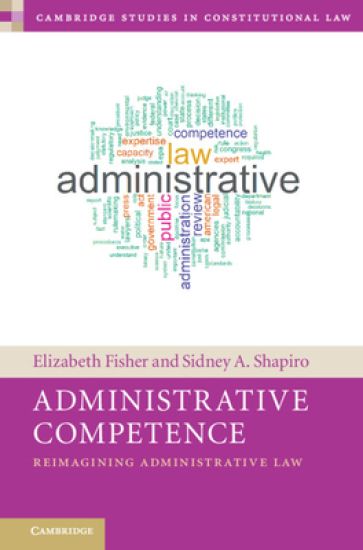
Administrative Competence

Administrative Competence

Elizabeth Fisher; Sidney A. Shapiro

Cambridge University Press
2021
pokkari
This book, by two of the world's leading administrative law scholars, reimagines administrative law as the law of public administration by making its competence the focus of administrative law. Grounded in extensive interdisciplinary, historical, and doctrinal analysis, Fisher and Shapiro show why understanding both the capacity and authority of expert public administration is crucial to ensure the legitimacy and accountability of the administrative state. To address the current precarious state of administrative law, they support a new study of the administrative process by an Attorney Generals Committee on Administrative Procedure leading to a revised Administrative Procedure Act (APA). This book is a must-read for anyone interested in administrative law and its reform.
Administrative Competence

Administrative Competence

Elizabeth Fisher; Sidney A. Shapiro

Cambridge University Press
2020
sidottu
This book, by two of the world's leading administrative law scholars, reimagines administrative law as the law of public administration by making its competence the focus of administrative law. Grounded in extensive interdisciplinary, historical, and doctrinal analysis, Fisher and Shapiro show why understanding both the capacity and authority of expert public administration is crucial to ensure the legitimacy and accountability of the administrative state. To address the current precarious state of administrative law, they support a new study of the administrative process by an Attorney Generals Committee on Administrative Procedure leading to a revised Administrative Procedure Act (APA). This book is a must-read for anyone interested in administrative law and its reform.
Achieving Democracy

Achieving Democracy

Sidney A. Shapiro; Joseph P. Tomain

Oxford University Press Inc
2015
nidottu
Democracy is the ability to participate freely and equally in the political and economic affairs of the country. Americans have relied on philosophical pragmatism and on the impulse of political progressivism to express those creedal democratic values. Achieving Democracy argues that, in the last 30 years, however, by focusing on free markets and small government, America has since lost its grasp on these crucial democratic values. Economically, the vast majority of Americans have been made worse off due to a historically unprecedented redistribution of wealth from the lower and middle classes to the top one percent. Politically, partisan gridlock has hampered efforts to seek fairer taxes, responsive and effective regulation, reliable health care, and better education, among other needs. Achieving Democracy critiques the history of the last 30 years of neoliberal government in the United States, and enables an understanding of the dynamic and changing nature of contemporary government and the future of the regulatory state. Sidney A. Shapiro and Joseph P. Tomain demonstrate how lessons from the past can be applied today to regain essential democratic losses within the successful framework of a progressive government to ultimately construct a good society for all citizens.
Achieving Democracy

Achieving Democracy

Sidney A. Shapiro; Joseph P. Tomain

Oxford University Press Inc
2014
sidottu
Democracy is the ability to participate freely and equally in the political and economic affairs of the country. Americans have relied on philosophical pragmatism and on the impulse of political progressivism to express those creedal democratic values. Achieving Democracy argues that, in the last 30 years, however, by focusing on free markets and small government, America has since lost its grasp on these crucial democratic values. Economically, the vast majority of Americans have been made worse off due to a historically unprecedented redistribution of wealth from the lower and middle classes to the top one percent. Politically, partisan gridlock has hampered efforts to seek fairer taxes, responsive and effective regulation, reliable health care, and better education, among other needs. Achieving Democracy critiques the history of the last 30 years of neoliberal government in the United States, and enables an understanding of the dynamic and changing nature of contemporary government and the future of the regulatory state. Sidney A. Shapiro and Joseph P. Tomain demonstrate how lessons from the past can be applied today to regain essential democratic losses within the successful framework of a progressive government to ultimately construct a good society for all citizens.
Risk Regulation at Risk

Risk Regulation at Risk

Sidney A. Shapiro; Robert L. Glicksman

Stanford University Press
2004
pokkari
In the 1960s and 1970s, Congress enacted a vast body of legislation to protect the environment and individual health and safety. Collectively, this legislation is known as "risk regulation" because it addresses the risk of harm that technology creates for individuals and the environment. In the last two decades, this legislation has come under increasing attack by critics who employ utilitarian philosophy and cost-benefit analysis. The defenders of this body of risk regulation, by contrast, have lacked a similar unifying theory. In this book, the authors propose that the American tradition of philosophical pragmatism fills this vacuum. They argue that pragmatism offers a better method for conceiving of and implementing risk regulation than the economic paradigm favored by its critics. While pragmatism offers a methodology in support of risk regulation as it was originally conceived, it also offers a perspective from which this legislation can be held up to critical appraisal. The authors employ pragmatism to support risk regulation, but pragmatism also leads them to agree with some of the criticisms against it, and even to level new criticisms of their own. In the end, the authors reject the picture—painted by risk regulation's critics—of widely excessive and irrational regulation, but the pragmatic perspective also leads them to propose a number of recommendations for useful reforms to risk regulation.
Risk Regulation at Risk

Risk Regulation at Risk

Sidney A. Shapiro; Robert L. Glicksman

Stanford University Press
2002
sidottu
In the 1960s and 1970s, Congress enacted a vast body of legislation to protect the environment and individual health and safety. Collectively, this legislation is known as "risk regulation" because it addresses the risk of harm that technology creates for individuals and the environment. In the last two decades, this legislation has come under increasing attack by critics who employ utilitarian philosophy and cost-benefit analysis. The defenders of this body of risk regulation, by contrast, have lacked a similar unifying theory. In this book, the authors propose that the American tradition of philosophical pragmatism fills this vacuum. They argue that pragmatism offers a better method for conceiving of and implementing risk regulation than the economic paradigm favored by its critics. While pragmatism offers a methodology in support of risk regulation as it was originally conceived, it also offers a perspective from which this legislation can be held up to critical appraisal. The authors employ pragmatism to support risk regulation, but pragmatism also leads them to agree with some of the criticisms against it, and even to level new criticisms of their own. In the end, the authors reject the picture—painted by risk regulation's critics—of widely excessive and irrational regulation, but the pragmatic perspective also leads them to propose a number of recommendations for useful reforms to risk regulation.
Workers at Risk

Workers at Risk

Thomas Mcgarity; Sidney A. Shapiro

Praeger Publishers Inc
1993
sidottu
The Occupational Safety and Health Administration (OSHA) is not close to meeting its mandate to protect American workers, according to administrative law specialists McGarity and Shapiro. Thousands of men and women are still victims of workplace accidents and occupational disease. The goal of this book is to analyze why OSHA has failed and to suggest what can be done to set it back on track. The book, divided into six parts, evaluates the current status of the protection of workers and provides a history of OSHA regulation. The authors suggest four methods to reduce workplace health and safety risks: (1) better management of OSHA; (2) reduced oversight by the courts and the executive branch; (3) a change in OSHA's legislative mandate; and (4) empowering workers to protect themselves.This important work will be of interest to scholars and professionals in occupational health, labor economics, labor law, and human resource management.