Kirjojen hintavertailu. Mukana 12 390 323 kirjaa ja 12 kauppaa.

Kirjailija

Sifeng Liu

Kirjat ja teokset yhdessä paikassa: 18 kirjaa, julkaisuja vuosilta 2005-2024, suosituimpien joukossa Optimization of Regional Industrial Structures and Applications. Vertaile teosten hintoja ja tarkista saatavuus suomalaisista kirjakaupoista.

18 kirjaa

Kirjojen julkaisuhaarukka 2005-2024.

Optimization of Regional Industrial Structures and Applications

Optimization of Regional Industrial Structures and Applications

Yaoguo Dang; Sifeng Liu; Yuhong Wang

Auerbach Publishers Inc.
2010
sidottu
Based on research projects supported by the National Natural Science Foundation of China and Nanjing University of Aeronautics and Astronautics, Optimization of Regional Industrial Structures and Applications provides an authoritative introduction to and survey of the cutting-edge research and applications in industrial structure optimization. Employing grey systems theory as its method of analysis, it integrates grey systems theory with industrial structure optimization theory to provide dynamic and efficient methods of measurement, analysis, and decision making. The authors cover several models of grey regional industrial structure, including grey correlation priority analysis, industrial structure order degree measurement model, regional leading industries grey assessment model and turnpike model. The first part of the book clarifies basic theory. This section covers the production and development of industrial structure theory, evolution laws of industrial structure, rationalization and upgrading of industrial structures, factors of industrial structure upgrading, input–output analysis, and mathematical modeling of regional industrial structures. The second section introduces four case studies that illustrate real-world research and applications. It considers the approaches and measures taken in China’s industrial structure upgrade during the "eleventh five-year plan". The case studies examine measures of and strategies for Jiangsu province’s industrial structural adjustment.This section also presents the optimization and promotion study of the "eleventh five" industrial structure of another city in China. The models detailed in this book not only develop application fields of grey systems theory, but also enrich the theories of industrial structure optimization. All of the methods presented in the text are reviewed in the case studies to supply readers with a vivid and practical understanding.
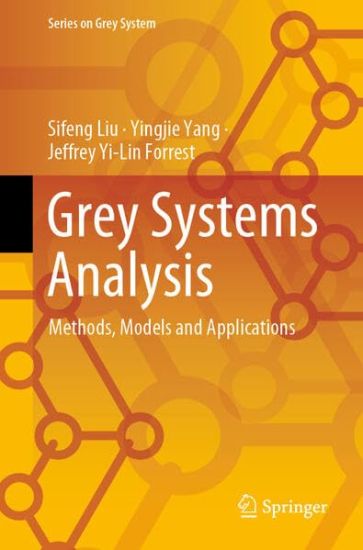
Grey Systems Analysis

Grey Systems Analysis

Sifeng Liu

SPRINGER VERLAG, SINGAPORE
2024
sidottu
This open access book is the 2nd edition involving the update on data, methods and models of Grey Systems. It covers up-to-date theoretical and applied advances in grey systems from across the world, and vividly presents the reader with the overall picture of this new theory and its frontier research. Many of the concepts, models and methods in the book are original by the author, including kernel, degree of greyness of grey number, simplified form of grey number, general grey number and the operation system; the axiomatic system of buffer operators and a series of weakening and strengthening buffer operators; a series of grey relational analysis models, including grey absolute, relative, synthetic, similarity, closeness, negative, three dimension, and grey relational analysis model for cross-sequences, etc.; grey fixed weight clustering model, grey evaluation models based on center-point and end-point mixed possibility functions; original difference grey model (ODGM), even difference grey model (EDGM), discrete grey model (DGM), fractional grey models, self-memory grey models; multi-attribute weighted intelligent grey target decision models, kernel weight vector group and the weighted comprehensive clustering coefficient vector, and spectrum analysis of sequence operators, etc. The revision includes: (1) Added new achievements made in recent years, such as the moving average denoise operator, a series of negative grey relational models, grey relational model for cross-sequences, standard uncertainty numbers and their operations, adaptive Grey Prediction Models and so on; (2) Important data related to the development of grey system theory has been updated; (3) Research reviews have been added to each chapter, and a large number of references have been added; (4)Updated application examples of commonly used models and methods. This book will be appropriate as a reference and/or textbook for courses of grey system theory for graduate students or high level undergraduate students, majoring in various fields of natural sciences, social sciences and engineering technology. It can also be utilized by researchers and technicians in research institutions, business entities, and government agencies.
Grey Systems Analysis

Grey Systems Analysis

Sifeng Liu; Yingjie Yang; Jeffrey Yi-Lin Forrest

SPRINGER VERLAG, SINGAPORE
2023
nidottu
The book covers up-to-date theoretical and applied advances in grey systems theory from across the world and vividly presents the reader with the overall picture of this new theory and its frontier research. Many of the concepts, models and methods in the book are original by the authors, including simplified form of grey number, general grey number and the operations of grey numbers; the axiomatic system of buffer operators and a series of weakening and strengthening operators; a series of grey relational analysis models, including grey absolute, relative, synthetic, similarity, closeness, negative and three dimension degree, etc.; grey fixed weight clustering model, grey evaluation models based on center-point and end-point mixed possibility functions; original difference grey model (ODGM), even difference grey model (EDGM), discrete grey model (DGM), fractional grey models, self-memory grey models; multi-attribute intelligent grey target decision models, weight vector group withkernel and the weighted comprehensive clustering coefficient vector, and spectrum analysis of sequence operators, etc.This book will be appropriate as a reference and/or professional book for courses of grey system theory for graduate students or high-level undergraduate students, majoring in areas of science, technology, agriculture, medicine, astronomy, earth science, economics, and management. It can also be utilized by researchers and practitioners in research institutions, business entities, and government agencies.
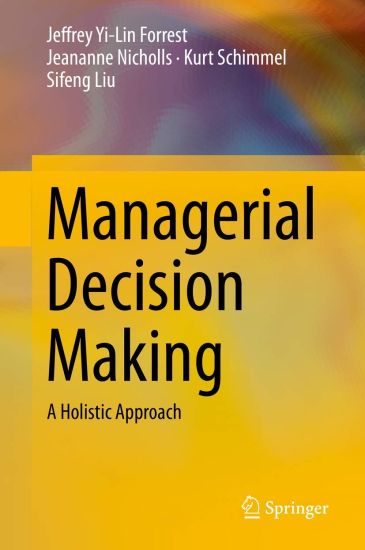
Managerial Decision Making

Managerial Decision Making

Jeffrey Yi-Lin Forrest; Jeananne Nicholls; Kurt Schimmel; Sifeng Liu

Springer Nature Switzerland AG
2020
nidottu
This book develops a general theory of managerial decision making on the basis of a few elementary postulates. It employs logic as the method of reasoning, systems science in general and the systemic YoYo Model in particular, as the intuitive playground. By doing so, the authors take individually background-based guesswork out of processes of decision making. All established conclusions are expected to be generally employable in real-life applications. At the same time, the book is user friendly to a wide range of audience, coincides with people's intuition, and provides applicable results and insights for practical purposes.
Theory of Science and Technology Transfer and Applications

Theory of Science and Technology Transfer and Applications

Sifeng Liu; Zhigeng Fang; Hongxing Shi; Benhai Guo

CRC Press
2019
nidottu
Constructive Suggestions for Efficiently Implementing Technology Transfer Theory of Science and Technology Transfer and Applications presents the mechanisms, features, effects, and modes of technology transfer. It addresses the measurement, cost, benefit, optimal allocation, and game theory of technology transfer, along with the dynamics of the technical diffusion field.The book explores the concept of technology transfer and its mechanism as the main theme. It measures the cost and benefit of technology transfer, analyzes technology transfer based on technical diffusion field theory, and presents case studies to illustrate the use of a linear programming model and government investment and planning model. The authors also offer strategic analyses that utilize game models and discuss the impact of technology transfer on economic growth.Accompanied by economic globalization, globalization in technology enables the rational allocation and flow of the elements of technology without restrictions, which in turn allows the sharing of technological activities and the space flow of technology more frequently. This book focuses on the creation and development of advanced productivities. Through many real-world examples, it shows how to implement technology transfer in society, leading technology to become socially and economically valued.
Managerial Decision Making

Managerial Decision Making

Jeffrey Yi-Lin Forrest; Jeananne Nicholls; Kurt Schimmel; Sifeng Liu

Springer Nature Switzerland AG
2019
sidottu
This book develops a general theory of managerial decision making on the basis of a few elementary postulates. It employs logic as the method of reasoning, systems science in general and the systemic YoYo Model in particular, as the intuitive playground. By doing so, the authors take individually background-based guesswork out of processes of decision making. All established conclusions are expected to be generally employable in real-life applications. At the same time, the book is user friendly to a wide range of audience, coincides with people's intuition, and provides applicable results and insights for practical purposes.
Hybrid Rough Sets and Applications in Uncertain Decision-Making
As a powerful approach to data reasoning, rough set theory has proven to be invaluable in knowledge acquisition, decision analysis and forecasting, and knowledge discovery. With the ability to enhance the advantages of other soft technology theories, hybrid rough set theory is quickly emerging as a method of choice for decision making under uncertain conditions. Keeping the complicated mathematics to a minimum, Hybrid Rough Sets and Applications in Uncertain Decision-Making provides a systematic introduction to the methods and application of the hybridization for rough set theory with other related soft technology theories, including probability, grey systems, fuzzy sets, and artificial neural networks. It also: Addresses the variety of uncertainties that can arise in the practical application of knowledge representation systems Unveils a novel hybrid model of probability and rough setsIntroduces grey variable precision rough set models Analyzes the advantages and disadvantages of various practical applications The authors examine the scope of application of the rough set theory and discuss how the combination of variable precision rough sets and dominance relations can produce probabilistic preference rules out of preference attribute decision tables of preference actions. Complete with numerous cases that illustrate the specific application of hybrid methods, the text adopts the latest achievements in the theory, method, and application of rough sets.
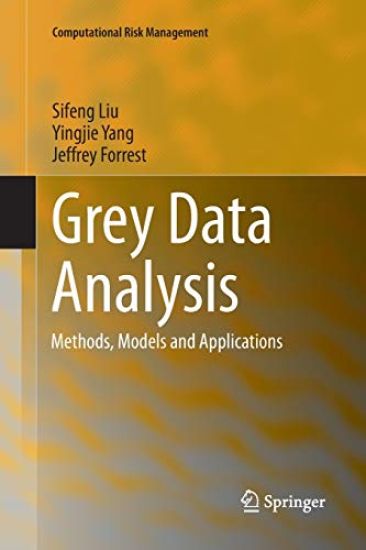
Grey Data Analysis

Grey Data Analysis

Sifeng Liu; Yingjie Yang; Jeffrey Forrest

Springer Verlag, Singapore
2018
nidottu
This book inclusively and systematically presents the fundamental methods, models and techniques of practical application of grey data analysis, bringing together the authors’ many years of theoretical exploration, real-life application, and teaching. It also reflects the majority of recent theoretical and applied advances in the theory achieved by scholars from across the world, providing readers a vivid overall picture of this new theory and its pioneering research activities. The book includes 12 chapters, covering the introduction to grey systems, a novel framework of grey system theory, grey numbers and their operations, sequence operators and grey data mining, grey incidence analysis models, grey clustering evaluation models, series of GM models, combined grey models, techniques for grey systems forecasting, grey models for decision-making, techniques for grey control, etc. It also includes a software package that allows practitioners to conveniently and practically employ the theory and methods presented in this book. All methods and models presented here were chosen for their practical applicability and have been widely employed in various research works.I still remember 1983, when I first participated in a course on Grey System Theory. The mimeographed teaching materials had a blue cover and were presented as a book. It was like finding a treasure: This fascinating book really inspired me as a young intellectual going through a period of confusion and lack of academic direction. It shone with pearls of wisdom and offered a beacon in the mist for a man trying to find his way in academic research. This book became the guiding light in my life journey, inspiring me to forge an indissoluble bond with Grey System Theory.——Sifeng Liu
Systems Evaluation

Systems Evaluation

Sifeng Liu; Naiming Xie; Chaoqing Yuan; Zhigeng Fang

CRC Press
2017
nidottu
A book in the Systems Evaluation, Prediction, and Decision-Making Series, Systems Evaluation: Methods, Models, and Applications covers the evolutionary course of systems evaluation methods, clearly and concisely. Outlining a wide range of methods and models, it begins by examining the method of qualitative assessment. Next, it describes the process and methods for building an index system of evaluation and considers the compared evaluation and the logical framework approach, analytic hierarchy process (AHP), and the data envelopment analysis (DEA) relative efficiency evaluation method.Unique in its emphasis on the practical applications of systems evaluation methods and models, the book introduces several new evaluation models of grey system, including general grey incidence model, grey incidence models based on similarity and closeness, grey cluster evaluation based on triangular whitenization functions, and multi-attribute grey target decision model. Explaining intricate concepts in language that is easy to understand it provides step-by-step explanations of the various methods and models.The text illustrates the practical application, analysis, and computation of systems evaluation methods and models with an abundance of practical examples and empirical studies. The case studies examine post evaluation of road-bridge construction projects, the efficiency evaluation of the science and technology activities, the evaluation of energy-saving projects in China, and the evaluation and selection of international cooperation projects.
Grey Data Analysis

Grey Data Analysis

Sifeng Liu; Yingjie Yang; Jeffrey Forrest

Springer Verlag, Singapore
2016
sidottu
This book inclusively and systematically presents the fundamental methods, models and techniques of practical application of grey data analysis, bringing together the authors’ many years of theoretical exploration, real-life application, and teaching. It also reflects the majority of recent theoretical and applied advances in the theory achieved by scholars from across the world, providing readers a vivid overall picture of this new theory and its pioneering research activities. The book includes 12 chapters, covering the introduction to grey systems, a novel framework of grey system theory, grey numbers and their operations, sequence operators and grey data mining, grey incidence analysis models, grey clustering evaluation models, series of GM models, combined grey models, techniques for grey systems forecasting, grey models for decision-making, techniques for grey control, etc. It also includes a software package that allows practitioners to conveniently and practically employ the theory and methods presented in this book. All methods and models presented here were chosen for their practical applicability and have been widely employed in various research works.I still remember 1983, when I first participated in a course on Grey System Theory. The mimeographed teaching materials had a blue cover and were presented as a book. It was like finding a treasure: This fascinating book really inspired me as a young intellectual going through a period of confusion and lack of academic direction. It shone with pearls of wisdom and offered a beacon in the mist for a man trying to find his way in academic research. This book became the guiding light in my life journey, inspiring me to forge an indissoluble bond with Grey System Theory.——Sifeng Liu
Grey Systems

Grey Systems

Sifeng Liu; Jeffrey Yi Lin Forrest

Springer-Verlag Berlin and Heidelberg GmbH Co. K
2014
nidottu
Due to inherent limitations in human sensing organs, most data collected for various purposes contain uncertainties. Even at the rare occasions when accurate data are available, the truthful predictions derived on the data tend to create chaotic consequences. So, to effectively process and make sense out of available data, we need methods to deal with uncertainty inherently existing inside the data. The intent of this monograph is to explore the fundamental theory, methods, and techniques of practical application of grey systems theory, initiated by Professor Deng Julong in 1982. This volume presents most of the recent advances of the theory accomplished by scholars from around the world. From studying this book, the reader will not only acquire an overall knowledge of this new theory but also be able to follow the most current research activities. All examples presented are based on practical applications of the theory when urgent real-life problems had to be addressed. Last but not the least, this book concludes with three appendices. The first one compares grey systems theory and interval analysis while revealing the fact that interval analysis is a part of grey mathematics. The second appendix presents an array of different approaches of studying uncertainties. And, the last appendix shows how uncertainties appear using general systems approach.
Systems Evaluation

Systems Evaluation

Sifeng Liu; Naiming Xie; Chaoqing Yuan; Zhigeng Fang

CRC Press Inc
2011
sidottu
A book in the Systems Evaluation, Prediction, and Decision-Making Series, Systems Evaluation: Methods, Models, and Applications covers the evolutionary course of systems evaluation methods, clearly and concisely. Outlining a wide range of methods and models, it begins by examining the method of qualitative assessment. Next, it describes the process and methods for building an index system of evaluation and considers the compared evaluation and the logical framework approach, analytic hierarchy process (AHP), and the data envelopment analysis (DEA) relative efficiency evaluation method.Unique in its emphasis on the practical applications of systems evaluation methods and models, the book introduces several new evaluation models of grey system, including general grey incidence model, grey incidence models based on similarity and closeness, grey cluster evaluation based on triangular whitenization functions, and multi-attribute grey target decision model. Explaining intricate concepts in language that is easy to understand it provides step-by-step explanations of the various methods and models.The text illustrates the practical application, analysis, and computation of systems evaluation methods and models with an abundance of practical examples and empirical studies. The case studies examine post evaluation of road-bridge construction projects, the efficiency evaluation of the science and technology activities, the evaluation of energy-saving projects in China, and the evaluation and selection of international cooperation projects.
Grey Systems

Grey Systems

Sifeng Liu; Jeffrey Yi Lin Forrest

Springer-Verlag Berlin and Heidelberg GmbH Co. K
2010
sidottu
Due to inherent limitations in human sensing organs, most data collected for various purposes contain uncertainties. Even at the rare occasions when accurate data are available, the truthful predictions derived on the data tend to create chaotic consequences. So, to effectively process and make sense out of available data, we need methods to deal with uncertainty inherently existing inside the data. The intent of this monograph is to explore the fundamental theory, methods, and techniques of practical application of grey systems theory, initiated by Professor Deng Julong in 1982. This volume presents most of the recent advances of the theory accomplished by scholars from around the world. From studying this book, the reader will not only acquire an overall knowledge of this new theory but also be able to follow the most current research activities. All examples presented are based on practical applications of the theory when urgent real-life problems had to be addressed. Last but not the least, this book concludes with three appendices. The first one compares grey systems theory and interval analysis while revealing the fact that interval analysis is a part of grey mathematics. The second appendix presents an array of different approaches of studying uncertainties. And, the last appendix shows how uncertainties appear using general systems approach.
Grey Information

Grey Information

Sifeng Liu; Yi Lin

Springer London Ltd
2010
nidottu
Rapid formation and development of new theories of systems science have become an important part of modern science and technology. For - ample, since the 1940s, there have appeared systems theory, information theory, fuzzy mathematics, cybernetics, dissipative structures, synergetics, catastrophe theory, chaos theory, bifurcations, ultra circulations, dynamics, and many other systems theories. Grey systems theory is also one of such systems theories that appeared initially in the 1980s. When the research of systems science and the method and technology of systems engineering are applied in various traditional disciplines, such as management science, decision science, and various scienti?c disciplines, a whole new group of new results and breakthroughs are obtained. Such a historical background has provided the environment and soil for grey systems theory to form and to develop rapidly in the past 20-plus years. More speci?cally, in 1982, Professor Deng Ju-Long published the ?rst research paper in the area of grey systems in the international journal entitled Systems and Control Letters, published by North-Holland Co. His paper was titled “Control Problems of Grey Systems. ” The publication of this paper signalled the birth of grey systems theory after many years of e ective research of the founding father. This new theory soon caught the attention of the international academic community and practitioners of science. Many well-known scholars, such as Chinese academicians Qian Xueshen, Song Jian, and Zhang Zhongjun. Professor Roger W.
Hybrid Rough Sets and Applications in Uncertain Decision-Making

Hybrid Rough Sets and Applications in Uncertain Decision-Making

Lirong Jian; Sifeng Liu; Yi Lin

Auerbach Publishers Inc.
2010
sidottu
As a powerful approach to data reasoning, rough set theory has proven to be invaluable in knowledge acquisition, decision analysis and forecasting, and knowledge discovery. With the ability to enhance the advantages of other soft technology theories, hybrid rough set theory is quickly emerging as a method of choice for decision making under uncertain conditions. Keeping the complicated mathematics to a minimum, Hybrid Rough Sets and Applications in Uncertain Decision-Making provides a systematic introduction to the methods and application of the hybridization for rough set theory with other related soft technology theories, including probability, grey systems, fuzzy sets, and artificial neural networks. It also: Addresses the variety of uncertainties that can arise in the practical application of knowledge representation systems Unveils a novel hybrid model of probability and rough setsIntroduces grey variable precision rough set models Analyzes the advantages and disadvantages of various practical applications The authors examine the scope of application of the rough set theory and discuss how the combination of variable precision rough sets and dominance relations can produce probabilistic preference rules out of preference attribute decision tables of preference actions. Complete with numerous cases that illustrate the specific application of hybrid methods, the text adopts the latest achievements in the theory, method, and application of rough sets.
Theory of Science and Technology Transfer and Applications

Theory of Science and Technology Transfer and Applications

Sifeng Liu; Zhigeng Fang; Hongxing Shi; Benhai Guo

Auerbach Publishers Inc.
2009
sidottu
Constructive Suggestions for Efficiently Implementing Technology Transfer Theory of Science and Technology Transfer and Applications presents the mechanisms, features, effects, and modes of technology transfer. It addresses the measurement, cost, benefit, optimal allocation, and game theory of technology transfer, along with the dynamics of the technical diffusion field.The book explores the concept of technology transfer and its mechanism as the main theme. It measures the cost and benefit of technology transfer, analyzes technology transfer based on technical diffusion field theory, and presents case studies to illustrate the use of a linear programming model and government investment and planning model. The authors also offer strategic analyses that utilize game models and discuss the impact of technology transfer on economic growth.Accompanied by economic globalization, globalization in technology enables the rational allocation and flow of the elements of technology without restrictions, which in turn allows the sharing of technological activities and the space flow of technology more frequently. This book focuses on the creation and development of advanced productivities. Through many real-world examples, it shows how to implement technology transfer in society, leading technology to become socially and economically valued.
Grey Game Theory and Its Applications in Economic Decision-Making

Grey Game Theory and Its Applications in Economic Decision-Making

Zhigeng Fang; Sifeng Liu; Hongxing Shi; Yi Lin

Auerbach Publishers Inc.
2009
sidottu
To make the best decisions, you need the best information. However, because most issues in game theory are grey, nearly all recent research has been carried out using a simplified method that considers grey systems as white ones. This often results in a forecasting function that is far from satisfactory when applied to many real situations. Grey Game Theory and Its Applications in Economic Decision Making introduces classic game theory into the realm of grey system theory with limited knowledge. The book resolves three theoretical issues: A game equilibrium of grey game A reasonable explanation for the equilibrium of a grey matrix of static nonmatrix game issues based on incomplete informationThe Centipede Game paradox, which has puzzled theory circles for a long time and greatly enriched and developed the core methods of subgame Nash perfect equilibrium analysis as a resultThe book establishes a grey matrix game model based on pure and mixed strategies. The author proposes the concepts of grey saddle points, grey mixed strategy solutions, and their corresponding structures and also puts forward the models and methods of risk measurement and evaluation of optimal grey strategies. He raises and solves the problems of grey matrix games. The book includes definitions of the test rules of information distortion experienced during calculation, the design of tokens based on new interval grey numbers, and new arithmetic laws to manipulate grey numbers. These features combine to provide a practical and efficient tool for forecasting real-life economic problems.
Grey Information

Grey Information

Sifeng Liu; Yi Lin

Springer London Ltd
2005
sidottu
Rapid formation and development of new theories of systems science have become an important part of modern science and technology. For - ample, since the 1940s, there have appeared systems theory, information theory, fuzzy mathematics, cybernetics, dissipative structures, synergetics, catastrophe theory, chaos theory, bifurcations, ultra circulations, dynamics, and many other systems theories. Grey systems theory is also one of such systems theories that appeared initially in the 1980s. When the research of systems science and the method and technology of systems engineering are applied in various traditional disciplines, such as management science, decision science, and various scienti?c disciplines, a whole new group of new results and breakthroughs are obtained. Such a historical background has provided the environment and soil for grey systems theory to form and to develop rapidly in the past 20-plus years. More speci?cally, in 1982, Professor Deng Ju-Long published the ?rst research paper in the area of grey systems in the international journal entitled Systems and Control Letters, published by North-Holland Co. His paper was titled “Control Problems of Grey Systems. ” The publication of this paper signalled the birth of grey systems theory after many years of e ective research of the founding father. This new theory soon caught the attention of the international academic community and practitioners of science. Many well-known scholars, such as Chinese academicians Qian Xueshen, Song Jian, and Zhang Zhongjun. Professor Roger W.