Kirjojen hintavertailu. Mukana 12 595 353 kirjaa ja 12 kauppaa.

Kirjailija

Silvan S. Schweber

Kirjat ja teokset yhdessä paikassa: 7 kirjaa, julkaisuja vuosilta 2005-2013, suosituimpien joukossa Mesons and Fields, V2: Mesons. Vertaile teosten hintoja ja tarkista saatavuus suomalaisista kirjakaupoista.

Mukana myös kirjoitusasut: Silvan S Schweber

7 kirjaa

Kirjojen julkaisuhaarukka 2005-2013.

Mesons and Fields, V2: Mesons

Mesons and Fields, V2: Mesons

Silvan S. Schweber; Hans A. Bethe; Frederic De Hoffmann

Literary Licensing, LLC
2013
sidottu
Mesons and Fields, Volume 2: Mesons is a comprehensive book written by Silvan S. Schweber. This book is a sequel to the first volume of Mesons and Fields and focuses on the study of mesons, which are subatomic particles that have a mass between that of an electron and a proton. The book begins with an introduction to the basic concepts of meson physics and then delves into the mathematical and theoretical aspects of meson interactions. The author provides a detailed account of the history of meson physics, including the discovery of mesons and their role in nuclear interactions. The book covers various topics related to mesons, such as the properties of mesons, meson decay, meson-nucleon interactions, and meson spectroscopy. The author also discusses the experimental techniques used to study mesons and the theoretical models used to describe their behavior. The book is written in a clear and concise manner, making it accessible to both students and researchers in the field of particle physics. It includes numerous diagrams, tables, and equations to aid in the understanding of the material. Overall, Mesons and Fields, Volume 2: Mesons is an essential resource for anyone interested in the study of mesons and their role in particle physics.In Two Volumes. Volume 1, Fields; Volume 2, Mesons.This scarce antiquarian book is a facsimile reprint of the old original and may contain some imperfections such as library marks and notations. Because we believe this work is culturally important, we have made it available as part of our commitment for protecting, preserving, and promoting the world's literature in affordable, high quality, modern editions, that are true to their original work.
Nuclear Forces

Nuclear Forces

Silvan S. Schweber

Harvard University Press
2012
sidottu
On the fiftieth anniversary of Hiroshima, Nobel-winning physicist Hans Bethe called on his fellow scientists to stop working on weapons of mass destruction. What drove Bethe, the head of Theoretical Physics at Los Alamos during the Manhattan Project, to renounce the weaponry he had once worked so tirelessly to create? That is one of the questions answered by Nuclear Forces, a riveting biography of Bethe’s early life and development as both a scientist and a man of principle. As Silvan Schweber follows Bethe from his childhood in Germany, to laboratories in Italy and England, and on to Cornell University, he shows how these differing environments were reflected in the kind of physics Bethe produced. Many of the young quantum physicists in the 1930s, including Bethe, had Jewish roots, and Schweber considers how Liberal Judaism in Germany helps explain their remarkable contributions. A portrait emerges of a man whose strategy for staying on top of a deeply hierarchical field was to tackle only those problems he knew he could solve. Bethe’s emotional maturation was shaped by his father and by two women of Jewish background: his overly possessive mother and his wife, who would later serve as an ethical touchstone during the turbulent years he spent designing nuclear bombs. Situating Bethe in the context of the various communities where he worked, Schweber provides a full picture of prewar developments in physics that changed the modern world, and of a scientist shaped by the unprecedented moral dilemmas those developments in turn created.
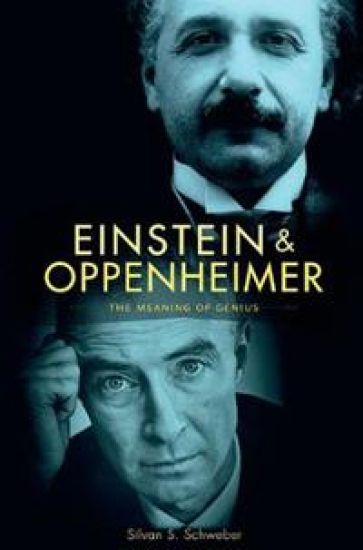
Einstein and Oppenheimer

Einstein and Oppenheimer

Silvan S. Schweber

Harvard University Press
2009
nidottu
Albert Einstein and J. Robert Oppenheimer, two iconic scientists of the twentieth century, belonged to different generations, with the boundary marked by the advent of quantum mechanics. By exploring how these men differed—in their worldview, in their work, and in their day—this book provides powerful insights into the lives of two critical figures and into the scientific culture of their times. In Einstein’s and Oppenheimer’s philosophical and ethical positions, their views of nuclear weapons, their ethnic and cultural commitments, their opinions on the unification of physics, even the role of Buddhist detachment in their thinking, the book traces the broader issues that have shaped science and the world.Einstein is invariably seen as a lone and singular genius, while Oppenheimer is generally viewed in a particular scientific, political, and historical context. Silvan Schweber considers the circumstances behind this perception, in Einstein’s coherent and consistent self-image, and its relation to his singular vision of the world, and in Oppenheimer’s contrasting lack of certainty and related non-belief in a unitary, ultimate theory. Of greater importance, perhaps, is the role that timing and chance seem to have played in the two scientists’ contrasting characters and accomplishments—with Einstein’s having the advantage of maturing at a propitious time for theoretical physics, when the Newtonian framework was showing weaknesses.Bringing to light little-examined aspects of these lives, Schweber expands our understanding of two great figures of twentieth-century physics—but also our sense of what such greatness means, in personal, scientific, and cultural terms.
An Introduction to Relativistic Quantum Field Theory

An Introduction to Relativistic Quantum Field Theory

Silvan S Schweber

Dover Publications Inc.
2005
nidottu
"Complete, systematic, self-contained...the usefulness and scope of application of such a work is enormous...combines thorough knowledge with a high degree of didactic ability and a delightful style."--Mathematical ReviewsIn a relatively simple presentation that remains close to familiar concepts, this text for upper-level undergraduates and graduate students introduces the modern developments of quantum field theory. Starting with a review of the one-particle relativistic wave equations, it proceeds to a second-quantized description of a system of n particles, examines the restriction that symmetries impose on Lagrangians, and analyzes simple models of field theories. Additional topics include the Feynman-Dyson perturbation treatment of relativistic field theories, the formulation of field theory in the Heisenberg picture, the axiomatic formulation of field theory, and dispersion theoretic methods. 1961 ed.