Kirjailija
Simon Critchley
Kirjat ja teokset yhdessä paikassa: 49 kirjaa, julkaisuja vuosilta 1996-2025, suosituimpien joukossa Bigert & Bergström : Works 1986-2016. Vertaile teosten hintoja ja tarkista saatavuus suomalaisista kirjakaupoista.
49 kirjaa
Kirjojen julkaisuhaarukka 1996-2025.
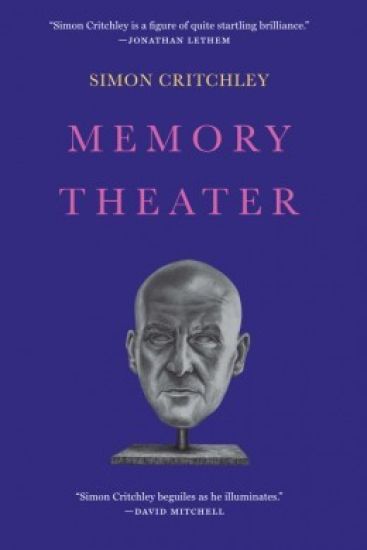
From this renowned philosopher comes a debut work of fiction, at once a brilliant pr cis of the history of philosophy, a semiautobiographical meditation on the absurd relationship between knowledge and memory, and a very funny storyA French philosopher dies during a savage summer heat wave. Boxes carrying his unpublished papers mysteriously appear in Simon Critchley's office. Rooting through them, Critchley discovers a brilliant text on the ancient art of memory and a cache of astrological charts predicting the deaths of various philosophers. Among them is a chart for Critchley himself, laying out in great detail the course of his life and eventual demise. While waiting for his friend's prediction to come through, Critchley receives the missing, final box, which contains a maquette of Giulio Camillo's sixteenth-century Venetian memory theater, a space supposed to contain the sum of all knowledge. With nothing left to hope for, Critchley devotes himself to one final project before his death--the building of a structure to house his collective memories and document the remnants of his entire life.
Suicide is everywhere. It haunts history and current events. It haunts our own networks of friends and family. The spectre of suicide looms large, but the topic is taboo because any meaningful discussion must at the very least consider that the answer to the question – ‘is life worth living?’ – might not be an emphatic yes; it might even be a stern no. Through a sweeping historical overview of suicide, a moving literary survey of famous suicide notes, and a psychological analysis of himself, Simon Critchley offers us an insight into what it means to possess the all too human gift and curse of being of being able to choose life or death. Five years after its initial publication, this revised edition of Notes on Suicide includes a new preface by the author adressing shifts in the discourse surrounding suicide, particularly in relation to social media.
How does one write an experimental ABC, an impossible theory that would deal with a series of phenomena, concepts, places, sensations, persons, and moods? A para-philosophy? Returning to a once-abandoned project of fragmented thoughts where the author’s voice moves from the serious to the pathetic, to the absurd, to the cynical, Simon Critchley’s ABC of Impossibility finds new life in the form of this small encyclopedic and aphoristic text where the reader bears witness to the slow emergence of an attempt at a poetic ontology. ABC of Impossibility is a unique undertaking that reexamines the poetic site of the fragment as thought. Following a heritage of fragmented, aphoristic thinkers including Pascal, Nietzsche, Kierkegaard, and Pessoa, Critchley revitalizes a para-philosophical thinking that can only be uttered by way of another. As he declares in the opening pages, “In writing this, I promise to tell the truth, but not to be myself.”
Levinas's idea of ethics as a relation of responsibility to the other person has become a highly influential and recognizable position across a wide range of academic and non-academic fields. Simon Critchley's aim in this book is to provide a less familiar, more troubling, and (hopefully) truer account of Levinas's work. A new dramatic method for reading Levinas is proposed, where the fundamental problem of his work is seen as the attempt to escape from the tragedy of Heidegger's philosophy and the way in which that philosophy shaped political events in the last century. Extensive and careful attention is paid to Levinas' fascinating but often overlooked work from the 1930s, where the proximity to Heidegger becomes clearer. Levinas's problem is very simple: how to escape from the tragic fatality of being as described by Heidegger. Levinas's later work is a series of attempts to answer that problem through claims about ethical selfhood and a series of phenomenological experiences, especially erotic relations and the relation to the child. These claims are analyzed in the book through close textual readings. Critchley reveals the problem with Levinas's answer to his own philosophical question and suggests a number of criticisms, particular concerning the question of gender. In the final, speculative part of the book, another answer to Levinas's problem is explored through a reading of the Song of Songs and the lens of mystical love.
The figure of Hamlet haunts our culture like the Ghost haunts him. Arguably, no literary work, not even the Bible, is more familiar to us than Shakespeare's Hamlet. Everyone knows at least six words from the play; often people know many more. Yet the play--Shakespeare's longest--is more than "passing strange" and becomes deeply unfamiliar when considered closely. Reading Hamlet alongside other writers, philosophers, and psychoanalysts--Carl Schmitt, Walter Benjamin, Freud, Lacan, Nietzsche, Melville, and Joyce--Simon Critchley and Jamieson Webster consider the political context and stakes of Shakespeare's play, its relation to religion, the movement of desire, and the incapacity to love.
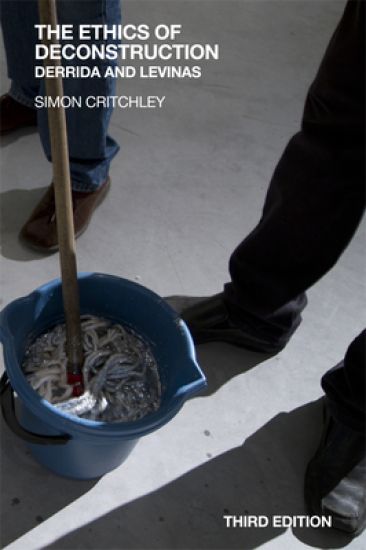
This is an expanded edition of the first book to argue for the ethical turn in Derrida's work. Simon Critchley's first book, The Ethics of Deconstruction, was originally published to great acclaim in 1992. It was the first book to argue for the ethical turn in Derrida's work and to show as powerfully as possible how deconstruction has persuasive ethical consequences that are vital to our thinking through of questions of politics and democracy. This new edition contains three new appendices and a new preface where Critchley reflects upon the origins, motivation and reception of The Ethics of Deconstruction.
Simon Critchley's first book, 'The Ethics of Deconstruction', was originally published to great acclaim in 1992. It was the first book to argue for the ethical turn in Derrida's work and to show as powerfully as possible how deconstruction has persuasive ethical consequences that are vital to our thinking through of questions of politics and democracy. This new edition contains three new appendixes and a new preface where Critchley reflects upon the origins, motivation and reception of 'The Ethics of Deconstruction'.
The return to religion has perhaps become the dominant cliché of contemporary theory, which rarely offers anything more than an exaggerated echo of a political reality dominated by religious war. Somehow, the secular age seems to have been replaced by a new era, where political action flows directly from metaphysical conflict. The Faith of the Faithless asks how we might respond. Following Critchley's Infinitely Demanding, this new book builds on its philosophical and political framework, also venturing into the questions of faith, love, religion and violence. Should we defend a version of secularism and quietly accept the slide into a form of theism-or is there another way?From Rousseau's politics and religion to the return to St. Paul in Taubes, Agamben and Badiou, via explorations of politics and original sin in the work of Schmitt and John Gray, Critchley examines whether there can be a faith of the faithless, a belief for unbelievers. Expanding on his debate with Slavoj Zizek, Critchley concludes with a meditation on the question of violence, and the limits of non-violence.
Arguably, no literary work is more familiar to us than Shakespeare's most famous tragedy. Everyone can quote at least six words from the play; often people know many more.In this riveting and thought-provoking re-examination, philosopher Simon Critchley and psychoanalyst Jamieson Webster explore Hamlet's continued relevance for a modern world no less troubled by existential anxieties than Elizabethan London.Reading the drama alongside writers, philosophers and psychoanalysts-Schmitt, Benjamin, Freud, Lacan, Nietzsche, Melville, and Joyce-the authors delve into the politics of the era, the play's relationship to religion, the exigencies of desire and the incapacity to love. It is an intellectual investigation that leads to a startling conclusion: Hamlet is a play about nothing in which Ophelia emerges as the true hero.From the illusion of theatre and the spectacle of statecraft to the psychological theatre of inhibition and emotion, what Hamlet makes manifest is the modern paradox of our lives: where we know, we cannot act.The Hamlet Doctrine is a passionate encounter with a great work of literature that continues to speak to us across centuries.
The Mattering of Matter - Documents from the Archive of the International Necronautical Society
Simon Critchley; Tom McCarthy
Sternberg Press
2013
nidottu
On August 7, 1999, Tom McCarthy founded the International Necronautical Society (INS) with a public presentation of the Founding Manifesto, a touchstone that would inform the organization's proceedings for years to come. Composed of official committee members and illicit "agents," the INS harks back to early twentieth-century avant-gardes, producing declarations, reports, public hearings, broadcasts, and research documents, as well as orchestrating more covert media infiltrations, all governed by the objective, set out in the Founding Manifesto, of mapping, entering, and occupying the space of death through literature, philosophy, culture, and technology. The Mattering of Matter is a collection of INS documents produced between 1999 and 2010. This edited selection of texts reflects the INS's development, through both internal bureaucratic changes and its ever-growing repertoire of references, all of which work towards their ultimate goal of constructing a necronautical "craft" with which to propound and escalate the overall INS project.
The clearest, boldest and most systematic statement of Simon Critchley's influential views on philosophy, ethics, and politics, Infinitely Demanding identifies a massive political disappointment at the heart of liberal democracy. Arguing that what is called for is an ethics of commitment that can inform a radical politics, Critchley considers the possibility of political subjectivity and action after Marx and Marxism, taking in the work of Kant, Levinas, Badiou and Lacan. Infinitely Demanding culminates in an argument for anarchism as an ethical practice and a remotivating means of political organization.
Impossible objects are those about which the philosopher, narrowly conceived, can hardly speak: poetry, film, music, humor. Such "objects" do not rely on philosophy for interpretation and understanding; they are already independent practices and sites of sensuous meaning production. As Elvis Costello has said, "writing about music is like dancing about architecture." We don't need literary theory in order to be riveted by the poem, nor a critic's analysis to enjoy a film. How then can philosophy speak about anything outside of itself, namely all of those things which actually matter to us in this world? In Impossible Objects, Simon Critchley - one of the most influential and insightful philosophers writing today - extends his philosophical investigation into non-philosophical territories, including discussions on tragedy, poetry, humor, and music. In a series of engaging and enlightening conversations, Critchley reflects on his early work on the ethics of deconstruction; the recurring themes of mortality and nihilism; his defense of neo-anarchism; and his recent investigation into secular faith, or "a faith of the faithless". Essential reading for artists, academics, and general readers alike, this book explores the relationship between the philosophical world and those complex and fascinating "impossible objects" which give life meaning.
The question of how to lead a happy and meaningful life has been at the heart of philosophical debate since time immemorial. Today, however, these questions seem to be addressed not by philosophers but self-help gurus, who frantically champion the individual's quest for self-expression and self-realization; the desire to become authentic. Against these new age sophistries, How to Stop Living and Start Worrying tackles the question of 'how to live' by forcing us to explore our troubling relationship with death. For Critchley, philosophy begins with the question of finitude and with his understanding of a key classical theme - that to philosophize is to learn how to die. Learning how to accept both our own and others' mortality as a part of life also raises the question of how to love. Critchley argues that the act of love requires us to give up something of ourselves, to lose control so as to be open to the demands of love. We will never be equal to this demand and so we are brought face to face with our own limitations - one form of which is what Critchley calls our 'originary inauthenticity'. By scrutinizing the very nature of humour, Critchley explores what we need to laugh at ourselves and presents the need to confront the inescapable ridiculousness of life. Reflecting on the work of over 20 years, this book provides a unique, witty and erudite introduction to the thought of Simon Critchley. It includes a revealing biographical conversation with Critchley and a fascinating debate with the critically acclaimed novelist Tom McCarthy about the nature of authenticity. Taken together the conversations give an intimate portrait of one of the most lucid, provocative and engaging philosophers writing today.
In Ethics-Politics-Subjectivity, Simon Critchley takes up three questions at the centre of contemporary theoretical debate: What is ethical experience? What can be said of the subject who has this experience? What, if any, is the relation of ethical experience to politics? Through spirited confrontations with major thinkers, such as Lacan, Nancy, Rorty, and, in particular, Levinas and Derrida, Critchley finds answers in a nuanced "ethics of finitude" and defends the political possibilities of deconstruction. Democracy, economics, friendship, and technology are all considered anew in Critchley's bold excursions on the meaning and value of recent French philosophy.
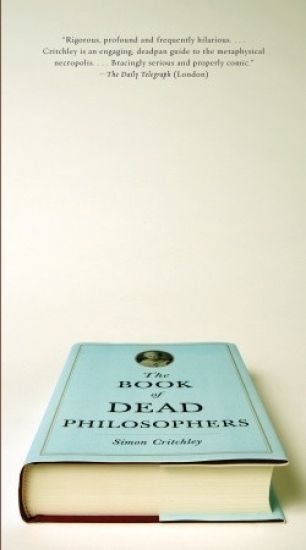
In this collection of brief lives (and deaths) of nearly two hundred of the world's greatest thinkers, noted philosopher Simon Critchley creates a register of mortality that is tragic, amusing, absurd, and exemplary. From the self-mocking haikus of Zen masters on their deathbeds to the last words of Christian saints and modern-day sages, this irresistible book contains much to inspire both amusement and reflection.Informed by Critchley's acute insight, scholarly intelligence, and sprightly wit, each entry tells its own tale, but collected together they add up to a profound and moving investigation of meaning and the possibility of happiness for us all.
On Heidegger's Being and Time is an outstanding exploration of Heidegger's most important work by two major philosophers. Simon Critchley argues that we must see Being and Time as a radicalization of Husserl's phenomenology, particularly his theories of intentionality, categorial intuition, and the phenomenological concept of the a priori. This leads to a reappraisal and defense of Heidegger's conception of phenomenology. In contrast, Reiner Schürmann urges us to read Heidegger 'backward', arguing that his later work is the key to unravelling Being and Time. Through a close reading of Being and Time Schürmann demonstrates that this work is ultimately aporetic because the notion of Being elaborated in his later work is already at play within it. This is the first time that Schürmann's renowned lectures on Heidegger have been published.The book concludes with Critchley's reinterpretation of the importance of authenticity in Being and Time. Arguing for what he calls an 'originary inauthenticity', Critchley proposes a relational understanding of the key concepts of the second part of Being and Time: death, conscience and temporality.
This book is an invitation to read poetry. Simon Critchley argues that poetry enlarges life with a range of observation, power of expression and attention to language that eclipses any other medium. In a rich engagement with the poetry of Wallace Stevens, Critchley reveals that poetry also contains deep and important philosophical insight. Above all, he agues for a 'poetic epistemology' that enables us to think afresh the philosophical problem of the relation between mind and world, and ultimately to cast the problem away. Drawing astutely on Kant, the German and English Romantics and Heidegger, Critchley argues that through its descriptions of particular things and their stubborn plainness - whether water, guitars, trees, or cats - poetry evokes the 'mereness' of things. It is this experience, he shows, that provokes the mood of calm and releases the imaginative insight we need to press back against the pressure of reality. Critchley also argues that this calm defines the cinematic eye of Terrence Malick, whose work is discussed at the end of the book.