Kirjojen hintavertailu. Mukana 12 250 562 kirjaa ja 12 kauppaa.

Kirjailija

Simon Forty

Kirjat ja teokset yhdessä paikassa: 34 kirjaa, julkaisuja vuosilta 2015-2026, suosituimpien joukossa Operation Market Garden. Vertaile teosten hintoja ja tarkista saatavuus suomalaisista kirjakaupoista.

34 kirjaa

Kirjojen julkaisuhaarukka 2015-2026.

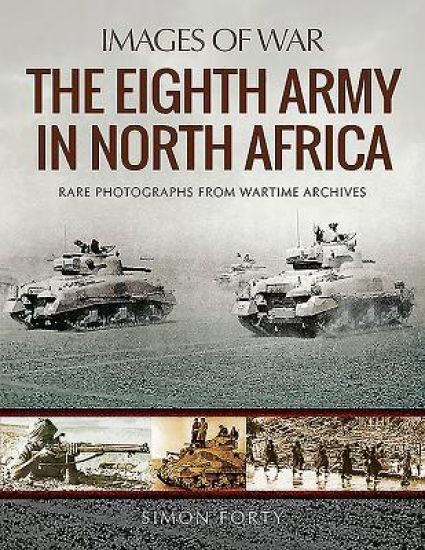
The Eighth Army in North Africa

The Eighth Army in North Africa

Simon Forty

Pen Sword Military
2019
nidottu
The British Eighth Army, which played a decisive role in defeating the Axis in North Africa, was one of the most celebrated Allied armies of the Second World War, and this photographic history is the ideal introduction to it. The carefully chosen photographs show the men, weapons and equipment of the army during campaigns in Egypt, Libya and Tunisia. The battles the army fought in the Western Desert in 1941 and 1942 are the stuff of legend, as is the second Battle of El Alamein when, under Montgomery, it defeated the German and Italian forces commanded by Rommel. The book gives a vivid insight into the fighting and the desert conditions, and it shows what a varied, multinational force the army was, for it brought together men from Britain, the British Empire and Commonwealth as well as Free French, Greeks and Poles.
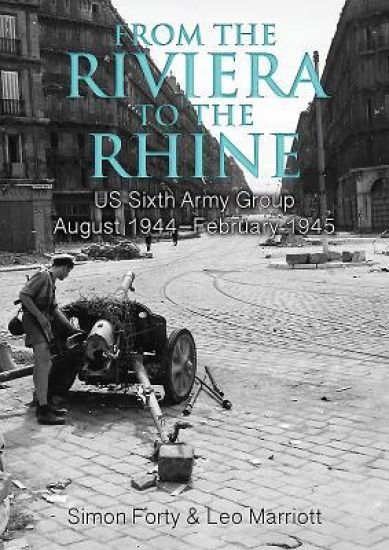
From the Riviera to the Rhine

From the Riviera to the Rhine

Simon Forty

Casemate Publishers
2018
sidottu
Two months after D-Day, just as the battle of Normandy was reaching its climax, with all eyes on the Falaise Pocket, the Allies unleashed the second invasion of France not in the Pas de Calais but the French Riviera. Immaculately planned, effectively undertaken, the Allies quickly broke out of their bridgehead, drove 400 miles into France in three weeks, and liberated 10,000 square miles of French territory while inflicting 143,250 German casualties. On September 10 they linked up with Patton’s Third Army and advanced into the Vosges Mountains, taking Strasbourg and holding the area against the Germans’ final big attack in the west: Operation Nordwind in January 1945. US Seventh Army and 6th Army Group undertook a successful campaign placing a third Allied army group with its own independent supply lines, in northeastern France at a time when the two northern Allied army groups were stretched to the limit. Without this force the Allies would have struggled to hold the frontage to Switzerland and Third Army would have been exposed to attack in its southern flank—something that could have had disastrous repercussions particularly during the Ardennes offensive of December 1944.The images of palm trees and azure seas obscure our view of this campaign. It was no cakewalk. The Germans knew the Allies were coming and had strong defences in the area. A shortage of landing craft, vehicles, and matériel meant that the US Seventh and French First armies were restricted in the assault. The heavy fog and anti-glider defences made for a difficult airborne assault, but it was carried out effectively, the amphibious assault was textbook in execution and the invasion of southern France ended up as a significant victory. But the story of 6th Army Group wasn’t finished. Taking up a position on the east flank of Third Army it fought its way through the Vosges and withstood the Germans’ last throw: Operation Nordwind—the vain attempt to relieve pressure on the Ardennes assault by attacking in the Vosges. Heavy fighting pressed hard towards Strasbourg but the Allies were ultimately victorious, inflicting severe losses on the Germans.
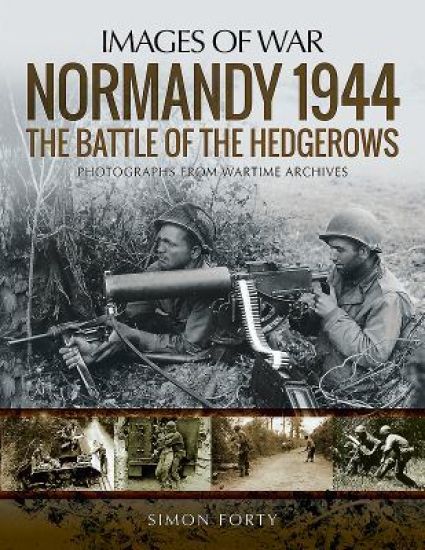
Normandy 1944: The Battle of the Hedgerows

Normandy 1944: The Battle of the Hedgerows

Simon Forty

Pen Sword Military
2018
nidottu
Just as the Anglo-Canadian forces in the east found it difficult to advance beyond Caen after D-Day, so the US First Army laboured to advance through the Norman bocage country in the west. The lethal struggle that developed there was a defining episode in the Normandy campaign, and this photographic history is a vivid introduction to it. Through a selection of over 150 carefully chosen and meticulously captioned�wartime photographs Simon Forty traces the course of the battle and gives the reader a graphic impression of the conditions, the terrain and the experience of the troops. The Germans mounted a tenacious defence. They fought from prepared positions in the high hedgerows. Each cramped field and narrow lane became a killing ground. But the Americans adapted their tactics and brought in special equipment including bulldozers and tanks with hedgerow cutters to force their way through. The losses were appalling as the Germans used snipers, mines, machineguns and artillery to great effect. Inexorably, however, and with enormous bravery, First Army solved their tactical problems, inflicted heavy casualties on the defenders and ground their way to Saint-L�.
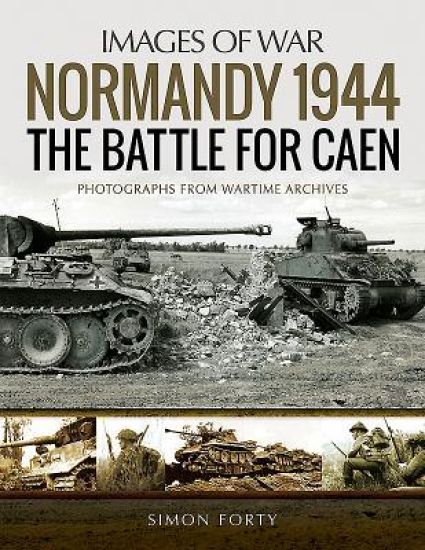
Normandy 1944: The Battle for Caen

Normandy 1944: The Battle for Caen

Simon Forty

Pen Sword Military
2018
nidottu
Caen, a D-Day objective on 6 June 1944, did not fall to the British and Canadian troops of Second Army until 6 August, by which time much of the city had been reduced to rubble. The two-month struggle was a crucial stage in the Normandy campaign and, as Simon Forty demonstrates in this photographic history, one of the most controversial. His detailed, graphic account gives the reader a fascinating insight into the opposing forces, the conditions, the terrain, the equipment and weaponry deployed-and it illustrates just how intense and protracted the fighting was on the ground. The reasons for the slow Allied advance have been hotly disputed. Deficiencies in British and Canadian equipment and tactics have been blamed, as has the tenacity of the German resistance. Ultimately a sequence of Allied operations sapped the defenders' strength, and it is these operations-Perch, Martlet, Epsom, Windsor, Charnwood, Jupiter, Atlantic, Goodwood-that feature strongly in the striking photographs that have been selected for this book. They record in the most dramatic fashion the character of the fighting and show how even the SS divisions and heavy tank battalions were eventually defeated.
The Ardennes Battlefields

The Ardennes Battlefields

Simon Forty; Leo Marriott

Casemate Publishers
2017
sidottu
Just after its seventieth anniversary, the Battle of the Bulge has lost none of its impact. The largest battle fought by US troops on the continent of Europe started in a surprise attack on December 16, 1944, by four German armies, spearheaded by the cream of the German Panzer forces. Under the cover of bad weather and heavy snow, Hitler’s last roll of the dice was intended to retake Antwerp, split the Allies, divide their political leadership, and force peace in the West, thus allowing the German forces to concentrate on defeating the Red Army. Strategic pipedream or not, the attack was furious and drained the Eastern Front of reinforcements: 12 armored and 29 infantry divisions, some 2,000 tanks and assault guns—mainly PzKpfw IVs (800), Panthers (750) and Tigers (250 including some of the new King Tigers)— spearheaded the assault, which smashed into the American First and Ninth Armies.Near-complete surprise was achieved thanks to a combination of Allied overconfidence, preoccupation with offensive plans, and poor reconnaissance. The Germans attacked where least expected—the forested Ardennes—a weakly defended section of the Allied line, taking advantage of the weather conditions, which grounded the Allies’ overwhelmingly superior air forces. The Allied response was magnificent. Initial reverses brought out the best of Eisenhower’s armies, which fought with determination and grit against the enemy and the elements. The harsh battles are best summed up by the defense of the northern shoulder around the Elsenborn Ridge, the battle for St. Vith, and in the south the siege of Bastogne, where the town’s commander, Gen. McAuliffe, rejected German calls for surrender with the pithy reply: “Nuts.”Within ten days the German attack had been nullified. Patton, at the time planning an attack further south, wheeled his Third Army round in a brilliant maneuver that relieved Bastogne and set up a counterattack which would drive the Germans back behind the Rhine. The Ardennes Battlefields includes details of what can be seen on the ground today—hardware, memorials, museums, and cemeteries—using a mixture of media to provide an overview of the campaign: maps old and new highlight what has survived and what hasn’t; then and now photography allows fascinating comparisons with the images taken at the time; aerial photos give another angle to the story. The fifth book by Leo Marriott and Simon Forty provides a different perspective to this crucial battlefield.
The Falaise Gap Battles

The Falaise Gap Battles

Simon Forty; Leo Marriott

Casemate Publishers
2017
nidottu
The denouement of the battle of Normandy, the fighting around Falaise and Chambois in August 1944 and the pursuit of the retreating German armies to the Seine provided the Allies with an immense victory. After ten weeks of hard attritional fighting, the Allies had broken loose from the bocage and the Germans’ deep defenses around Caen: by the end of September they would be close to the German border. As US First Army and British Second Army squeezed the western and northern edges of the German salient, so Third Army rushed headlong eastwards and then north to create the lower of two pincers—the other formed as the Canadian First Army and the Polish 1st Armoured Division pushed south of Caen. As could be expected, the Germans did not simply give up: they fought furiously to keep the pincers from closing. When they did, attacks from inside the pocket to break out and outside the pocket to break in led to fierce fighting between Chambois and Argentan. When the dust settled, between 80,000 and 100,000 troops had been trapped by the Allied encirclement. Estimates vary considerably, but it seems safe to say that at least 10,000 of the German forces were killed and around 50,000 became PoWs. The rest, however, escaped, but without most of their equipment, destroyed in the battle or abandoned in the retreat over the Seine. Those that did were subsequently to reform, rearm and conduct an effective defense into late 1944.The Past & Present Series reconstructs historical battles by using photography, juxtaposing modern views with those of the past together with concise explanatory text. It shows how much infrastructure has remained and how much such as outfits, uniforms, and ephemera has changed, providing a coherent link between now and then.
1st Airborne

1st Airborne

Simon Forty; Leo Marriott

Casemate Publishers
2017
nidottu
While the 6th Airborne Division had landed in France on D-Day and covered itself in glory, its counterpart, the 1st Airborne Division, had last seen action during an amphibious assault at Taranto on September 9, 1943, as part of the invasion of Italy. Returned to the UK in December 1943, it was held in reserve during the battle of Normandy and spent three months waiting for action, as plan after plan was proposed and then discarded, such was the speed of the Allied pursuit of the Germans.In September 1944, however, 1st Airborne played a leading role in Operation Market—the air component of Operation Market Garden, an audacious attempt by the Allies to bypass the Siegfried Line and advance into the Ruhr. It was to be 1st Airborne’s last action of the war. Encountering more resistance than expected, including II SS Panzer Corps, the division landed too far from Arnhem bridge, and fought bravely but in vain. Held up en route, particularly at Nijmegen, XXX Corps’ advance to Arnhem stuttered and ran late.After nine days of fighting, 1st Airborne had lost 8,000 men around Arnhem when the survivors retreated across the Lower Rhine to safety. During those nine days, however, they had created a legend: first as the small unit under Lt-Col John Frost held the “bridge too far” and then as the Oosterbeek perimeter came under sustained attack waiting for XXX Corps to arrive.The Past & Present Series reconstructs historical battles by using photography, juxtaposing modern views with those of the past together with concise explanatory text. It shows how much infrastructure has remained and how much such as outfits, uniforms, and ephemera has changed, providing a coherent link between now and then.
The Normandy Battlefields

The Normandy Battlefields

Leo Marriott; Simon Forty

Casemate Publishers
2017
sidottu
The Normandy Battlefields: D-Day & the Bridgehead ended as the Allies fought to expand their D-Day foothold. In Bocage and Breakout, Leo Marriott and Simon Forty take the story forward as the success of the invasion continued into the Cotentin, with Cherbourg falling on 29 June, before it bogged down in face of determined German defense and the bocage countryside—innumerable small fields surrounded by hedgerows, each one hiding anti-tank weapons, mortars and machine guns. As US First Army fought its way south, on the eastern edges of the bridgehead, British and Canadian forces were fighting a war of attrition around Caen facing the bulk of the German armor as division after division was fed into Normandy. Like a pressure cooker, the fighting intensified until, seven weeks after D-Day, Operation ‘Cobra’ broke the German line. Quickly Patton’s Third Army, operational from 1 August, flooded through the gap exploiting the German confusion, encircling what was left of the German armies in the Falaise Pocket and advancing quickly through into Brittany. Three weeks later, the Battle of Normandy was over, the routed German Army—without most of its heavy weapons left in the Falaise Pocket or on the banks of the Seine—was retreating helter skelter back towards Germany and the Low Countries pursued by the Allies in a reverse of the 1940 Blitzkrieg campaign.The three months of war in June–July 1944 were brutal, with losses of front-line troops as heavy as in World War I. The German defense was tenacious, particularly in face of Allied air supremacy. The Allies struggled to get into a position to allow their more mobile forces room for maneuver and and the fighting was ferocious.When victory came, it came at a cost: 209,672 casualties among the ground forces, including 36,976 killed and 19,221 missing. The Allied air forces lost 16,714 airmen. The corresponding German losses were even more significant: some 450,000 men, of whom 240,000 were killed or wounded. More important to the Germans were the losses of heavy equipment—tanks, assault guns, artillery, personnel carriers. As an example, 12th SS Panzer Division had lost 94% of its armor, nearly all of its artillery and 70% of its vehicles. With c20,000 men and 150 tanks before the campaign, after Falaise it had 300 men and 10 tanks.Mixing text, maps and images, many of them specially commissioned including aerial photography, The Normandy Battlefields: Bocage and Breakout explains and interprets the complexities of the Normandy campaign in an original and cohesive package.
Omaha Beach

Omaha Beach

Leo Marriott; Simon Forty

Casemate Publishers
2016
nidottu
Of the five beaches attacked on 6 June, Omaha saw the sternest fighting. Well-placed defenders on the high ground and extensive beach defenses did their job. On top of this, so much had gone wrong with the first wave: many of the amphibious DD Sherman tanks didn’t reach the beach. They were released from their landing craft too far away where the greater swell swamped them and the troops landing on Omaha missed their firepower. Another problem was that many units landed in the wrong place. Strong tides and winds carried the landing craft off line and led to confusion. Finally, the German emplacements and defenses were well-placed on high ground and the only cover on the beach face=Calibri>– the seawal – was over a killing ground. There were 32 fortified areas located between the Vire River and Port-en-Bessin: in all, 12 of these strongpoints were able to direct fire on Omaha Beach. The attacking forcesface=Calibri>–units of the US 29th and 1st Inf Divs – suffered over 2,000 casualties, many of them drowned during the approach, but led by US Rangers, themselves misplaced (they were the follow-up troops to Rudder’s Rangers who had scaled the Pointe du Hoc) the American troops pushed forward and by nightfall, they had gained hold of the beach and its immediate hinterland. Despite the casualties, 34,000 troops had been landed by the end of the day.
6th Airborne

6th Airborne

Leo Marriott; Simon Forty

Casemate Publishers
2016
nidottu
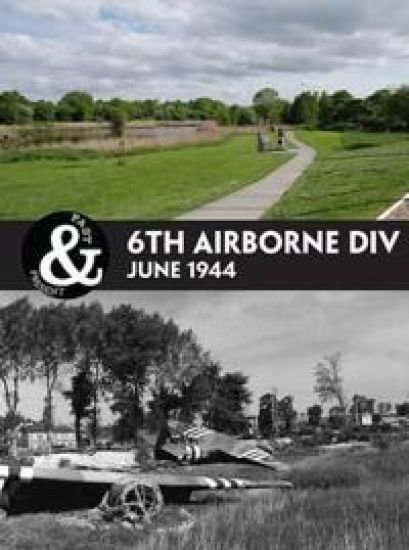
Operation Tonga began at 22:56 on the night of 5 June, when six Halifax heavy bombers took off from Tarrant Rushton towing six Horsas carrying a coup–de–main force consisting of D Coy, Ox and Bucks LI reinforced with two extra platoons from B Coy and a party of sappers, who were tasked with capturing the bridges over the Caen Canal and the River Orne. 6th Airborne Division—which included 1st Canadian Para Bn–had been allotted three specific tasks to achieve, apart from protecting the eastern flank of the Allied seaborne landings. First, it was to capture intact the two bridges over the Caen Canal and the Orne River at Benouville and Ranville. Second, the division was to destroy the heavily fortified Merville coastal artillery battery located at Franceville Plage, to ensure that it could not shell the British forces landing on Sword Beach. A third task was to destroy several bridges spanning the River Dives–at Varaville, Robehomme, Bures, and Troarn. The division would then hold the territory that it had seized until it could be relieved by advancing Allied ground forces.
101st Airborne

101st Airborne

Stephen Smith; Simon Forty

Casemate Publishers
2016
nidottu
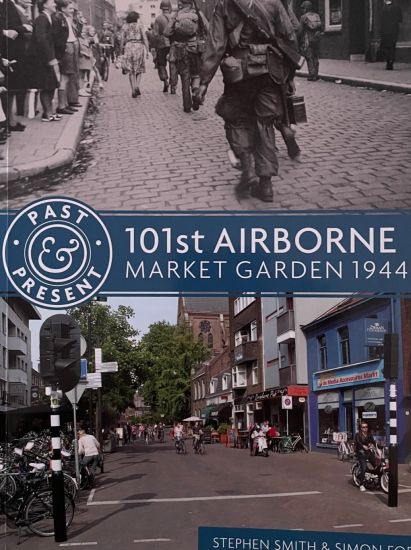
After its operations in the Cotentin and around Carentan, the 101st was withdrawn from the lines in late June and sailed back to England on LSTs in July. After several false alerts, they invaded by air again into the Netherlands on September 17, 1944, part of the airborne element of Operation 'Market Garden'. The mission was to hold open Hell’s Highway so that land forces could advance safely to Arnhem.Operation 'Market Garden' is a strongly debated subject among WW2 historians: was it a brave attempt to end the war early that foundered for being a bridge too far, or was it, rather, an ill-conceived waste of resources that should have been used on another front? With hindsight, there’s no doubt that the operation was a daring face=Calibri>– if not risky – attempt to attack deep into enemy territory proposed by a general often disparaged for being too conservative.But at the beginning of September, it seemed to the Allied commanders that the enemy was disorganized; it had lost many men, huge numbers of vehicles, and had retreated helter-skelter through France and Belgium. In reality, the Germans had already started brilliant fire brigade reorganization and would soon have an effective defence throughout the Netherlands.The 101st parachuted right into the middle of enemy territory and north of Eindhoven. They met little resistance to begin with and captured most of their initial objectives by the end of 17 September. But the Germans managed to demolish the division’s primary objective, a bridge over the Wilhelmina Canal at Son, forcing the 101st to attempt to capture a similar bridge a few kilometers away at best. They found the approach blocked but continued to hold territory enabling engineers to rebuild the demolished bridge. Other divisional units continued moving to the south and eventually reached the northern end of Eindhoven. In the following days they successfully defended the town of Veghel but failed to take the city of Helmond. As Operation 'Market Garden' progressed, the rest of the 101st Airborne Division joined the 82nd Airborne Division on the island to the north of Nijmegen. The Screaming Eagles saw seventy-two days of fierce round-the-clock fighting against crack German troops and showed their fighting ability and tenacity.
Bastogne

Bastogne

Stephen Smith; Simon Forty

Casemate Publishers
2016
nidottu
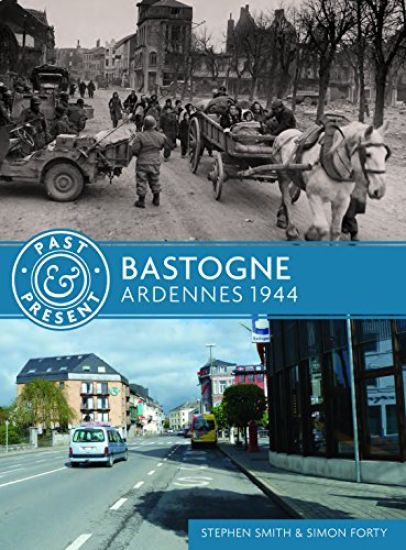
Bastogne will live forever in the annals of American military history. From the resounding 'Nuts', in response to the German demand for surrender, to the breaking of the siege by Patton’s Third Army – brilliantly disengaged from its positions on the Saar, wheeled 90 degrees and marched northwards faster than any thought possible – the defense of Bastogne and victory in the Ardennes was one of the greatest feats of American arms in the European Theatre. This title in the Past & Present series looks at the encirclement, siege, and relief with then and now photographs; specially commissioned aerial photos, and a wealth of detail.
Hitler’S Atlantic Wall

Hitler’S Atlantic Wall

George Forty; Leo Marriott; Simon Forty

Casemate Publishers
2016
sidottu
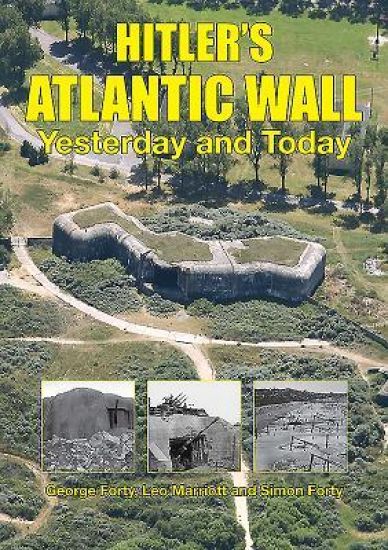
Masters of the continent, the Nazis realized that they would have to defend their gains, and once the United States entered the war, redoubled their efforts. Using forced and slave labor they built a chain of defensive positions, coastal batteries, and beach defenses from the top of Norway to the Franco-Spanish border. However, as was so typical of the Nazis, while the bunkers and batteries seem impressively constructed, and the Atlantic Wall has left a permanent reminder of the years of Nazi domination, it was crippled by lack of strategic planning, internal bickering, and a multitude of command structures that did not communicate with each other effectively. In June 1944 the Allies burst through the wall, and while it took many lives to break the crust of the German defenses, the vaunted Atlantic Wall proved ineffective save for the fortresses the Allies bypassed and subdued later. Using the same formula as in their books on The Normandy Battlefields and Race to the Rhine, Leo Marriott and Simon Forty combine bespoke aerial photography with old photographs, maps, and current illustrations to provide a pictorial analysis of the subject—Around 500 illustrations ensure the subject is well covered. After opening sections on the construction of the wall, the defensive plan, and the different structures that were built, Hitler’s Atlantic Wall yesterday and today provides a survey of the key locations and what can be seen today—including many of the museums that interpret them. The bulk of the book is divided geographically by country, dealing with France, Belgium, the Netherlands, Denmark, and Norway. After 70 years, the Atlantic Wall is still a remarkable reminder of the war years, and one that continues to fascinate.
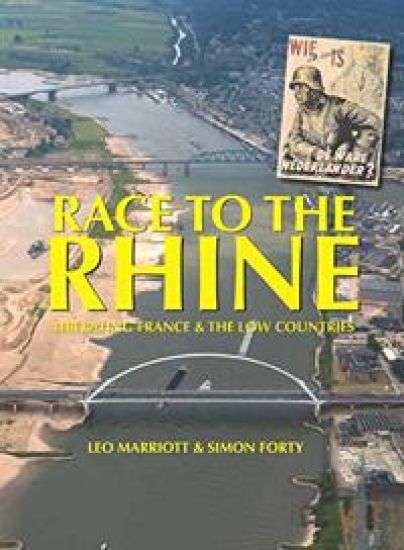
Race to the Rhine

Race to the Rhine

Leo Marriott; Simon Forty

Casemate Publishers
2015
sidottu
The speed of the German Blitzkrieg in 1940 and the relative ease with which they brushed aside Allied defenses meant four years of occupation. But in June 1944—this time with American forces—the Allies finally returned for a rematch. The destruction of German forces in Normandy’s Falaise pocket, on August 14,was as quick as the Blitzkrieg had been: by September British troops were in Ghent and Liege; Canadian forces liberated Ostend, and in northeast France Patton's Third Army was moving rapidly to the German border, taking Rheims on August 29 and Verdun on the 30th. Paris was liberated on August 25th. The liberation of the Low Countries would not prove as straightforward, however. Operation Market Garden—Montgomery's brave thrust toward the Rhine at Arnhem—started on September 17 and hoped to end German resistance at a stroke. But it ended in failure on the 25th with over 6,000 paratroopers captured. V-1 flying bombs had meantime been launched from northern France and the Low Countries from August 1944. During September the more frightening German V-2s began raining in. In late October, belated operations began to clear the Scheldt Estuary and open the port of Antwerp to the Allies, and took nearly a month. Belgium was almost free of the Nazi yoke and the Netherlands looked likely to be cleared before Christmas. Then, on December 16, came Hitler's last roll of the dice: a major German counter-offensive in the Ardennes aiming to split the Allied armies and retake Antwerp. It turned out to be their last try: the American defenders held, and finally with better weather, Patton's army and Allied air superiority told. With the Germans having shot their last bolt, in the spring the Rhine was gained. Race to the Rhine, a companion volume to The Normandy Battlefields, links modern aerial photography with contemporary illustrations to provide a modern interpretation of the battles, replete with maps, diagrams and photos. It is now 70 years since Western Europe was freed from its occupation, and this book provides a graphic view of how it was accomplished. For those interested in visiting the sites, it supplies a guide to the places that best represent the battles today.