Kirjojen hintavertailu. Mukana 12 390 323 kirjaa ja 12 kauppaa.

Kirjailija

Siu-Kui Au

Kirjat ja teokset yhdessä paikassa: 3 kirjaa, julkaisuja vuosilta 2014-2018, suosituimpien joukossa Operational Modal Analysis. Vertaile teosten hintoja ja tarkista saatavuus suomalaisista kirjakaupoista.

3 kirjaa

Kirjojen julkaisuhaarukka 2014-2018.

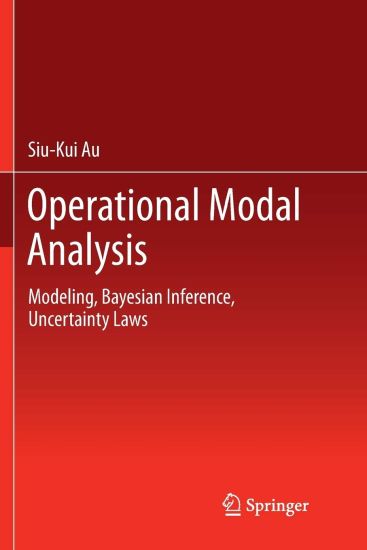
Operational Modal Analysis

Operational Modal Analysis

Siu-Kui Au

Springer Verlag, Singapore
2018
nidottu
This book presents operational modal analysis (OMA), employing a coherent and comprehensive Bayesian framework for modal identification and covering stochastic modeling, theoretical formulations, computational algorithms, and practical applications. Mathematical similarities and philosophical differences between Bayesian and classical statistical approaches to system identification are discussed, allowing their mathematical tools to be shared and their results correctly interpreted. The authors provide their data freely in the web at https://doi.org/10.7910/DVN/7EVTXGMany chapters can be used as lecture notes for the general topic they cover beyond the OMA context. After an introductory chapter (1), Chapters 2–7 present the general theory of stochastic modeling and analysis of ambient vibrations. Readers are first introduced to the spectral analysis of deterministic time series (2) and structural dynamics (3),which do not require the use of probability concepts. The concepts and techniques in these chapters are subsequently extended to a probabilistic context in Chapter 4 (on stochastic processes) and in Chapter 5 (on stochastic structural dynamics). In turn, Chapter 6 introduces the basics of ambient vibration instrumentation and data characteristics, while Chapter 7 discusses the analysis and simulation of OMA data, covering different types of data encountered in practice. Bayesian and classical statistical approaches to system identification are introduced in a general context in Chapters 8 and 9, respectively. Chapter 10 provides an overview of different Bayesian OMA formulations, followed by a general discussion of computational issues in Chapter 11. Efficient algorithms for different contexts are discussed in Chapters 12–14 (single mode, multi-mode, and multi-setup). Intended for readers with a minimal background in mathematics, Chapter 15 presents the ‘uncertainty laws’ in OMA, one of the latest advances that establish the achievable precision limit of OMA and provide a scientific basis for planning ambient vibration tests. Lastly Chapter 16 discusses the mathematical theory behind the results in Chapter 15, addressing the needs of researchers interested in learning the techniques for further development. Three appendix chapters round out the coverage.This book is primarily intended for graduate/senior undergraduate students and researchers, although practitioners will also find the book a useful reference guide. It covers materials from introductory to advanced level, which are classified accordingly to ensure easy access. Readers with an undergraduate-level background in probability and statistics will find the book an invaluable resource, regardless of whether they are Bayesian or non-Bayesian.
Operational Modal Analysis

Operational Modal Analysis

Siu-Kui Au

Springer Verlag, Singapore
2017
sidottu
This book presents operational modal analysis (OMA), employing a coherent and comprehensive Bayesian framework for modal identification and covering stochastic modeling, theoretical formulations, computational algorithms, and practical applications. Mathematical similarities and philosophical differences between Bayesian and classical statistical approaches to system identification are discussed, allowing their mathematical tools to be shared and their results correctly interpreted. The authors provide their data freely in the web at https://doi.org/10.7910/DVN/7EVTXGMany chapters can be used as lecture notes for the general topic they cover beyond the OMA context. After an introductory chapter (1), Chapters 2–7 present the general theory of stochastic modeling and analysis of ambient vibrations. Readers are first introduced to the spectral analysis of deterministic time series (2) and structural dynamics (3),which do not require the use of probability concepts. The concepts and techniques in these chapters are subsequently extended to a probabilistic context in Chapter 4 (on stochastic processes) and in Chapter 5 (on stochastic structural dynamics). In turn, Chapter 6 introduces the basics of ambient vibration instrumentation and data characteristics, while Chapter 7 discusses the analysis and simulation of OMA data, covering different types of data encountered in practice. Bayesian and classical statistical approaches to system identification are introduced in a general context in Chapters 8 and 9, respectively. Chapter 10 provides an overview of different Bayesian OMA formulations, followed by a general discussion of computational issues in Chapter 11. Efficient algorithms for different contexts are discussed in Chapters 12–14 (single mode, multi-mode, and multi-setup). Intended for readers with a minimal background in mathematics, Chapter 15 presents the ‘uncertainty laws’ in OMA, one of the latest advances that establish the achievable precision limit of OMA and provide a scientific basis for planning ambient vibration tests. Lastly Chapter 16 discusses the mathematical theory behind the results in Chapter 15, addressing the needs of researchers interested in learning the techniques for further development. Three appendix chapters round out the coverage.This book is primarily intended for graduate/senior undergraduate students and researchers, although practitioners will also find the book a useful reference guide. It covers materials from introductory to advanced level, which are classified accordingly to ensure easy access. Readers with an undergraduate-level background in probability and statistics will find the book an invaluable resource, regardless of whether they are Bayesian or non-Bayesian.
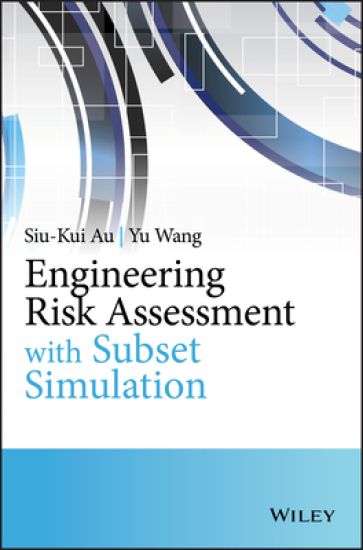
Engineering Risk Assessment with Subset Simulation

Engineering Risk Assessment with Subset Simulation

Siu-Kui Au; Yu Wang

John Wiley Sons Inc
2014
sidottu
This book starts with the basic ideas in uncertainty propagation using Monte Carlo methods and the generation of random variables and stochastic processes for some common distributions encountered in engineering applications. It then introduces a class of powerful simulation techniques called Markov Chain Monte Carlo method (MCMC), an important machinery behind Subset Simulation that allows one to generate samples for investigating rare scenarios in a probabilistically consistent manner. The theory of Subset Simulation is then presented, addressing related practical issues encountered in the actual implementation. The book also introduces the reader to probabilistic failure analysis and reliability-based sensitivity analysis, which are laid out in a context that can be efficiently tackled with Subset Simulation or Monte Carlo simulation in general. The book is supplemented with an Excel VBA code that provides a user-friendly tool for the reader to gain hands-on experience with Monte Carlo simulation. Presents a powerful simulation method called Subset Simulation for efficient engineering risk assessment and failure and sensitivity analysisIllustrates examples with MS Excel spreadsheets, allowing readers to gain hands-on experience with Monte Carlo simulationCovers theoretical fundamentals as well as advanced implementation issuesA companion website is available to include the developments of the software ideas This book is essential reading for graduate students, researchers and engineers interested in applying Monte Carlo methods for risk assessment and reliability based design in various fields such as civil engineering, mechanical engineering, aerospace engineering, electrical engineering and nuclear engineering. Project managers, risk managers and financial engineers dealing with uncertainty effects may also find it useful.