Kirjojen hintavertailu. Mukana 12 657 676 kirjaa ja 12 kauppaa.

Kirjailija

Smita Bedis

Kirjat ja teokset yhdessä paikassa: 13 kirjaa, julkaisuja vuosilta 2019-2023, suosituimpien joukossa Characterization of Surfactant & Electrolyte. Vertaile teosten hintoja ja tarkista saatavuus suomalaisista kirjakaupoista.

13 kirjaa

Kirjojen julkaisuhaarukka 2019-2023.

Charakterisierung von Tensid und Elektrolyt

Charakterisierung von Tensid und Elektrolyt

Smita Bedis; Priyadarshani Kamble

Verlag Unser Wissen
2023
pokkari
Aus der Studie l sst sich schlie en, dass die physikalisch-chemischen Eigenschaften einer l-in-Wasser-Emulsion am st rksten durch die Variationen des Gehalts an Tensid 17R4 A und NaCl beeinflusst wurden.Die NaCl-Tensid- l-Wechselwirkungen hatten einen starken Einfluss auf die Stabilit t der hergestellten Emulsion. 17R4 Pluronic, wenn es in minimaler Menge (1%) zusammen mit Ludox und 2 mg NaCl verwendet wurde, f hrte zu der stabilsten Emulsion, die ber 6 Monate ohne Anzeichen von Aufrahmung auf dem Pr fstand stand. l-in-Wasser-Emulsionsabf lle k nnen mit der elektrochemischen Destabilisierungsmethode wirksam behandelt werden, wobei das bereitgestellte Aluminium und der Massen-pH-Wert die beiden kritischsten Faktoren in diesem Prozess sind. Versuche mit einem station ren pH-Wert au erhalb des Bereichs von 5-9 f hren zu keiner Emulsionsaufspaltung und damit zu keiner CSB-Eliminierung. Au erdem hat der Elektrolyt einen erheblichen Einfluss auf die Ergebnisse. Nach unserem zweiten Schema haben wir festgestellt, dass die Nanoemulsion potenziell zur Verbesserung der oralen Bioverf gbarkeit von Ibuprofen beitragen kann. Ein pseudotern res Phasendiagramm wurde erfolgreich konstruiert, um die Bioverf gbarkeit zu optimieren.

Caratterizzazione di tensioattivi ed elettroliti

Caratterizzazione di tensioattivi ed elettroliti

Smita Bedis; Priyadarshani Kamble

Edizioni Sapienza
2023
pokkari
Le variazioni della concentrazione del tensioattivo 17R4 hanno influenzato maggiormente le caratteristiche fisico-chimiche di un'emulsione olio-in-acqua.Dallo studio, possiamo concludere che le propriet fisico-chimiche di un'emulsione olio-in-acqua sono state influenzate soprattutto dalle variazioni del contenuto di tensioattivo 17R4 A e NaCl.Le interazioni NaCl-surfattante-olio hanno avuto una forte influenza sulla stabilit dell'emulsione preparata. Il tensioattivo pluronico 17R4, utilizzato in quantit minima (1%) insieme a Ludox e 2 mg di NaCl, ha dato luogo all'emulsione pi stabile, che ha resistito sul banco oltre 6 mesi senza alcun segno di cremazione. I rifiuti delle emulsioni olio-acqua possono essere trattati efficacemente con il metodo della destabilizzazione elettrochimica. L'alluminio fornito e il pH della massa sono i due fattori pi critici del processo. Gli esperimenti con un pH allo stato stazionario al di fuori dell'intervallo 5-9 non provocano la rottura dell'emulsione e, di conseguenza, l'eliminazione del COD. Inoltre, l'elettrolita ha un impatto significativo sui risultati. Secondo il nostro secondo schema, abbiamo scoperto che la nanoemulsione potenzialmente utile per migliorare la biodisponibilit orale dell'ibuprofene. stato costruito con successo un diagramma di fase pseudoternario per optare per l'uso della nanoemulsione.
Caractérisation du tensioactif et de l'électrolyte

Caractérisation du tensioactif et de l'électrolyte

Smita Bedis; Priyadarshani Kamble

Editions Notre Savoir
2023
pokkari
L' tude permet de conclure que les propri t s physico-chimiques d'une mulsion huile dans eau sont principalement affect es par les variations des teneurs en tensioactif 17R4 A et en NaCl.Le tensioactif Pluronic 17R4, lorsqu'il est utilis en quantit minimale (1%) avec le Ludox et 2 mg de NaCl, donne l' mulsion la plus stable, qui est rest e sur le banc pendant plus de 6 mois sans aucun signe de cr mage. Les d chets d' mulsions d'huile dans l'eau peuvent tre trait s efficacement en utilisant la m thode de d stabilisation lectrochimique. L'aluminium fourni et le pH global sont les deux facteurs les plus critiques dans le processus. Les exp riences avec un pH l' tat stable en dehors de la plage 5-9 n'entra nent pas de rupture de l' mulsion et, par cons quent, pas d' limination de la DCO. En outre, l' lectrolyte a un impact significatif sur les r sultats. Selon notre deuxi me sch ma, nous avons constat que la nano mulsion peut potentiellement contribuer am liorer la biodisponibilit orale de l'ibuprof ne. Un diagramme de phase pseudoternaire a t construit avec succ s pour optimiser la biodisponibilit de l'ibuprof ne.
Caracterização do surfactante e do eletrólito

Caracterização do surfactante e do eletrólito

Smita Bedis; Priyadarshani Kamble

Edicoes Nosso Conhecimento
2023
pokkari
As altera es na concentra o do tensioativo 17R4 foram as que mais influenciaram as caracter sticas f sico-qu micas de uma emuls o leo em gua. A partir do estudo, podemos concluir que as propriedades f sico-qu micas de uma emuls o leo em gua foram principalmente afectadas pelas varia es nos teores de tensioativo 17R4 A e NaCl.As interac es NaCl-surfactante- leo tiveram uma forte influ ncia na estabilidade da emuls o preparada. O tensioativo plur nico 17R4, quando utilizado numa quantidade m nima (1%) juntamente com Ludox e 2mg de NaCl, resultou na emuls o mais est vel que permaneceu no banco de ensaio durante mais de 6 meses sem qualquer sinal de forma o de espuma. Os res duos de emuls es de leo em gua podem ser tratados eficazmente utilizando o m todo de desestabiliza o eletroqu mica, sendo o alum nio fornecido e o pH da massa os dois factores mais cr ticos no processo. As experi ncias com um pH em estado estacion rio fora do intervalo 5-9 n o resultam na rutura da emuls o e, consequentemente, na elimina o da CQO. Al m disso, o eletr lito tem um impacto significativo nos resultados. De acordo com o nosso segundo esquema, descobrimos que a nanoemuls o tem o potencial de ajudar a melhorar a biodisponibilidade oral do ibuprofeno. Foi constru do com sucesso um diagrama de fase pseudotern rio para optar por uma nanoemuls o com um teor de oxig nio de 1,5 mg/dL.
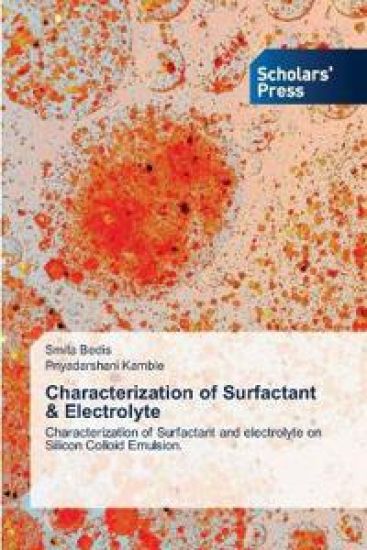
Characterization of Surfactant & Electrolyte

Characterization of Surfactant & Electrolyte

Smita Bedis; Priyadarshani Kamble

SCHOLARS' PRESS
2023
pokkari
Changes in surfactant 17R4 concentration influenced the physio-chemical characteristics of an oil- in-water emulsion the most.From the study, we can conclude that the physcio-chemical properties of an oil-in-water emulsion were mostly affected by the variations in the contents of surfactant 17R4 A and NaCl. The NaCl-surfactant-oil interactions had a strong influence on the stability of the prepared emulsion. Pluronic surfactant 17R4 when used in minimal amount (1%) alongside Ludox and 2mg NaCl resulted to the most stable emulsion which stood on the bench beyond 6months without any sign of creaming. Oil-in-water emulsion wastes may be effectively treated using the electrochemical destabilization method. The aluminum provided and the bulk pH are the two most critical factors in the process. Experiments with a steady-state pH outside of the 5-9 range result in no emulsion break-up and, as a result, no COD elimination. In addition, the electrolyte has a significant impact on the outcomes. According to our second scheme, we found that nanoemulsion has the potentially help for enhancing the oral bioavailability of ibuprofen.
Estimation of AntiParkinson's Drugs

Estimation of AntiParkinson's Drugs

Madhuri Chaudhari; Smita Bedis; Aniket Garud

LAP Lambert Academic Publishing
2019
pokkari
Pramipexole hydrochloride (PPX) and ropinirole hydrochloride (RPN), are nonergot dopamine agonist, selective for dopamine D2 and D3 receptors, in contrast to ergot derivatives that also have activity at D1 type and other nondopaminergic neurotransmitter receptors, indicated for the treatment of the signs and symptoms of Parkinson's disease. The nigrostristrial neurodegeneration that proceeds over the cource of parkinson's disease limits the no. of striatal nerve terminals that are available to decarboxylate levodopa to dopamine. Drugs (PPX and RPN) that act directly to stimulate dopamine receptors, however do not require functioning dopaminergic nerve terminals and can be useful in the management of last- stage disease problems during levodopa therapy. The present work deals with development of validated analytical methods for these antiparkinson's agents in bulk and in their respective pharmaceutical dosage forms by RP-HPLC and HPTLC techniques and different UV spectrophotometric methods.