Kirjojen hintavertailu. Mukana 12 559 232 kirjaa ja 12 kauppaa.

Kirjailija

Sonia Hernandez

Kirjat ja teokset yhdessä paikassa: 8 kirjaa, julkaisuja vuosilta 2014-2022, suosituimpien joukossa Farming Across Borders. Vertaile teosten hintoja ja tarkista saatavuus suomalaisista kirjakaupoista.

Mukana myös kirjoitusasut: Sonia Hernández, Sònia Hernández

8 kirjaa

Kirjojen julkaisuhaarukka 2014-2022.

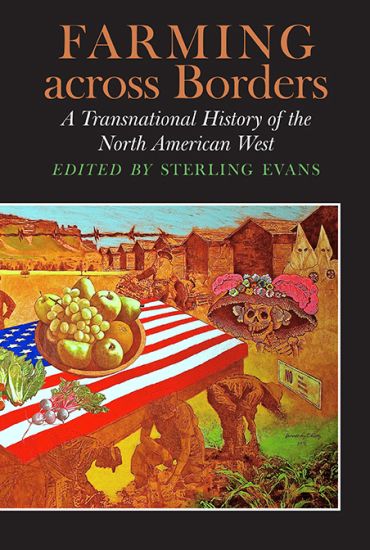
Farming Across Borders

Farming Across Borders

Timothy P. Bowman; Kristin Hoganson; Laura Hooton; Josh MacFadyen; Todd Meyers; Peter S Morris; Andrew Dunlop; Alicia Marion Dewey; John Weber; Sonia Hernandez; Rosa E Cobos; Matt Caire-Perez; Paige Raibmon; Jason McCollom; Thomas D Isern; Suzzanne Kelley; Anthony Carlson; Stephen Mumme; Tisa Anders

Texas A M University Press
2017
sidottu
Farming across Borders uses agricultural history to connect the regional experiences of the American West, northern Mexico, western Canada, and the North American side of the Pacific Rim, now writ large into a broad history of the North American West. Case studies of commodity production and distribution, trans-border agricultural labor, and environmental change unite to reveal new perspectives on a historiography traditionally limited to a regional approach.Sterling Evans has curated nineteen essays to explore the contours of “big” agricultural history. Crops and commodities discussed include wheat, cattle, citrus, pecans, chiles, tomatoes, sugar beets, hops, henequen, and more. Toiling over such crops, of course, were the people of the North American West, and as such, the contributing authors investigate the role of agricultural labor, from braceros and Hutterites to women working in the sorghum fields and countless other groups in between.As Evans concludes, “society as a whole (no matter in what country) often ignores the role of agriculture in the past and the present.” Farming across Borders takes an important step toward cultivating awareness and understanding of the agricultural, economic, and environmental connections that loom over the North American West regardless of lines on a map. In the words of one essay, “we are tied together . . . in a hundred different ways.”
Prosopagnosia

Prosopagnosia

Sònia Hernández

Scribe Publications
2022
pokkari
A sly and playful novel about the many faces we all have. Fifteen-year-old Berta says that beautiful things aren’t made for her, she isn’t destined to have them, the only things she deserves are ugly. It’s why her main activity, when she’s not at school, is playing the ‘prosopagnosia game’ — standing in front of the mirror and holding her breath until she can no longer recognise her own face. Berta’s mother is in her forties. By her own estimation, she is at least twenty kilos overweight, and her husband has just left her. Her whole life, she has felt a keen sense of being very near to the end of things. She used to be a cultural critic for a regional newspaper. Now she feels it is her responsibility to make her and her daughter’s lives as happy as possible. A man who claims to be the famous Mexican artist Vicente Rojo becomes entangled in their lives when he sees Berta faint at school and offers her the gift of a painting. This sets in motion an uncanny game of assumed and ignored identities, where the limits of what one wants and what one can achieve become blurred.
For a Just and Better World

For a Just and Better World

Sonia Hernandez

University of Illinois Press
2021
nidottu
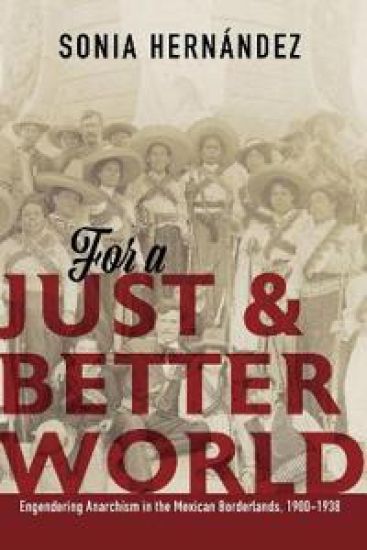
Caritina Piña Montalvo personified the vital role played by Mexican women in the anarcho-syndicalist movement. Sonia Hernández tells the story of how Piña and other Mexicanas in the Gulf of Mexico region fought for labor rights both locally and abroad in service to the anarchist ideal of a worldwide community of workers. An international labor broker, Piña never left her native Tamaulipas. Yet she excelled in connecting groups in the United States and Mexico. Her story explains the conditions that led to anarcho-syndicalism's rise as a tool to achieve labor and gender equity. It also reveals how women's ideas and expressions of feminist beliefs informed their experiences as leaders in and members of the labor movement. A vivid look at a radical activist and her times, For a Just and Better World illuminates the lives and work of Mexican women battling for labor rights and gender equality in the early twentieth century.
For a Just and Better World

For a Just and Better World

Sonia Hernandez

University of Illinois Press
2021
sidottu
Caritina Piña Montalvo personified the vital role played by Mexican women in the anarcho-syndicalist movement. Sonia Hernández tells the story of how Piña and other Mexicanas in the Gulf of Mexico region fought for labor rights both locally and abroad in service to the anarchist ideal of a worldwide community of workers. An international labor broker, Piña never left her native Tamaulipas. Yet she excelled in connecting groups in the United States and Mexico. Her story explains the conditions that led to anarcho-syndicalism's rise as a tool to achieve labor and gender equity. It also reveals how women's ideas and expressions of feminist beliefs informed their experiences as leaders in and members of the labor movement. A vivid look at a radical activist and her times, For a Just and Better World illuminates the lives and work of Mexican women battling for labor rights and gender equality in the early twentieth century.
Prosopagnosia

Prosopagnosia

Sònia Hernández

Scribe Us
2021
nidottu
A sly and playful novel about the many faces we all have. Fifteen-year-old Berta says that beautiful things aren't made for her, or that she isn't destined to have them, or that the only things she deserves are ugly. It's why her main activity, when she's not at school, is playing the "prosopagnosia game"--standing in front of the mirror and holding her breath until she can no longer recognise her own face. An ibis is the only animal she wants for a pet. Berta's mother is in her forties. By her own estimation, she is at least twenty kilos overweight, and her husband has just left her. Her whole life, she has felt a keen sense of being very near to the end of things. She used to be a cultural critic for a regional newspaper. Now she feels it is her responsibility to make her and her daughter's lives as happy as possible. A man who claims to be the famous Mexican artist Vicente Rojo becomes entangled in their lives when he sees Berta faint at school and offers her the gift of a painting. This sets in motion an uncanny game of assumed and ignored identities, where the limits of what one wants and what one can achieve become blurred. Art, culture, motherhood, and the search for meaning all have a part to play in whether S nia Hern ndez' characters recognise what they see within.
Working Women Into the Borderlands

Working Women Into the Borderlands

Sonia Hernández; Sterling D. Evans

Texas A M University Press
2014
sidottu
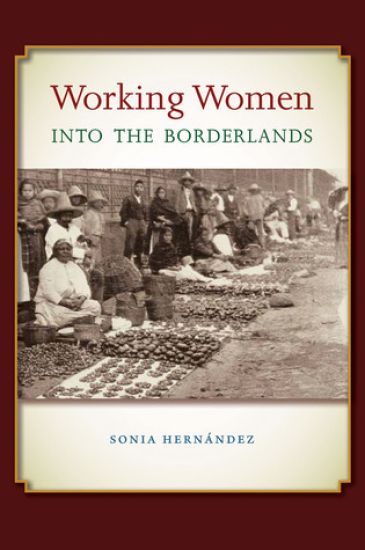
In Working Women into the Borderlands, author Sonia Hernández sheds light on how women’s labor was shaped by US capital in the northeast region of Mexico and how women’s labor activism simultaneously shaped the nature of foreign investment and relations between Mexicans and Americans. As capital investments fueled the growth of heavy industries in cities and ports such as Monterrey and Tampico, women’s work complemented and strengthened their male counterparts’ labor in industries which were historically male-dominated.As Hernández reveals, women laborers were expected to maintain their “proper” place in society, and work environments were in fact gendered and class-based. Yet, these prescribed notions of class and gender were frequently challenged as women sought to improve their livelihoods by using everyday forms of negotiation including collective organizing, labor arbitration boards, letter writing, creating unions, assuming positions of confianza (“trustworthiness”), and by migrating to urban centers and/or crossing into Texas. Drawing extensively on bi-national archival sources, newspapers, and published records, Working Women into the Borderlands demonstrates convincingly how women’s labor contributions shaped the development of one of the most dynamic and contentious borderlands in the globe.
Working Women into the Borderlands

Working Women into the Borderlands

Sonia Hernández; Sterling D. Evans

Texas A M University Press
2014
nidottu
In Working Women into the Borderlands, author Sonia Hernández sheds light on how women’s labor was shaped by US capital in the northeast region of Mexico and how women’s labor activism simultaneously shaped the nature of foreign investment and relations between Mexicans and Americans. As capital investments fueled the growth of heavy industries in cities and ports such as Monterrey and Tampico, women’s work complemented and strengthened their male counterparts’ labor in industries which were historically male-dominated.As Hernández reveals, women laborers were expected to maintain their “proper” place in society, and work environments were in fact gendered and class-based. Yet, these prescribed notions of class and gender were frequently challenged as women sought to improve their livelihoods by using everyday forms of negotiation including collective organizing, labor arbitration boards, letter writing, creating unions, assuming positions of confianza (“trustworthiness”), and by migrating to urban centers and/or crossing into Texas. Drawing extensively on bi-national archival sources, newspapers, and published records, Working Women into the Borderlands demonstrates convincingly how women’s labor contributions shaped the development of one of the most dynamic and contentious borderlands in the globe.