Kirjojen hintavertailu. Mukana 12 390 323 kirjaa ja 12 kauppaa.

Kirjailija

Sophocles

Kirjat ja teokset yhdessä paikassa: 339 kirjaa, julkaisuja vuosilta 1825-2026, suosituimpien joukossa Sophocles' Oedipus at Colonus. Vertaile teosten hintoja ja tarkista saatavuus suomalaisista kirjakaupoista.

339 kirjaa

Kirjojen julkaisuhaarukka 1825-2026.

Fragments

Fragments

Sophocles

LOEB
1996
sidottu
Ancient Athens’ most successful tragedian.Sophocles (497/6–406 BC), the second of the three great tragedians of Athens and by common consent one of the world's greatest poets, wrote more than 120 plays. Only seven of these survive complete, but we have a wealth of fragments, from which much can be learned about Sophocles' language and dramatic art. This volume presents a collection of all the major fragments, ranging in length from two lines to a very substantial portion of the satyr play The Searchers. Prefatory notes provide frameworks for the fragments of known plays. Many of the Sophoclean fragments were preserved by quotation in other authors; others, some of considerable size, are known to us from papyri discovered during the past century. Among the lost plays of which we have large fragments, The Searchers shows the god Hermes, soon after his birth, playing an amusing trick on his brother Apollo; Inachus portrays Zeus coming to Argos to seduce Io, the daughter of its king; and Niobe tells how Apollo and his sister Artemis punish Niobe for a slight upon their mother by killing her twelve children. Throughout the volume, as in the extant plays, we see Sophocles drawing his subjects from heroic legend.This is the final volume of Lloyd-Jones's Loeb Classical Library edition of Sophocles. In Volumes I and II he gives a faithful and very skillful translation of the seven surviving plays. Volume I contains Oedipus Tyrannus, Ajax, and Electra. Volume II contains Oedipus at Colonus, Antigone, The Women of Trachis, and Philoctetes.
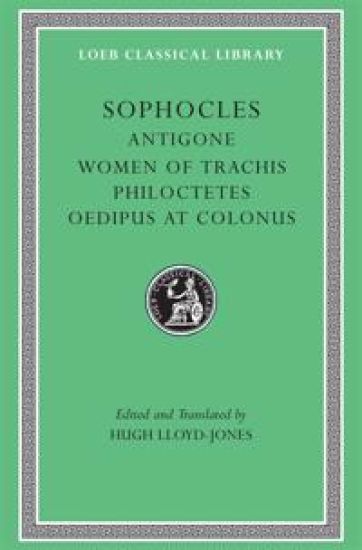
Antigone. Women of Trachis. Philoctetes. Oedipus at Colonus
Ancient Athens’ most successful tragedian.Sophocles (497/6–406 BC), with Aeschylus and Euripides, was one of the three great tragic poets of Athens, and is considered one of the world's greatest poets. The subjects of his plays were drawn from mythology and legend. Each play contains at least one heroic figure, a character whose strength, courage, or intelligence exceeds the human norm—but who also has more than ordinary pride and self-assurance. These qualities combine to lead to a tragic end. Hugh Lloyd-Jones gives us, in two volumes, a new translation of the seven surviving plays. Volume I contains Oedipus Tyrannus (which tells the famous Oedipus story), Ajax (a heroic tragedy of wounded self-esteem), and Electra (the story of siblings who seek revenge on their mother and her lover for killing their father). Volume II contains Oedipus at Colonus (the climax of the fallen hero's life), Antigone (a conflict between public authority and an individual woman's conscience), The Women of Trachis (a fatal attempt by Heracles' wife to regain her husband's love), and Philoctetes (Odysseus' intrigue to bring an unwilling hero to the Trojan War). Of his other plays, only fragments remain; but from these much can be learned about Sophocles' language and dramatic art. The major fragments—ranging in length from two lines to a very substantial portion of the satyr play The Searchers—are collected in Volume III of this edition. In prefatory notes Lloyd-Jones provides frameworks for the fragments of known plays.
Ajax. Electra. Oedipus Tyrannus
Ancient Athens’ most successful tragedian.Sophocles (497/6–406 BC), with Aeschylus and Euripides, was one of the three great tragic poets of Athens, and is considered one of the world's greatest poets. The subjects of his plays were drawn from mythology and legend. Each play contains at least one heroic figure, a character whose strength, courage, or intelligence exceeds the human norm—but who also has more than ordinary pride and self-assurance. These qualities combine to lead to a tragic end. Hugh Lloyd-Jones gives us, in two volumes, a new translation of the seven surviving plays. Volume I contains Oedipus Tyrannus (which tells the famous Oedipus story), Ajax (a heroic tragedy of wounded self-esteem), and Electra (the story of siblings who seek revenge on their mother and her lover for killing their father). Volume II contains Oedipus at Colonus (the climax of the fallen hero's life), Antigone (a conflict between public authority and an individual woman's conscience), The Women of Trachis (a fatal attempt by Heracles' wife to regain her husband's love), and Philoctetes (Odysseus' intrigue to bring an unwilling hero to the Trojan War). Of his other plays, only fragments remain; but from these much can be learned about Sophocles' language and dramatic art. The major fragments—ranging in length from two lines to a very substantial portion of the satyr play The Searchers—are collected in Volume III of this edition. In prefatory notes Lloyd-Jones provides frameworks for the fragments of known plays.
Ajax

Ajax

Sophocles

Bristol Classical Press
1991
pokkari
Sophocles' Ajax is one of the most disturbing and powerful surviving ancient tragedies. But it is also difficult to understand and interpret. What are we to make of its protagonist's extremism? Does Ajax deserve the isolation and divine punishment he experiences? Why is his state of mind so difficult to determine? Dr Hesk offers answers to these and many other questions by drawing together the very latest critical work on the play and introducing the reader to key frames for its interpretation, including Sophoclean heroism, language and form; Homeric intertextuality and Athens' 'masculinist' culture, and the twentieth-century reception of Ajax.
Sophocles: Oedipus Tyrannus

Sophocles: Oedipus Tyrannus

Sophocles

Bristol Classical Press
1991
nidottu
This edition of Oedipus Tyrannus is abridged from the full edition and differs mainly in the omission of an English translation. It contains an introduction, the Greek text and commentary in English. The full editions of all the plays, including Oedipus Tyrannus, are also available from Bristol Classical Press.
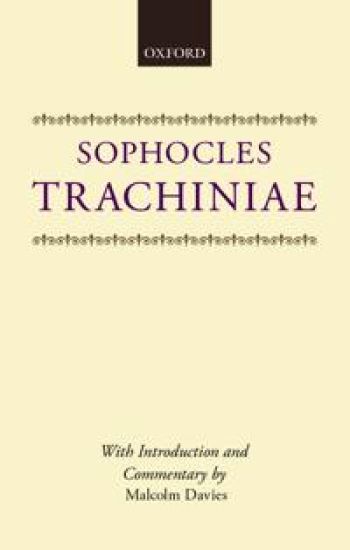
Trachiniae

Trachiniae

Sophocles

Oxford University Press
1991
sidottu
Sophocles' Trachiniae (`Women of Trachis') is named after the chorus of this tragedy which is concerned with the innocent and ill-fated attempt of Deianeira to win back her husband Heracles after he has sacked the city of Oechalia and fallen in love with the daughter of the defeated king. Over the years, the play has suffered sustained criticism because of the difficulties it presents of reconciling the plot, language, and characterization with Sophocles' other works. Recently, however, much work has been done to achieve a better understanding of the play in isolation and to increase modern regard for it. In a thought-provoking introduction, Dr Davies discusses the merits of the play, the question of its unity, its treatment of the hero Heracles, the story's pre-sophoclean tradition, and the evidence of contemporary art. In the commentary itself he discusses textual problems that arise from a frequently corrupt and uncertain text, as well as wider issues of interpretation. the text which is reproduced and presupposed in the commentary is the recently established Oxford Classical Text of Lloyd-Jones and Wilson
Elektra: Play

Elektra: Play

Sophocles

NEW DIRECTIONS PUBLISHING CORPORATION
1990
nidottu
Early in 1949, while under indictment for treason and hospitalized by court order at St. Elizabeths Hospital in Washington, D.C., Ezra Pound collaborated with Rudd Fleming, a professor at the University of Maryland, on a new version of Sophokles' Elektra. Pound's decision to focus on this play of imprisonment and justice at such a crucial juncture in his own life and art throws both the play and the poet into stark and ironic relief. Rediscovered and finally produced to great acclaim in 1987 by New York's Classic Stage Company, the Pound/Fleming translation of Elektra is now available in an acting edition prepared by the CSC Repertory's artistic director. Carey Perloff says of the translation: "It is energetic, slightly outrageous, and very American .... It's very chiseled, very spare, not flowing or lyrical. It's sort of 'cowboy.' But line for line, it is Sophokles." Ms. Perloff also gives suggestions for staging and casting which will be invaluable to other producers and directors.
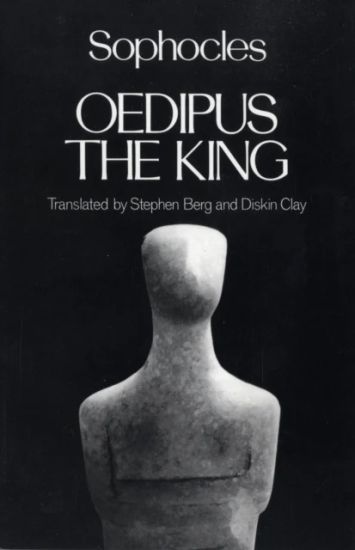
Oedipus The King

Oedipus The King

Sophocles

Oxford University Press Inc
1989
nidottu
In this highly-acclaimed translation of the most famous of all Greek tragedies, Stephen Berg – a well-known poet – and Diskin Clay – a distinguished classicist – combine their talents to produce a powerful version of Sophocles' timeless work. The volume also contains a critical introduction, commentary on difficult passages, stage directions, and glossaries of myythical and geographical terms.
The Theban Plays

The Theban Plays

Sophocles

Penguin Classics
1973
pokkari
King Oedipus/Oedipus at Colonus/AntigoneThree towering works of Greek tragedy depicting the inexorable downfall of a doomed royal dynastyThe legends surrounding the house of Thebes inspired Sophocles to create this powerful trilogy about humanity's struggle against fate. King Oedipus is the devastating portrayal of a ruler who brings pestilence to Thebes for crimes he does not realize he has committed and then inflicts a brutal punishment upon himself. Oedipus at Colonus provides a fitting conclusion to the life of the aged and blinded king, while Antigone depicts the fall of the next generation, through the conflict between a young woman ruled by her conscience and a king too confident of his own authority.Translated with an Introduction by E. F. WATLING
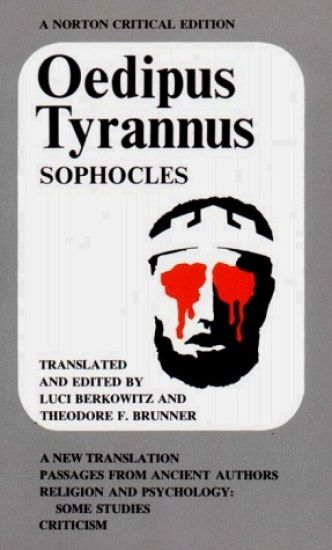
Oedipus Tyrannus

Oedipus Tyrannus

Sophocles

WW Norton Co
1970
nidottu
The text is accompanied by a wealth of carefully chosen background materials and essays. "Passages from Ancient Authors" includes selections from Homer's Odyssey, Thucydides' account of the plague, and Euripedes' Phoenissae. The best of ancient and modern criticism is represented, encouraging discussion from psychological, religious, anthropological, dramatic, and literary perspectives. Under the heading "Religion and Psychology" are included writings on the Oedipus myth by Martin P. Nilsson, Meyer Fortes, Gordon M. Kirkwood, Thalia Phillies Feldman, and Sigmund Freud. The authors of the selections in "Criticism" are Aristotle, C. M. Bowra, R. C. Jebb, S. M. Adams, A. J. A. Waldock, Albin Lesky, Werner Jaeger, Friedrich Nietzsche, John Jones, D. W. Lucas, Bernard M. W. Knox, Cedric H. Whitman, Richmond Lattimore, Robert Cohen, Francis Fergusson, and H. D. F. Kitto. The special question of Oedipus's guilt or innocence is addressed in essays by J. T. Sheppard, Laszlo Versenyi, P. H. Vellacott, E. R. Dodds, Thomas Gould, and Philip Wheelwright.