Kirjojen hintavertailu. Mukana 12 595 353 kirjaa ja 12 kauppaa.

Kirjailija

Soubhik Chakraborty

Kirjat ja teokset yhdessä paikassa: 18 kirjaa, julkaisuja vuosilta 2010-2024, suosituimpien joukossa Signal Analysis of Hindustani Classical Music. Vertaile teosten hintoja ja tarkista saatavuus suomalaisista kirjakaupoista.

18 kirjaa

Kirjojen julkaisuhaarukka 2010-2024.

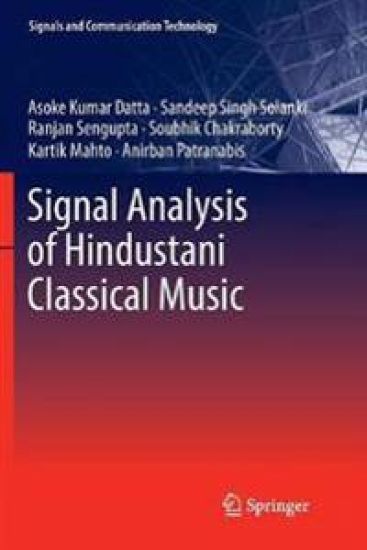
Signal Analysis of Hindustani Classical Music

Signal Analysis of Hindustani Classical Music

Asoke Kumar Datta; Sandeep Singh Solanki; Ranjan Sengupta; Soubhik Chakraborty; Kartik Mahto; Anirban Patranabis

Springer Verlag, Singapore
2018
nidottu
This book presents a comprehensive overview of the basics of Hindustani music and the associated signal analysis and technological developments. It begins with an in-depth introduction to musical signal analysis and its current applications, and then moves on to a detailed discussion of the features involved in understanding the musical meaning of the signal in the context of Hindustani music. The components consist of tones, shruti, scales, pitch duration and stability, raga, gharana and musical instruments. The book covers the various technological developments in this field, supplemented with a number of case studies and their analysis. The book offers new music researchers essential insights into the use the automatic concept for finding and testing the musical features for their applications. Intended primarily for postgraduate and PhD students working in the area of scientific research on Hindustani music, as well as other genres where the concepts are applicable, it is also a valuable resource for professionals and researchers in musical signal processing.
Signal Analysis of Hindustani Classical Music

Signal Analysis of Hindustani Classical Music

Asoke Kumar Datta; Sandeep Singh Solanki; Ranjan Sengupta; Soubhik Chakraborty; Kartik Mahto; Anirban Patranabis

Springer Verlag, Singapore
2017
sidottu
This book presents a comprehensive overview of the basics of Hindustani music and the associated signal analysis and technological developments. It begins with an in-depth introduction to musical signal analysis and its current applications, and then moves on to a detailed discussion of the features involved in understanding the musical meaning of the signal in the context of Hindustani music. The components consist of tones, shruti, scales, pitch duration and stability, raga, gharana and musical instruments. The book covers the various technological developments in this field, supplemented with a number of case studies and their analysis. The book offers new music researchers essential insights into the use the automatic concept for finding and testing the musical features for their applications. Intended primarily for postgraduate and PhD students working in the area of scientific research on Hindustani music, as well as other genres where the concepts are applicable, it is also a valuable resource for professionals and researchers in musical signal processing.

Outlier Detection Using Power Mean

Outlier Detection Using Power Mean

Soubhik Chakraborty; Medhika Kumari

Eliva Press
2023
pokkari
Outliers have been regarded as the noisy data in statistics which have now turned out to be an important problem and are now been researched in diverse fields and application domains. Outlier detection has been in core interest of not only the statisticians but all the professionals who are working on a particular data set. Many outlier detection techniques have been developed specific to certain application domains, while some techniques are more generic. This work has added one more technique to the bucket list of all those professionals. Power mean which has been used as a general method to calculate various means like arithmetic mean (power mean with power 1), geometric mean (power mean with power 0), Lorentz mean (power mean with power 1/3) etc. can also be used to detect the sensitivity of the data towards being the outlier. This work studies various powers of power mean for outlier detection. It contains two different data sets, one containing fractions and the other integers. The results have been verified by the existing standard techniques of outlier detection. Thus this book contains description of detecting outliers using power mean with different types of data sets, graphs and figures for better understanding. The idea is to check the efficacy of the method using a data set in which the outlier or the anomaly is already known and then testing the same method for a data set in which the outliers are not known to us. The open research issues and challenges at the end will provide researchers a clear path for the future of outlier detection methods. The book would be useful for practitioners of applied statistics and data analysts.
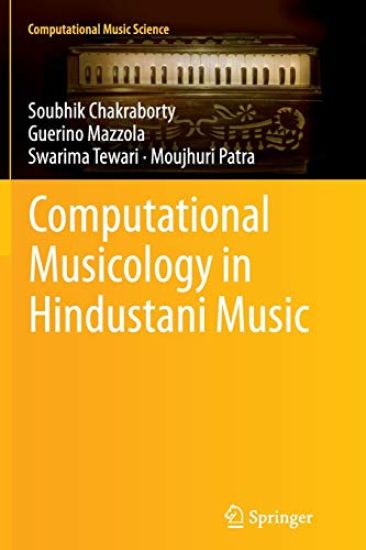
Computational Musicology in Hindustani Music

Computational Musicology in Hindustani Music

Soubhik Chakraborty; Guerino Mazzola; Swarima Tewari; Moujhuri Patra

Springer International Publishing AG
2016
nidottu
The book opens with a short introduction to Indian music, in particular classical Hindustani music, followed by a chapter on the role of statistics in computational musicology. The authors then show how to analyze musical structure using Rubato, the music software package for statistical analysis, in particular addressing modeling, melodic similarity and lengths, and entropy analysis; they then show how to analyze musical performance. Finally, they explain how the concept of seminatural composition can help a music composer to obtain the opening line of a raga-based song using Monte Carlo simulation. The book will be of interest to musicians and musicologists, particularly those engaged with Indian music.
Computational Musicology in Hindustani Music

Computational Musicology in Hindustani Music

Soubhik Chakraborty; Guerino Mazzola; Swarima Tewari; Moujhuri Patra

Springer International Publishing AG
2014
sidottu
The book opens with a short introduction to Indian music, in particular classical Hindustani music, followed by a chapter on the role of statistics in computational musicology. The authors then show how to analyze musical structure using Rubato, the music software package for statistical analysis, in particular addressing modeling, melodic similarity and lengths, and entropy analysis; they then show how to analyze musical performance. Finally, they explain how the concept of seminatural composition can help a music composer to obtain the opening line of a raga-based song using Monte Carlo simulation. The book will be of interest to musicians and musicologists, particularly those engaged with Indian music.