Kirjojen hintavertailu. Mukana 12 657 676 kirjaa ja 12 kauppaa.

Kirjailija

Soumyajit Mukherjee

Kirjat ja teokset yhdessä paikassa: 14 kirjaa, julkaisuja vuosilta 2013-2025, suosituimpien joukossa Structural Geological Atlas. Vertaile teosten hintoja ja tarkista saatavuus suomalaisista kirjakaupoista.

14 kirjaa

Kirjojen julkaisuhaarukka 2013-2025.

Rift and Drift Episodes of Western India since the Mesozoic Era

Rift and Drift Episodes of Western India since the Mesozoic Era

Swagato Dasgupta; Soumyajit Mukherjee

ELSEVIER SCIENCE PUBLISHING CO INC
2025
nidottu
Rift and Drift Episodes of Western India since the Mesozoic Era: Outcrop-Based Analyses, Volume Seven covers the architecture and tectonics of volcanic passive margin of the Indian west coast, as well as on the Deccan Large Igneous Province. Detailed understanding of tectonic evolution and stress regimes of western Indian basins is necessary to this research. As such, this book aims to provide a tectonic framework, structural history and paleostress regimes of the following rift basins of Indian western margin based on outcrop-study: (i) Jaisalmer, (ii) Bikaner- Nagaur, (iii) Barmer, (iv) Cambay and (v) Kutch. The tectonic linkage amongst these basins and with the Indian west coast will also be covered. The Mesozoic and Tertiary basins of western Indian margin have special importance in terms of their genesis and tectonic evolution. Mesozoic stratigraphy has been identified in Jaisalmer, Kutch and Barmer basins. These basins initiated as intra-cratonic rift basins during Gondwana. Episodic rifting of Africa and India resulting in separation and drifting of the Indian plate during Late Gondwana (Jurassic to Early Cretaceous), developed these basins. Inheritance of pre-existing structures played a key role in basin evolution. The Cambay and the Tertiary rifting of Barmer basin was a consequence of oblique rifting between the Seychelles micro-continent and the Indian plate, having extension direction trending ~NE.

Crustal Channel Flow Kinematics and Examples

Crustal Channel Flow Kinematics and Examples

Soumyajit Mukherjee

Springer International Publishing AG
2024
sidottu
Since the landmark paper by the Dalhousie University research group (2001, Nature) on coupled thermal–mechanical channel flow extrusion of the Higher Himalaya, there has been an intense debate on the validity and modifications of this extrusion mechanism. To understand this important ductile deformation process, one needs to grasp its fluid mechanical foundation. However, for the sake of brevity, research papers present key equations and not their detail derivations. To fill the gap, this book starts with basic fluid mechanics of channel flow and explains their ‘working principles’ by solving a number of problems. It also summarizes our current understanding of the mountain building processes related to channel flow. The book uses an easy language to help non-specialists and undergraduate students. It will be an ideal book for those geoscientists with little mathematical background who need to deal with this deformation mechanism in their research work.
Understanding Pore Space through Log Measurements

Understanding Pore Space through Log Measurements

K. Meenakshi Sundaram; Soumyajit Mukherjee

ELSEVIER SCIENCE TECHNOLOGY
2022
nidottu
This book Understanding Pore Space through Log Measurements deals with porosity, insight on pore shape connectedness, grain size, grain aspect ratio, permeability etc. Most of the published literature is focused on permeability from log measurements and log analytic techniques for porosity and fluid saturation determination. On the other hand, this book aims at looking at porosity distribution, pore shape, and pore connectedness using log measurements and thus bringing pore space into focus. A compilation of available knowledge from this perspective will lead the reader to better understanding of reservoir characterization takeaways, which exploration and exploitation managers and workers will be looking for.
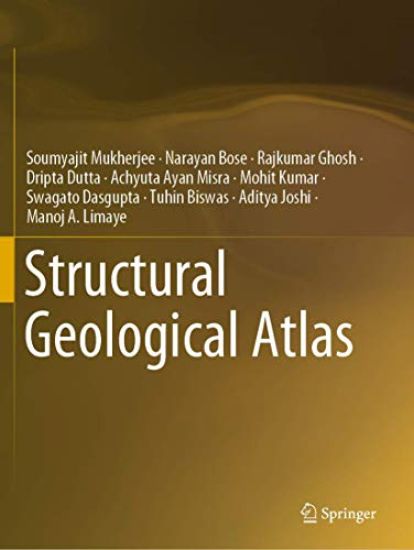
Structural Geological Atlas

Structural Geological Atlas

Soumyajit Mukherjee; Narayan Bose; Rajkumar Ghosh; Dripta Dutta; Achyuta Ayan Misra; Mohit Kumar; Swagato Dasgupta; Tuhin Biswas; Aditya Joshi; Manoj A. Limaye

Springer Verlag, Singapore
2021
nidottu
This book presents more than 600 eye-catching structural geological photographs and explanatory descriptions, from different Indian terrains. This book will enable easy identification of deformation features, one of the most important tasks in structural geology at the meso- and micro-scales. The book focuses on ductile and brittle shear sense indicators. This book suits for the undergraduate and graduate geoscience students. The book will be of considerable interest to tectonicians and structural geologists, given the enormous international importance of Indian terrains for exploration and other purposes.
Sediment Compaction and Applications in Petroleum Geoscience

Sediment Compaction and Applications in Petroleum Geoscience

Troyee Dasgupta; Soumyajit Mukherjee

Springer Nature Switzerland AG
2020
nidottu
This book discusses how sediments compact with depth and applications of the compaction trends. Porosity reduction in sediment conveniently indicates the degree of sediments compacted after deposition. Published empirical curves- the compaction curves- are depth-wise porosity variation through which change in pore spaces from sediment surface to deeper depths e.g. up to 6 km can be delineated. Porosity is derived from well logs. Compaction curves, referred to as the Normal Porosity Profile of shales, sandstones and shale bearing sandstones of different models are reviewed along with the different mechanical and chemical compaction processes. These compaction models reveals how porosity reduces depth-wise and the probable reason for anomalous zones. Deviation from these normal compaction trends may indicate abnormal pressure scenarios: either over- or under pressure. We highlight global examples of abnormal pressure scenarios along with the different primary- and secondary mechanisms. Well logs and cores being the direct measurements of porosity, well log is the only cost-effective way to determine porosity of subsurface rocks. Certain well logs can detect overpressure and the preference of one log above the other helps reduce the uncertainty. Apart from delineation of under-compacted zones by comparing the modeled- with the actual compaction, porosity data can also estimate erosion.
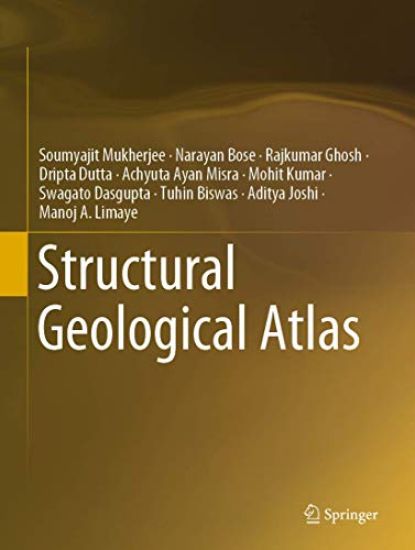
Structural Geological Atlas

Structural Geological Atlas

Soumyajit Mukherjee; Narayan Bose; Rajkumar Ghosh; Dripta Dutta; Achyuta Ayan Misra; Mohit Kumar; Swagato Dasgupta; Tuhin Biswas; Aditya Joshi; Manoj A. Limaye

Springer Verlag, Singapore
2019
sidottu
This book presents more than 600 eye-catching structural geological photographs and explanatory descriptions, from different Indian terrains. This book will enable easy identification of deformation features, one of the most important tasks in structural geology at the meso- and micro-scales. The book focuses on ductile and brittle shear sense indicators. This book suits for the undergraduate and graduate geoscience students. The book will be of considerable interest to tectonicians and structural geologists, given the enormous international importance of Indian terrains for exploration and other purposes.
Sediment Compaction and Applications in Petroleum Geoscience

Sediment Compaction and Applications in Petroleum Geoscience

Troyee Dasgupta; Soumyajit Mukherjee

Springer Nature Switzerland AG
2019
sidottu
This book discusses how sediments compact with depth and applications of the compaction trends. Porosity reduction in sediment conveniently indicates the degree of sediments compacted after deposition. Published empirical curves- the compaction curves- are depth-wise porosity variation through which change in pore spaces from sediment surface to deeper depths e.g. up to 6 km can be delineated. Porosity is derived from well logs. Compaction curves, referred to as the Normal Porosity Profile of shales, sandstones and shale bearing sandstones of different models are reviewed along with the different mechanical and chemical compaction processes. These compaction models reveals how porosity reduces depth-wise and the probable reason for anomalous zones. Deviation from these normal compaction trends may indicate abnormal pressure scenarios: either over- or under pressure. We highlight global examples of abnormal pressure scenarios along with the different primary- and secondary mechanisms. Well logs and cores being the direct measurements of porosity, well log is the only cost-effective way to determine porosity of subsurface rocks. Certain well logs can detect overpressure and the preference of one log above the other helps reduce the uncertainty. Apart from delineation of under-compacted zones by comparing the modeled- with the actual compaction, porosity data can also estimate erosion.
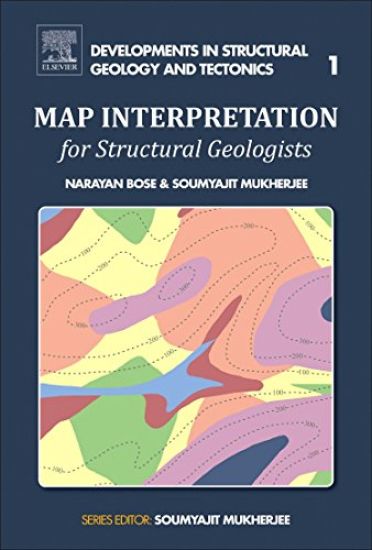
Map Interpretation for Structural Geologists

Map Interpretation for Structural Geologists

Narayan Bose; Soumyajit Mukherjee

Elsevier Science Publishing Co Inc
2017
nidottu
Map Interpretation for Structural Geologists covers various topics, from deciphering topography using contour patterns to interpreting folds, faults, unconformities and dykes. By interpreting several types of maps, this book gives readers the confidence to solve difficult geologic questions related to map interpretation in the classroom and in the field. Interpreting geological and structural maps is an inseparable part of learning structural geology in the undergraduate curriculum and postgraduate development.
Deformation Microstructures in Rocks

Deformation Microstructures in Rocks

Soumyajit Mukherjee

Springer-Verlag Berlin and Heidelberg GmbH Co. K
2017
nidottu
Study of microstructures is an indispensable component of understanding structural geology of any terrain. A number of ‘new’ microscopic structures such as ‘flanking microstructures’, trapezoid-shaped mineral grains, reversal of ductile shear sense, micro-duplexes, V-pull aparts, and new minerals nucleating inside host minerals have recently been described in individual manuscripts. However, for the sake of brevity, microstructural papers cannot show all possible variation in their morphology. The proposed book aims to present these structures with attractive colour photographs. Each photomicrograph will have a comprehensive caption. The book also presents grain boundary migration, boudins, symptoms of metamorphic retrogression, and how well known shear sense indicators (S-C fabrics, mineral fish etc.) vary in morphology in serial-sections. The target audience is for graduate and postgraduate geosciences students and researchers of structural geology.
Atlas of Shear Zone Structures in Meso-scale

Atlas of Shear Zone Structures in Meso-scale

Soumyajit Mukherjee

Springer International Publishing AG
2016
nidottu
Study of structures associated with shear zones is a crucial aspect to understand the deformation mechanism associated with such zones. Shear zones have been emphasized since it will lead to many latest applied studies such as radioactive waste disposal, groundwater flow etc. For the sake of brevity, research papers cannot show all possible variation in structures found in shear zones. The proposed book aims to present some of these structures in great details with attractive colour photographs. Each photograph will have a comprehensive caption.
Ductile Shear Zones

Ductile Shear Zones

Soumyajit Mukherjee; Kieran F. Mulchrone

John Wiley Sons Inc
2015
sidottu
The elucidation of the mechanisms and kinematics of shear zone deformation, at both local and regional scales, is the subject of a great deal of interest to scientists in the hydrocarbon industry, in seismology, and in structural geology more generally. This book comprises a collection of five theoretical and twelve regional contributions to the subject from a number of leading researchers in the field, with particular emphasis on work carried out in the Indian subcontinent. The book will be invaluable to advances students and researchers involved in the kinematics of shear.
Tectonic Inheritance in Continental Rifts and Passive Margins

Tectonic Inheritance in Continental Rifts and Passive Margins

Achyuta Ayan Misra; Soumyajit Mukherjee

Springer International Publishing AG
2015
nidottu
This work reviews the mechanism of rifting with a focus on pre-existing tectonic weaknesses in pre-rift and/or basement rocks, i.e., on tectonic inheritance. The passive margins that are studied in this book are the Norwegian Continental Shelf, the Eastern North America and the East and West Indian Continental Margins. The continental rifts that have been analysed are the East African Rift System, the Brazilian Continental Rift Systems and the European Cenozoic Rift System. It states how rifts and passive margins serve as valuable locations for hydrocarbon exploration. Tectonic inheritance/heritage examines the influence of pre-existing/pre-rift elements on the geometry, genesis and propagation of rift-related faults. Such elements include anisotropies in the shallow crustal levels, as well as the rheology of the lithosphere. Inheritance greatly influences the architecture of rifted passive margins including the attitude of faults and geometry of horsts, (half-) grabens, transfer zones etc. Inheritance is also a determining factor in the width of rifts and rift shoulder topography.
Atlas of Shear Zone Structures in Meso-scale

Atlas of Shear Zone Structures in Meso-scale

Soumyajit Mukherjee

Springer International Publishing AG
2013
sidottu
Study of structures associated with shear zones is a crucial aspect to understand the deformation mechanism associated with such zones. Shear zones have been emphasized since it will lead to many latest applied studies such as radioactive waste disposal, groundwater flow etc. For the sake of brevity, research papers cannot show all possible variation in structures found in shear zones. The proposed book aims to present some of these structures in great details with attractive colour photographs. Each photograph will have a comprehensive caption.
Deformation Microstructures in Rocks

Deformation Microstructures in Rocks

Soumyajit Mukherjee

Springer-Verlag Berlin and Heidelberg GmbH Co. K
2013
sidottu
Study of microstructures is an indispensable component of understanding structural geology of any terrain. A number of ‘new’ microscopic structures such as ‘flanking microstructures’, trapezoid-shaped mineral grains, reversal of ductile shear sense, micro-duplexes, V-pull aparts, and new minerals nucleating inside host minerals have recently been described in individual manuscripts. However, for the sake of brevity, microstructural papers cannot show all possible variation in their morphology. The proposed book aims to present these structures with attractive colour photographs. Each photomicrograph will have a comprehensive caption. The book also presents grain boundary migration, boudins, symptoms of metamorphic retrogression, and how well known shear sense indicators (S-C fabrics, mineral fish etc.) vary in morphology in serial-sections. The target audience is for graduate and postgraduate geosciences students and researchers of structural geology.