Kirjailija
Srikant Sarangi
Kirjat ja teokset yhdessä paikassa: 12 kirjaa, julkaisuja vuosilta 2003-2026, suosituimpien joukossa Teamwork and Team Talk. Vertaile teosten hintoja ja tarkista saatavuus suomalaisista kirjakaupoista.
12 kirjaa
Kirjojen julkaisuhaarukka 2003-2026.
Decision-making in institutional and professional settings has remained an area of curiosity for social science and communication researchers. This first-of-its-kind edited volume demonstrates how team talk and teamwork are paramount to decision-making in workplaces. In contemporary Western societies, the conditions of decision-making are rapidly changing with the foregrounding of division of professional labour and distributed expertise against the backdrop of a client-centred ideology that legitimizes shared decision-making. Increasingly, in health and social care settings, key decisions concerning clients are arrived at in team meetings, which have consequences both for the decisional processes and outcomes. This book argues that team-based decision-making can be studied optimally at the interactional level within an institutional backdrop. The contributors of Teamwork and Team Talk select particular sites of teamwork and team talk and adopt different analytical frameworks within the qualitative research paradigm to explore specific talk–work configurations. Like an orchestra, the division of interactional labour seems distributed and coordinated along the lines of role-responsibilities. Bringing together empirically grounded studies focusing on how team talk and teamwork are paramount for problem formulation, generation of options, assessment of solutions and more, the team of global contributors brings to light the tensions, benefits, and complexities inherent to these processes.

Communicative Contingencies in Handling Emergency Medical Calls
Srikant Sarangi
UNIVERSITY OF TORONTO PRESS
2025
pokkari
Calls to emergency medical services are primarily a telephone-mediated communicative activity, where detailed critical information is exchanged through an elaborate series of questions and answers. Although, on the surface, it may seem a routine information-exchange activity, the framing of questions and how they are responded to and followed up in the absence of any visible cues are filled with communicative contingencies, requiring fast-thinking professional judgment. The core focus of humanities and medicine scholar Srikant Sarangi’s work is to unpack these nuanced communicative contingencies underpinning decision-making from a language/interaction perspective. In adopting the activity-type analytical framework to identify the various linguistic and interactional features of telephone-mediated emergency medical calls and their rhetorical potential, the book explores how the different elicited and volunteered information trajectories vis-à-vis instruction and advice formats constitute the basis of risk assessments and decisions regarding dispatch of help. Drawing on a comprehensive database of telephone calls about breathlessness (comprising 400 call transcripts from two regions in Denmark), the book highlights caller type as a significant variable in the communication process. In essence, during the emergency medical calls, the call-taker handles not only factual information in an algorithmic, scripted manner against established criteria but also the caller type as part of the emergent communicative contingencies. In addition to delineating the general interaction trajectories across the dataset, of the six caller types identified, the analysis focuses on three types – patient, spouse/partner, and professional carer – and each type receives case-study length treatment. The key findings of Communicative Contingencies in Handling Emergency Medical Calls lead to the formulation of a set of practical guidelines for the training of professional practitioners and for raising awareness among caller types.
Communicative Contingencies in Handling Emergency Medical Calls
Srikant Sarangi
UNIVERSITY OF TORONTO PRESS
2025
pokkari
Calls to emergency medical services are primarily a telephone-mediated communicative activity, where detailed critical information is exchanged through an elaborate series of questions and answers. Although, on the surface, it may seem a routine information-exchange activity, the framing of questions and how they are responded to and followed up in the absence of any visible cues are filled with communicative contingencies, requiring fast-thinking professional judgment. The core focus of humanities and medicine scholar Srikant Sarangi’s work is to unpack these nuanced communicative contingencies underpinning decision-making from a language/interaction perspective. In adopting the activity-type analytical framework to identify the various linguistic and interactional features of telephone-mediated emergency medical calls and their rhetorical potential, the book explores how the different elicited and volunteered information trajectories vis-à-vis instruction and advice formats constitute the basis of risk assessments and decisions regarding dispatch of help. Drawing on a comprehensive database of telephone calls about breathlessness (comprising 400 call transcripts from two regions in Denmark), the book highlights caller type as a significant variable in the communication process. In essence, during the emergency medical calls, the call-taker handles not only factual information in an algorithmic, scripted manner against established criteria but also the caller type as part of the emergent communicative contingencies. In addition to delineating the general interaction trajectories across the dataset, of the six caller types identified, the analysis focuses on three types – patient, spouse/partner, and professional carer – and each type receives case-study length treatment. The key findings of Communicative Contingencies in Handling Emergency Medical Calls lead to the formulation of a set of practical guidelines for the training of professional practitioners and for raising awareness among caller types.
Interpreter-Mediated Healthcare Communication engages conceptually and empirically with the ongoing debate concerning the ‘influence’ occasioned by the participation of an interpreter – whether professionally trained or as a lay family member – in healthcare delivery. Healthcare delivery, especially in the primary care sector, is increasingly becoming multicultural and multilingual in character. This global reality manifests itself as a communicative challenge in interpreter-mediated healthcare consultations, involving professional as well as family members in the role of interpreters. In the context of this book (previously published as a special issue of the journal Communication & Medicine), interpreter-mediated healthcare consultations are seen simultaneously as multilingual and multiparty interactions, as well as being dyadic and triadic communication. The introductory editorial sets the scene by foregrounding the core notion of ‘communicative vulnerability’ of all participants – the care recipient, the healthcare provider and the interpreter – in relation to the emergent interactional subtleties at the spheres of participation and interaction. In addition to the ‘brought along’ communicative vulnerability of the participants, the interactional trajectory itself, iteratively, contributes to such vulnerability at the contingent level. Especially, the interpreter routinely shifts between ‘just being a linguistic/literal medium/conduit’ to ‘strategically being a communicative mediator/broker’, potentially influencing the processes and outcomes of a given healthcare encounter. The contributors to the volume, representing different parts of the world (Australia, Italy, The Netherlands, Sweden, UK and USA), address, in different ways, the complexities surrounding the concepts of ‘participation’, ‘mediation’ and ‘shifts in roles/frames/footings’ and their interactional manifestation/consequence. As the empirical studies illustrate, the interpreters – professional or otherwise – position themselves actively in the interaction as their roles and participation formats become situationally and culturally embedded, albeit in varying degrees in different phases of the consultation. The contributions engage along a variety of axes as far as the data settings are concerned – professional vs lay interpreters, primary vs. tertiary healthcare setting and low-stake vs. high-stake encounters. The issues raised in the book – albeit dealing mainly within the confines of the western healthcare landscape – point in the direction of how ‘communicative vulnerability’ may be heightened in relation to the currently dominant paradigms of patient-centredness, patient autonomy and shared decision making.
This collection brings together for the first time in a single volume many of the major figures in contemporary discourse studies. Each chapter is an original contribution which has been specifically commissioned for this book, and together they document the wide range of concerns and techniques which characterise the discipline at the turn of the century.Discourse and Social Life is concerned with a variety of different types of data - talk, text and interaction - and covers research sites which range from the home setting through the health care setting and the courtroom to the public sphere. The book not only provides a critical, historical overview of different traditions of discourse analysis, but also projects to some extent the possible developments of this field of study, as other allied disciplines (Philosophy, Psychology, Sociology, Rhetoric and Communication Studies) are taking a discursive turn. Readers are invited to draw parallels between these different approaches to studying discourse in its social context. The contributors are- Sally Candlin, Malcolm Coulthard, Justine Coupland, Nikolas Coupland, Norman Fairclough, Ruqaiya Hasan, Robert Kaplan, Geoff Leech, Yon Maley, Greg Myers, Celia Roberts, Srikant Sarangi, Ron Scollon, Theo van Leeuwen, Henry Widdowson and Ruth Wodak.
Sociolinguistics and Social Theory
Nikolas Coupland; Srikant Sarangi; Christopher N. Candlin
Routledge
2016
sidottu
The empirical and descriptive strengths of sociolinguistics, developed over more than 40 years of research, have not been matched by an active engagement with theory. Yet, over this time, social theorising has taken important new turns, linked in many ways to linguistic and discursive concerns. Sociolinguistics and Social Theory is the first book to explore the interface between sociolinguistic analysis and modern social theory. The book sets out to reunite sociolinguistics with the concepts and perspectives of several of the most influential modern theorists of society and social action, including Bakhtin, Foucault, Habermas, Sacks, Goffman, Bourdieu and Giddens. In eleven newly commissioned chapters, leading sociolinguists reappraise the theoretical framing of their research, reaching out beyond conventional limits. The authors propose significant new orientations to key sociolinguistic themes, including- - social motivations for language variation and change- language, power and authority- language and ageing- language, race and class- language planningIn substantial introductory and concluding chapters, the editors and invited discussants reassess the boundaries of sociolinguistic theory and the priorities of sociolinguistic methods. Sociolinguistics and Social Theory encourages students and researchers of sociolinguistics to be more reflexively aware and critical of the social bases of their analyses and invites a reasessment of the place sociolinguistics occupies in the social sciences generally.
Language, Bureaucracy and Social Control explores the varying inter-relationships between language, forms of bureaucratic organisation and social control. The text provides a detailed examination of the discursive dimensions of some of the key techniques of modern power: the 'productive' surveillance practices of administrative and public service institutions. Special attention is paid to recent developments within the state domain and the private economy such as the introduction of consumerism and promotional practices in welfare institutions, and the spread of bureaucratisation in contexts such as banking and education.
Advances in molecular genetics have led to the increasing availability of genetic testing for a variety of inherited disorders. While this new knowledge presents many obvious health benefits to prospective individuals and their families it also raises complex ethical and moral dilemmas for families as well as genetic professionals. This book explores the ways in which genetic testing generates not only probabilities of potential futures, but also enjoys new forms of social, individual and professional responsibility. Concerns about confidentiality and informed consent involving children, the assessment of competence and maturity, the ability to engage in shared decision-making through acts of disclosure and choice, are just some of the issues that are examined in detail.
Language Practices in Social Work
Christopher Hall; Stefaan Slembrouck; Srikant Sarangi
Routledge
2006
sidottu
Analysis of language and discourse in social sciences has become increasingly popular over the past thirty years. Only very recently has it been applied to the study of social work, despite the fact that communication and language are central to social work practice. This book looks at how social workers, their clients and other professionals categorise and manage the problems of social work in ways which are rendered understandable, accountable and which justify professional intervention. Features include:studies of key practice areas in social work, such as interviews, case conferences, home visitsanalysis of the language and construction used in typical case studies of everyday social work practice exploration of the ways in which professionals can examine their own practice and uncover the discursive, narrative and rhetorical methods that they use. The purpose of this engaging study is to increase awareness of language and discourse in order to help develop better practice in social work. It is essential reading for professionals in social work, child welfare and the human services and will be a valuable contribution to the study of professional language and communication.
Language Practices in Social Work
Christopher Hall; Stefaan Slembrouck; Srikant Sarangi
Routledge
2006
nidottu
Analysis of language and discourse in social sciences has become increasingly popular over the past thirty years. Only very recently has it been applied to the study of social work, despite the fact that communication and language are central to social work practice. This book looks at how social workers, their clients and other professionals categorise and manage the problems of social work in ways which are rendered understandable, accountable and which justify professional intervention. Features include:studies of key practice areas in social work, such as interviews, case conferences, home visitsanalysis of the language and construction used in typical case studies of everyday social work practice exploration of the ways in which professionals can examine their own practice and uncover the discursive, narrative and rhetorical methods that they use. The purpose of this engaging study is to increase awareness of language and discourse in order to help develop better practice in social work. It is essential reading for professionals in social work, child welfare and the human services and will be a valuable contribution to the study of professional language and communication.
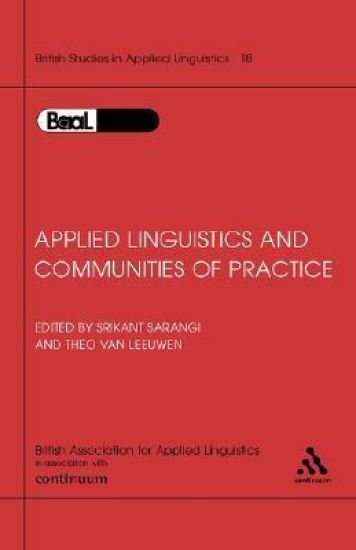
Applied Linguistics & Communities of Practice
Srikant Sarangi
Continuum International Publishing Group Ltd.
2003
nidottu
The papers in this volume, selected through peer-review from the presentations at the 2002 annual conference of the British Association for Applied Linguistics in Cardiff, demonstrate the strides applied linguists have taken, in 'pure' or 'impure' form, since the classic volume of Corder's Introducing Applied Linguistics speculated about the discipline's possible frontiers. Foundational questions of the following kind form the backbone of the volume: 'Is applied linguistics applied enough?'; 'Can applied linguists go where no linguists have been before?'; 'Do applied linguists belong to one community of practice or do they constitute a community of communities?'; 'On a cost-benefit scale, how can applied linguists gain communality across interdisciplinary initiatives while not losing their disciplinary autonomy?'. With a judicious combination of empirical, theoretical and policy-oriented studies, the volume takes a close, hard look at the present and future challenges. This is summed up in a call to arms for applied linguistics to become more practically relevant and reflexively grounded not only in addressing real world problems, but also in doing so collaboratively in a sustained way with practitioners involved. Srikant Sarangi is Director of the Communication Research Centre, Centre for Language and Communication at Cardiff University. Theo van Leeuwen is based at the Centre for Language and Communication, Cardiff University.