
Kirjojen hintavertailu. Mukana 12 595 353 kirjaa ja 12 kauppaa.

Kirjailija

Stacey M. Floyd-Thomas

Kirjat ja teokset yhdessä paikassa: 3 kirjaa, julkaisuja vuosilta 2016-2026, suosituimpien joukossa When the Good Life Goes Bad. Vertaile teosten hintoja ja tarkista saatavuus suomalaisista kirjakaupoista.

3 kirjaa

Kirjojen julkaisuhaarukka 2016-2026.

When the Good Life Goes Bad

When the Good Life Goes Bad

Stacey M. Floyd-Thomas; Michael Eric Dyson

UNIVERSITY OF ILLINOIS PRESS
2026
nidottu
The Seven Deadly Sins have become the seven markers of success in America. Lust, pride, greed, sloth, envy, gluttony, wrath—these once-condemned principles now guide people's pursuit of the good life. Stacey M. Floyd-Thomas examines how the Seven Deadly Sins have shaped the moral strivings and sociopolitical condition of American society and culture in the twenty-first century. Drawing on a multidimensional approach, Floyd-Thomas uses race, gender, class, and other lenses to break down the moral crises that define the American Dream. Her critique exposes the harm done by individual and collective practices of sexual objectification, capitalist materialism, wealth inequality, and technological hubris before pivoting to the rise of right-wing populism, white Christian nationalism, and the politics of cruelty. But Floyd-Thomas also proposes an ethic that emphasizes truth-telling, community engagement, and values rooted in humility, justice, and mercy—a new path for the US to overcome systemic oppression and create a more just society. Evocative and ambitious, When the Good Life Goes Bad takes readers on a wide-ranging journey through US life and culture to explain what corrupted the American dream.

When the Good Life Goes Bad

When the Good Life Goes Bad

Stacey M. Floyd-Thomas; Michael Eric Dyson

UNIVERSITY OF ILLINOIS PRESS
2026
sidottu
The Seven Deadly Sins have become the seven markers of success in America. Lust, pride, greed, sloth, envy, gluttony, wrath—these once-condemned principles now guide people's pursuit of the good life. Stacey M. Floyd-Thomas examines how the Seven Deadly Sins have shaped the moral strivings and sociopolitical condition of American society and culture in the twenty-first century. Drawing on a multidimensional approach, Floyd-Thomas uses race, gender, class, and other lenses to break down the moral crises that define the American Dream. Her critique exposes the harm done by individual and collective practices of sexual objectification, capitalist materialism, wealth inequality, and technological hubris before pivoting to the rise of right-wing populism, white Christian nationalism, and the politics of cruelty. But Floyd-Thomas also proposes an ethic that emphasizes truth-telling, community engagement, and values rooted in humility, justice, and mercy—a new path for the US to overcome systemic oppression and create a more just society. Evocative and ambitious, When the Good Life Goes Bad takes readers on a wide-ranging journey through US life and culture to explain what corrupted the American dream.
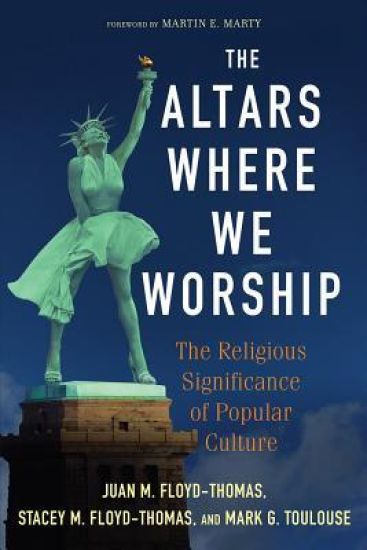
The Altars Where We Worship

The Altars Where We Worship

Juan M. Floyd-Thomas; Stacey M. Floyd-Thomas; Mark G. Toulouse

Westminster/John Knox Press,U.S.
2016
nidottu
While a large percentage of Americans claim religious identity, the number of Americans attending traditional worship services has significantly declined in recent decades. Where, then, are Americans finding meaning in their lives, if not in the context of traditional religion? In this provocative study, the authors argue that the objects of our attention have become our god and fulfilling our desires has become our religion. They examine the religious dimensions of six specific aspects of American culturebody and sex, big business, entertainment, politics, sports, and science and technologythat function as “altars� where Americans gather to worship and produce meaning for their lives. The Altars Where We Worship shows how these secular altars provide resources for understanding the self, others, and the world itself. “For better or worse,� the authors write, “we are faced with the reality that human experiences before these altars contain religious characteristics in common with experiences before more traditional altars.� Readers will come away with a clearer understanding of what religion is after exploring the thoroughly religious aspects of popular culture in the United States.