Kirjojen hintavertailu. Mukana 12 595 353 kirjaa ja 12 kauppaa.

Kirjailija

Stamatios N.-A. Souentie

Kirjat ja teokset yhdessä paikassa: 2 kirjaa, julkaisuja vuosilta 2012-2016, suosituimpien joukossa Gravity, Special Relativity, and the Strong Force. Vertaile teosten hintoja ja tarkista saatavuus suomalaisista kirjakaupoista.

2 kirjaa

Kirjojen julkaisuhaarukka 2012-2016.

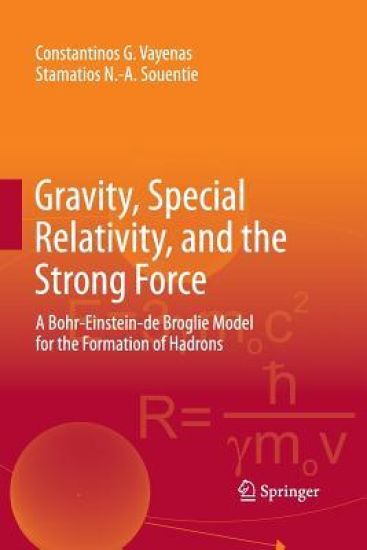
Gravity, Special Relativity, and the Strong Force

Gravity, Special Relativity, and the Strong Force

Constantinos G. Vayenas; Stamatios N.-A. Souentie

Springer-Verlag New York Inc.
2016
nidottu
This book shows that the strong interaction forces, which keep hadrons and nuclei together, are relativistic gravitational forces exerted between very small particles in the mass range of neutrinos. First, this book considers the motion of two or three charged particles under the influence of electrostatic and gravitational forces only, which shows that bound states are formed by following the same semi-classical methodology used by Bohr to describe the H atom. This approach is also coupled with Newton’s gravitational law and with Einstein’s special relativity. The results agree with experiments on the masses, binding energies, radii, angular moments and magnetic moments of hadrons. The model provides the means to rationalize all the main experimental features of the strong force. Some of the implications for the unification of forces and the nature of our micro-cosmos and macro-cosmos are also discussed. The creation of mass itself, in other words, of hadrons from particlesas light as neutrinos, can now be modeled in a straightforward manner.
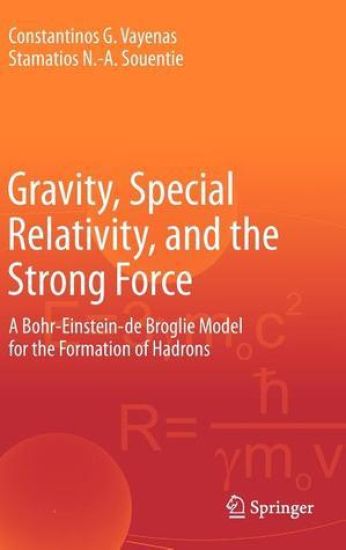
Gravity, Special Relativity, and the Strong Force

Gravity, Special Relativity, and the Strong Force

Constantinos G. Vayenas; Stamatios N.-A. Souentie

Springer-Verlag New York Inc.
2012
sidottu
This book shows that the strong interaction forces, which keep hadrons and nuclei together, are relativistic gravitational forces exerted between very small particles in the mass range of neutrinos. First, this book considers the motion of two or three charged particles under the influence of electrostatic and gravitational forces only, which shows that bound states are formed by following the same semi-classical methodology used by Bohr to describe the H atom. This approach is also coupled with Newton’s gravitational law and with Einstein’s special relativity. The results agree with experiments on the masses, binding energies, radii, angular moments and magnetic moments of hadrons. The model provides the means to rationalize all the main experimental features of the strong force. Some of the implications for the unification of forces and the nature of our micro-cosmos and macro-cosmos are also discussed. The creation of mass itself, in other words, of hadrons from particlesas light as neutrinos, can now be modeled in a straightforward manner.