Kirjojen hintavertailu. Mukana 12 595 353 kirjaa ja 12 kauppaa.

Kirjailija

Stanley E. Porter

Kirjat ja teokset yhdessä paikassa: 54 kirjaa, julkaisuja vuosilta 1970-2025, suosituimpien joukossa Method in Unit Delimitation. Vertaile teosten hintoja ja tarkista saatavuus suomalaisista kirjakaupoista.

Mukana myös kirjoitusasut: Stanley E Porter

54 kirjaa

Kirjojen julkaisuhaarukka 1970-2025.

Active Hermeneutics

Active Hermeneutics

Stanley E. Porter; Jason C. Robinson

Routledge
2020
sidottu
Hermeneutics, as a discipline of the humanities, is often assumed to be in thrall to the same subjectivity of every interpretive method, in direct contrast to the objectivity prized by the natural sciences. This book argues that there is a false dichotomy here, and that ancient and modern ideas of knowledge can be utilized to create a new active form of hermeneutics. One capable of creating a standard by which to judge better and worse models of understanding.This book explores decisive aspects over which the future of hermeneutics—a future inexplicably tied to a history of hermeneutics—will continue to struggle, namely the limits and possibilities of situated human understanding. This book is located in the middle of a number of major, converging discussions within contemporary intellectual discourse. Drawing upon a wide range of ancient and modern hermeneutical thought, including Aristotle, Bernstein, Heidegger, Kant, and Gadamer, the result is a hermeneutical approach that pushes beyond the traditional limits of human understanding. This is a bold attempt to move hermeneutics into a new phase. As such, it will be of significant interest to scholars and academics working in General Hermeneutics, Theology, and the Philosophy of Religion.
Fundamentals of New Testament Greek

Fundamentals of New Testament Greek

Stanley E Porter; Jeffrey T Reed; Matthew Brook O'Donnell

William B Eerdmans Publishing Co
2019
pokkari
"We know that this book works and will take students to a level not often achieved through other beginning textbooks." So say Stanley Porter and his coauthors in the preface to their Fundamentals of New Testament Greek -- an ambitious, comprehensive introduction to the grammar and vocabulary of the Greek New Testament. This first-year Greek textbook discusses all the forms and basic syntax of Koine Greek, complete with extensive paradigms, examples, and explanations. Porter, Reed, and O'Donnell's Fundamentals of New Testament Greek features pedagogically sound and linguistically informed techniques of language instruction. The volume introduces the individual words and grammatical details of Greek, sensitive to their frequency of use in the New Testament, reinforcing for students the elements that they will most often encounter. Grammatical forms, including the less common ones, are analyzed and explained in detail, often with illustrative examples from the Greek New Testament. The authors include complete paradigms and give numerous examples; the vocabulary list includes nearly one thousand words, which are introduced throughout the book's thirty chapters. Students who complete this text will be able to move directly into Greek exegesis courses and more advanced Greek-language courses. Fundamentals of New Testament Greek will prove invaluable for gaining a thorough foundational understanding of New Testament Greek, including full exposure to the formation, accenting, and semantics of its complex verbal system.
Moulton's Grammar of New Testament Greek

Moulton's Grammar of New Testament Greek

James Hope Moulton; Stanley E. Porter

T. T.Clark Ltd
2019
muu
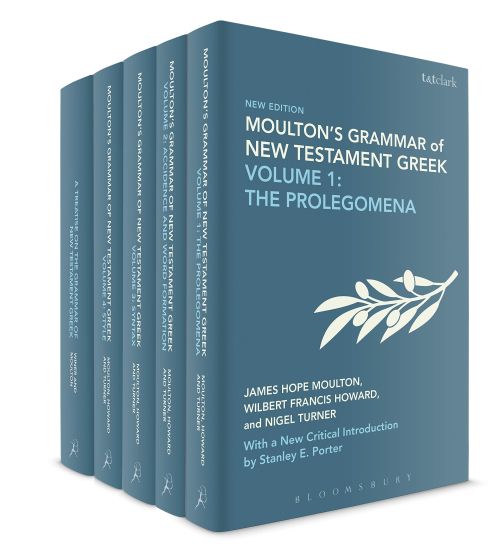
Now updated in a five-volume set this classic grammar of New Testament Greek, begun in 1906 by James Hope Moulton and completed by William Francis Howard, and Nigel Turner, and the supplementary volume by Moulton's father supplied with it, cover every aspect of the Greek language in the New Testament. With thought-provoking analysis and a multitude of invaluable charts and indices it continues to act as an invaluable resource for advanced students of New Testament Greek today. Each of the four volumes, and the 'Winer-Moulton' volume also included, features a lengthy critical introduction and bibliography by Stanley E. Porter, one of the leading scholars of New Testament Greek, who provides critical reflection on the style and approach used in this classic work, as well as a discussion of developments in the study of New Testament Greek over the last 40 years. Volume 1: The Prolegomena introduces foundational premises upon which the subsequent three volumes build, providing a sketch of the language of the New Testament. Volume 2: Accidence and Word-Formation deals with three essential components of New Testament Greek: sounds and writing, accidence (word inflection, noun declension, and verb conjugation), and word formation. Volume 3: Syntax focuses on the construction of a sentence. Divided into two parts, it begins with a detailed discussion of nouns, adjectives, verbs and pronouns, to give the reader a clear and comprehensive understanding of the individual elements making up the language. Part Two concerns the complete sentence and its syntax, featuring sections on the ordinary simple sentence and its construction. Volume 4: Style examines the diverse styles of writing exhibited by each author of the New Testament. It explores the grammatical and other linguistic features which distinguish the work of one author from that of another, attempting to isolate and identify varying techniques. A Treatise on the Grammar of New Testament Greek is a classic work on the use of Greek in exegesis.
Evangelical Theological Method – Five Views

Evangelical Theological Method – Five Views

Stanley E. Porter; Steven M. Studebaker

IVP Academic
2018
nidottu
How should one approach the task of theology? The question of methodology is increasingly one of interest among theologians, who recognize that the very manner in which we approach theology informs both the questions we ask and the conclusions we reach. This volume in IVP's Spectrum Multiview series brings together five evangelical theologians with distinctly different approaches to the theological task. After presenting the approaches—which include appeals to Scripture, context, missions, interdisciplinary studies, and dogmatics—each contributor responds to the other views. Emerging from this theological conversation is an awareness of our methodological commitments and the benefits that each approach can bring to the theological task. Contributors: Sung Wook ChungJohn R. FrankeTelford C. WorkVictor Ifeanyi EzigboPaul Louis Metzger Spectrum Multiview Books offer a range of viewpoints on contested topics within Christianity, giving contributors the opportunity to present their position and also respond to others in this dynamic publishing format.
Apostle Paul

Apostle Paul

Stanley E. Porter

William B Eerdmans Publishing Co
2016
nidottu
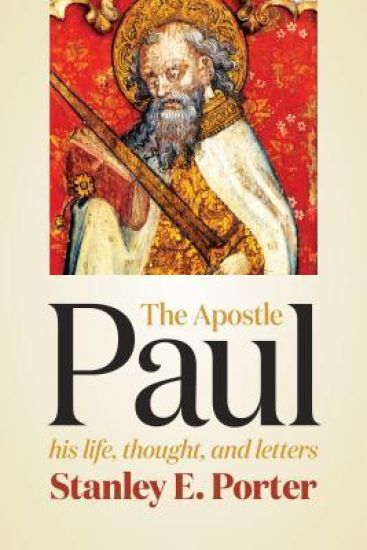
In this comprehensive introduction to the apostle Paul, Stanley Porter devotes serious consideration both to the background and major contours of Paul's thought and to the unique contributions of each of his letters. Porter begins by introducing the Pauline tradition and outlining the basics of Paul's life, the chronology of his ministry, and his several imprisonments. Porter then discusses the background to Paul's thought, examines some of the major themes of his writings, and treats issues concerning the Pauline epistles, such as pseudonymity and canon. Finally, Porter delves into all thirteen of Paul's letters individually, placing them within their historical contexts and examining critical issues relating to the content and interpretation of each letter. The result is a thorough, balanced treatment of one of the most important figures in Christianity.
The Synoptic Problem – Four Views

The Synoptic Problem – Four Views

Stanley E. Porter; Bryan R. Dyer

Baker Academic, Div of Baker Publishing Group
2016
nidottu
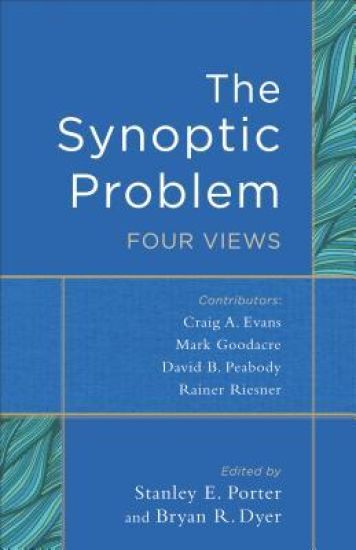
Leading Scholars Debate a Key New Testament TopicThe relationship between Matthew, Mark, and Luke is one of the most contested topics in Gospel studies. How do we account for the close similarities--and differences--in the Synoptic Gospels? In the last few decades, the standard answers to the typical questions regarding the Synoptic Problem have come under fire, while new approaches have surfaced. This up-to-date introduction articulates and debates the four major views. Following an overview of the issues, leading proponents of each view set forth their positions and respond to each of the other views. A concluding chapter summarizes the discussion and charts a direction for further study.
Sacred Tradition in the New Testament – Tracing Old Testament Themes in the Gospels and Epistles
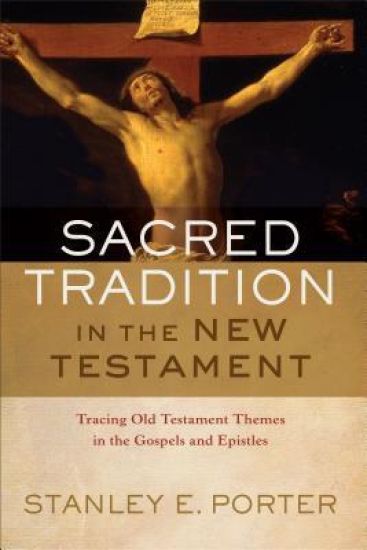
Leading biblical scholar Stanley Porter critiques the state of research regarding the New Testament's use of the Old Testament and sacred traditions. He provides needed orientation for readers interested in New Testament references to themes such as "son of man" and "suffering servant" as well as the faith of Abraham and the Passover. Porter explains that examining scriptural traditions is fundamental to understanding central ideas in the New Testament regarding Jesus. He sheds light on major themes in New Testament Christology and soteriology, offering fresh, constructive proposals.
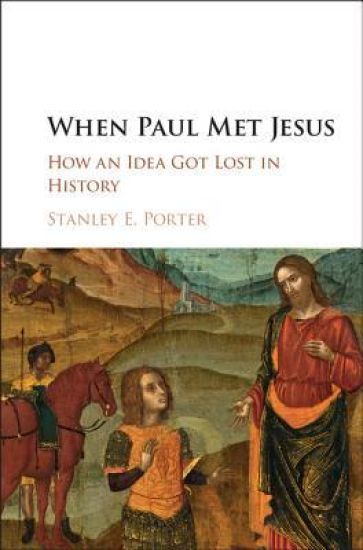
When Paul Met Jesus

When Paul Met Jesus

Stanley E. Porter

Cambridge University Press
2016
sidottu
Did Paul ever meet Jesus and hear him teach? A century ago, a curious assortment of scholars - William Ramsay, Johannes Weiss, and James Hope Moulton - thought that he had. Since then, their idea has virtually disappeared from New Testament scholarship, to be revived in this monograph. When Paul Met Jesus is an exercise in both biblical exegesis and intellectual history. After examining the positive arguments raised, it considers the negative influence of Ferdinand Christian Baur, William Wrede, and Rudolf Bultmann on such an idea, as they drove a growing wedge between Jesus and Paul. In response, Stanley E. Porter analyzes three passages in the New Testament - Acts 9:1-9 and its parallels, 1 Corinthians 9:1, and 2 Corinthians 5:16 - to confirm that there is New Testament evidence that Paul encountered Jesus. The implications of this discovery are then explored in important Pauline passages that draw Jesus and Paul back together again.
Fundamentals of New Testament Textual Criticism

Fundamentals of New Testament Textual Criticism

Stanley E. Porter; Andrew W. Pitts

William B Eerdmans Publishing Co
2015
nidottu
This book provides a student-level overview of the foundational elements necessary to grasp textual criticism of the New Testament, also addressing such issues as canonical formation and translation theory.Stanley Porter and Andrew Pitts cover a range of topics related to New Testament textual criticism, including appropriate definitions, the canon, the manuscripts of the New Testament, and the best methodologies for determining the original reading when manuscripts disagree. They also provide a history of the various editions of the New Testament with a how-to guide for using and understanding them.The end of each chapter includes a list of key vocabulary and a select bibliography, making this text especially useful for teachers and students. An appendix introduces students to the tools of textual criticism and invites discussion on how they might use textual criticism in a future classroom or ministry setting.
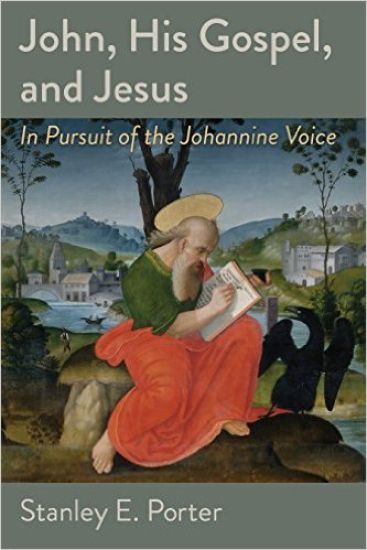
John, His Gospel, and Jesus

John, His Gospel, and Jesus

Stanley E. Porter

William B Eerdmans Publishing Co
2015
nidottu
In this volume Stanley Porter tackles a wide variety of important and often highly contentious topics within John's Gospel as a means of defining and capturing the distinctive Johannine voice. Topics discussed include John's Gospel in relation to competing Gospels, the public proclamation of Jesus in John, the sources of John's Gospel, John's prologue, the "I Am" sayings, the notion of truth, the Passover theme, and the ending of John's Gospel.Each chapter, besides surveying representative research, puts forward new and insightful proposals regarding the topics concerned. Porter does not shy away from topics that have often perplexed Johannine scholars, and he confronts some of the viewpoints that have led to confusion in the field. Significantly, each chapter considers the Johannine voice as it represents, presents, and treats Jesus, grounding the book in the wider field of Gospel and New Testament investigation.
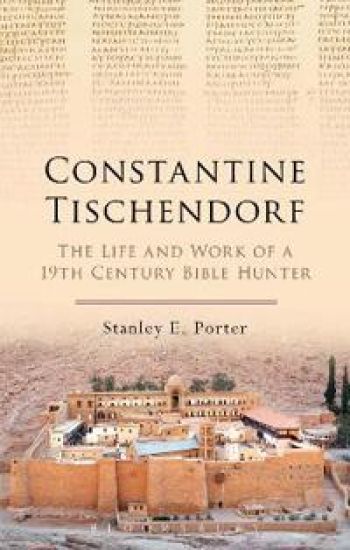
Constantine Tischendorf

Constantine Tischendorf

Stanley E. Porter

T. T.Clark Ltd
2014
nidottu
Constantin von Tischendorf was a pioneer. He existed in an age when biblical studies as we know it was being formed, when the quest for forgotten manuscripts and lost treasures was being undertaken with no less zeal and intrigue than it is today. It was Tischendorf who found, and preserved, the oldest extant version of the complete bible that we know of, the so-called Codex Sinaiticus, which he discovered in poor condition at St Catherine's Monastery at the foot of Mount Sinai, in 1846.With the discovery of the Codex Tischendorf, and others, was to take the study of biblical texts further than ever before, through linguistic methods, and attention to the most ancient sources available. In many ways Tischendorf was a father figure of the modern Historical Critical Method.In this short biography, Stanley E. Porter, himself one of the most respected scholars of the New Testament and Koine Greek currently writing, gives a portrait of Tischendorf's life and work, together with an annotated republication of Tischendorf's influential work on the Gospels. Published to celebrate Tischendorf's bicentenary, in 2015, this volume will be a must for those seeking to understand how the study of biblical manuscripts began, and to understand the man who discovered the oldest version of the bible as we know it.
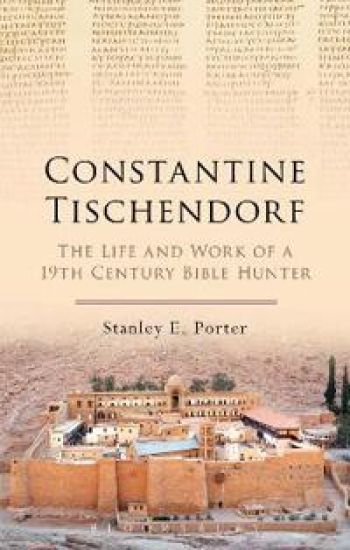
Constantine Tischendorf

Constantine Tischendorf

Stanley E. Porter

T. T.Clark Ltd
2014
sidottu
Constantin von Tischendorf was a pioneer. He existed in an age when biblical studies as we know it was being formed, when the quest for forgotten manuscripts and lost treasures was being undertaken with no less zeal and intrigue than it is today. It was Tischendorf who found, and preserved, the oldest extant version of the complete bible that we know of, the so-called Codex Sinaiticus, which he discovered in poor condition at St Catherine's Monastery at the foot of Mount Sinai, in 1846.With the discovery of the Codex Tischendorf, and others, was to take the study of biblical texts further than ever before, through linguistic methods, and attention to the most ancient sources available. In many ways Tischendorf was a father figure of the modern Historical Critical Method.In this short biography, Stanley E. Porter, himself one of the most respected scholars of the New Testament and Koine Greek currently writing, gives a portrait of Tischendorf's life and work, together with an annotated republication of Tischendorf's influential work on the Gospels. Published to celebrate Tischendorf's bicentenary, in 2015, this volume will be a must for those seeking to understand how the study of biblical manuscripts began, and to understand the man who discovered the oldest version of the bible as we know it.
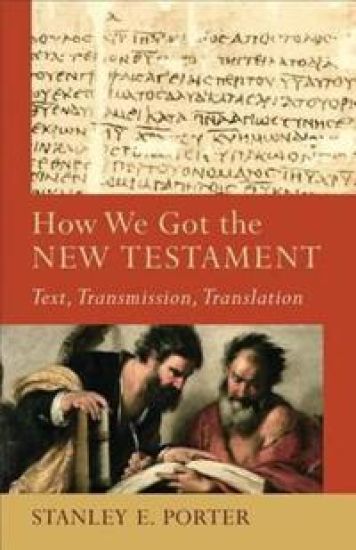
How We Got the New Testament – Text, Transmission, Translation

How We Got the New Testament – Text, Transmission, Translation

Stanley E. Porter; Craig Evans; Lee Mcdonald

Baker Academic, Div of Baker Publishing Group
2013
nidottu
2013 Word Guild Award (Biblical Studies)A recognized expert in New Testament Greek offers a historical understanding of the writing, transmission, and translation of the New Testament and provides cutting-edge insights into how we got the New Testament in its ancient Greek and modern English forms. In part responding to those who question the New Testament's reliability, Stanley Porter rigorously defends the traditional goals of textual criticism: to establish the original text. He reveals fascinating details about the earliest New Testament manuscripts and shows that the textual evidence supports an early date for the New Testament's formation. He also explores the vital role translation plays in biblical understanding and evaluates various translation theories. The book offers a student-level summary of a vast amount of historical and textual information.
The Future of Biblical Interpretation

The Future of Biblical Interpretation

Matthew R Malcolm; Stanley E Porter

Paternoster Press
2013
nidottu
How should we expect multiple interpretations of the Bible to be kept in check? Each of the contributors, experts in the field, considers one parameter of responsibility, which may act as a constraint on the validity of competing biblical interpretations. Stanley E. Porter considers theological resposibility; Walter Moberly on ecclesial reponsibility; Richard S. Briggs on scriptural responsibility; Matthew R Malcolm on kerygmatic responsibility; James D.G. Dunn on historical reponsibility; Robert C. Morgan on critical; Tom Greggs on relational responsibility and Anthony C Thiselton considers the topic as a whole. What emereges is a plurivocal but concordant projection of fruitful ways forward for biblical interpretation.
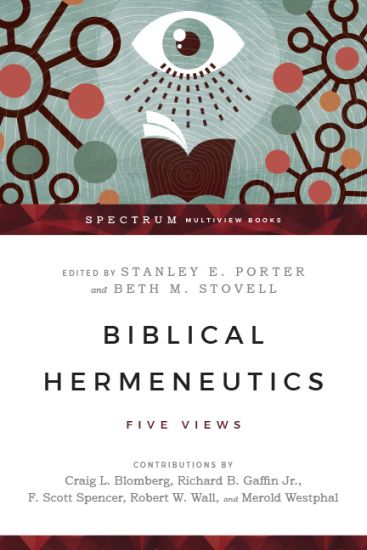
Biblical Hermeneutics – Five Views

Biblical Hermeneutics – Five Views

Stanley E. Porter; Beth M. Stovell

Inter-Varsity Press,US
2012
nidottu
In this Spectrum Multiview volume five experts in biblical hermeneutics gather to state and defend their approach to the discipline. Contributors include: Craig Blomberg with the historical-critical/grammatical approachRichard Gaffin with the redemptive-historical approachScott Spencer with the literary/postmodern approachRobert Wall with the canonical approachMerold Westphal with the philosophical/theological approach Spectrum Multiview Books offer a range of viewpoints on contested topics within Christianity, giving contributors the opportunity to present their position and also respond to others in this dynamic publishing format.
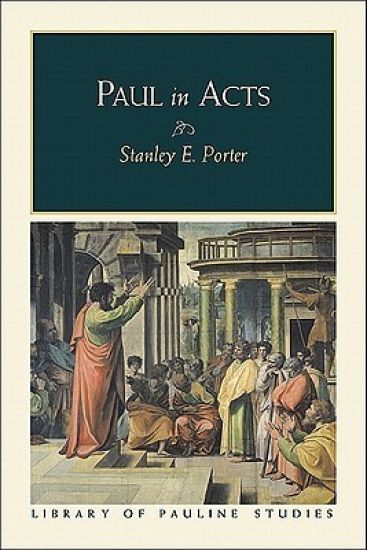
Paul in Acts

Paul in Acts

Stanley E. Porter

Baker Academic Brazos Press
2012
nidottu
Stanley E. Porter focuses upon the depiction of Paul in the book of Acts from literary-critical, rhetorical, and theological perspectives, among several others. The essays within this volume examine various topics related to the Paul of Acts such as the extent to which the "we" passages of Acts should function as a source regarding Paul, and the theology and perspective of these passages in terms of their portrait of him. Porter analyzes the Acts passages that deal with Paul and the Holy Spirit and the question of whether Paul is an epistolographer or rhetorician. He examines Paul's missionary speeches and apologetic speeches in Acts. Porter also looks at Acts 21 and Paul's arrest in Jerusalem before he closes with an analysis of some common conceptions and misconceptions of the Paul of Acts and the Paul of the letters. The Library of Pauline Studies is a series of books exploring key issues in Pauline and related studies. This series is edited by Stanley E. Porter, principal, dean, and professor of New Testament at McMaster Divinity College in Hamilton, Ontario, Canada.
Hermeneutics

Hermeneutics

Stanley E. Porter; Jason C. Robinson

William B Eerdmans Publishing Co
2011
nidottu
In this concentrated, intelligible, and useful introductory volume Stanley Porter and Jason Robinson give a splendid overview of hermeneutical and interpretive thought. Neither an all-inclusive survey that moves too quickly over the surface of complex issues nor a specialized volume on a single, narrow topic, Porter and Robinson's Hermeneutics provides critical analysis of major movements and figures in hermeneutics and interpretive theory in the modern era -- from Schleiermacher and Heidegger to Thiselton and Culpepper -- showing especially how these interpreters and their movements have impacted biblical and theological study.
Fundamentals of New Testament Greek

Fundamentals of New Testament Greek

Stanley E. Porter

William B Eerdmans Publishing Co
2010
nidottu
This extremely useful volume is a comprehensive introduction to the grammar and vocabulary of the Greek of the New Testament, with extensive paradigms, examples, and explanations. / Porter, Reed, and O'Donnell's Fundamentals of New Testament Greek makes use of pedagogically sound and linguistically informed language-instruction techniques to provide the most effective textbook possible. The book introduces the individual elements of the Greek language according to their frequency of use in the New Testament so as to reinforce in students the elements that they will most often encounter. Every grammatical element is explained in sufficient detail -- including illustrative examples -- and is accompanied by useful information to describe its composition and analysis. The authors also include complete paradigms with plenty of examples, and significant vocabulary is introduced throughout the course of the volume. / Students who complete this text can engage in serious reading, translation, and understanding of the Greek New Testament, moving directly into Greek exegesis courses and more advanced Greek-language courses. Fundamentals of New Testament Greek: First Year will prove invaluable for gaining a thorough foundational understanding of New Testament Greek. It is bound to be a standard text for years to come.