Kirjojen hintavertailu. Mukana 12 595 353 kirjaa ja 12 kauppaa.

Kirjailija

Stefan Schauer

Kirjat ja teokset yhdessä paikassa: 3 kirjaa, julkaisuja vuosilta 2020-2025, suosituimpien joukossa Cyber-Security in Critical Infrastructures. Vertaile teosten hintoja ja tarkista saatavuus suomalaisista kirjakaupoista.

3 kirjaa

Kirjojen julkaisuhaarukka 2020-2025.

Cybersicherheit in kritischen Infrastrukturen

Cybersicherheit in kritischen Infrastrukturen

Stefan Rass; Stefan Schauer; Sandra König; Quanyan Zhu

Springer Fachmedien Wiesbaden
2025
sidottu
Dieses Buch stellt ein Kompendium ausgewählter spiel- und entscheidungstheoretischer Modelle zur Erreichung und Bewertung der Sicherheit kritischer Infrastrukturen vor. Angesichts aktueller Berichte über Sicherheitsvorfälle verschiedenster Art lässt sich ein Paradigmenwechsel hin zu immer heterogeneren Angriffen erkennen. Hierbei werden verschiedene Techniken kombiniert werden, was zu einer fortgeschrittenen, anhaltenden Bedrohung führen kann. Sicherheitsvorkehrungen müssen diesen vielfältigen Bedrohungsmustern in ebenso vielfältiger Weise gerecht werden. Als Antwort darauf bietet dieses Buch eine Fülle von Techniken zum Schutz vor und zur Abschwächung von IT-Angriffen. Ein Großteil der traditionellen Sicherheitsforschung konzentriert sich auf bestimmte Angriffsszenarien oder Anwendungen und ist bestrebt, einen Angriff "praktisch unmöglich" zu machen. Ein neueres Sicherheitskonzept betrachtet die Sicherheit als ein Szenario, in dem die Kosten eines Angriffs den möglichen Nutzen übersteigen. Dies schließt die Möglichkeit eines Angriffs nicht aus, sondern minimiert die Wahrscheinlichkeit eines solchen auf das geringstmögliche Risiko. Das Buch folgt dieser ökonomischen Definition von Sicherheit und bietet eine managementwissenschaftliche Sichtweise, die ein Gleichgewicht zwischen Sicherheitsinvestitionen und dem daraus resultierenden Nutzen anstrebt. Es konzentriert sich auf die Optimierung von Ressourcen angesichts von Bedrohungen wie Terrorismus und fortgeschrittenen, anhaltenden Bedrohungen. Ausgehend von der Erfahrung der Autoren und inspiriert von realen Fallstudien bietet das Buch einen systematischen Ansatz für die Sicherheit und Widerstandsfähigkeit kritischer Infrastrukturen. Das Buch ist eine Mischung aus theoretischer Arbeit und praktischen Erfolgsgeschichten und richtet sich vor allem an Studenten und Praktiker, die eine Einführung in spiel- und entscheidungstheoretische Techniken für die Sicherheit suchen. Die erforderlichen mathematischen Konzepte sind in sich abgeschlossen, werden rigoros eingeführt und durch Fallstudien illustriert. Das Buch bietet auch Software-Tools, die den Leser bei der praktischen Anwendung der wissenschaftlichen Modelle und Berechnungsrahmen unterstützen. Dieses Buch ist eine Übersetzung einer englischen Originalausgabe. Die Übersetzung wurde mit Hilfe von künstlicher Intelligenz (maschinelle Übersetzung durch den Dienst DeepL.com) erstellt. Eine anschließende menschliche Überarbeitung erfolgte vor allem in Bezug auf den Inhalt, so dass sich das Buch stilistisch anders liest als eine herkömmliche Übersetzung.
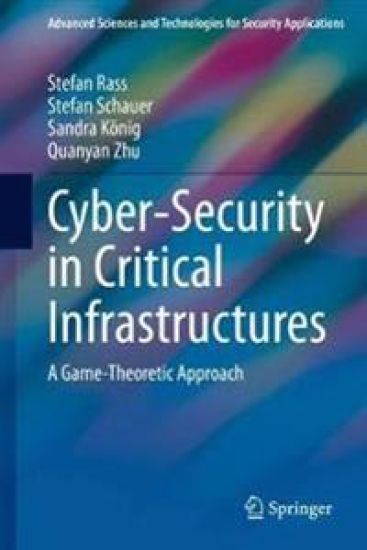
Cyber-Security in Critical Infrastructures

Cyber-Security in Critical Infrastructures

Stefan Rass; Stefan Schauer; Sandra König; Quanyan Zhu

Springer Nature Switzerland AG
2021
nidottu
This book presents a compendium of selected game- and decision-theoretic models to achieve and assess the security of critical infrastructures. Given contemporary reports on security incidents of various kinds, we can see a paradigm shift to attacks of an increasingly heterogeneous nature, combining different techniques into what we know as an advanced persistent threat. Security precautions must match these diverse threat patterns in an equally diverse manner; in response, this book provides a wealth of techniques for protection and mitigation. Much traditional security research has a narrow focus on specific attack scenarios or applications, and strives to make an attack “practically impossible.” A more recent approach to security views it as a scenario in which the cost of an attack exceeds the potential reward. This does not rule out the possibility of an attack but minimizes its likelihood to the least possible risk. The book follows this economic definition of security, offering a management scientific view that seeks a balance between security investments and their resulting benefits. It focuses on optimization of resources in light of threats such as terrorism and advanced persistent threats. Drawing on the authors’ experience and inspired by real case studies, the book provides a systematic approach to critical infrastructure security and resilience. Presenting a mixture of theoretical work and practical success stories, the book is chiefly intended for students and practitioners seeking an introduction to game- and decision-theoretic techniques for security. The required mathematical concepts are self-contained, rigorously introduced, and illustrated by case studies. The book also provides software tools that help guide readers in the practical use of the scientific models and computational frameworks.
Cyber-Security in Critical Infrastructures

Cyber-Security in Critical Infrastructures

Stefan Rass; Stefan Schauer; Sandra König; Quanyan Zhu

Springer Nature Switzerland AG
2020
sidottu
This book presents a compendium of selected game- and decision-theoretic models to achieve and assess the security of critical infrastructures. Given contemporary reports on security incidents of various kinds, we can see a paradigm shift to attacks of an increasingly heterogeneous nature, combining different techniques into what we know as an advanced persistent threat. Security precautions must match these diverse threat patterns in an equally diverse manner; in response, this book provides a wealth of techniques for protection and mitigation. Much traditional security research has a narrow focus on specific attack scenarios or applications, and strives to make an attack “practically impossible.” A more recent approach to security views it as a scenario in which the cost of an attack exceeds the potential reward. This does not rule out the possibility of an attack but minimizes its likelihood to the least possible risk. The book follows this economic definition of security, offering a management scientific view that seeks a balance between security investments and their resulting benefits. It focuses on optimization of resources in light of threats such as terrorism and advanced persistent threats. Drawing on the authors’ experience and inspired by real case studies, the book provides a systematic approach to critical infrastructure security and resilience. Presenting a mixture of theoretical work and practical success stories, the book is chiefly intended for students and practitioners seeking an introduction to game- and decision-theoretic techniques for security. The required mathematical concepts are self-contained, rigorously introduced, and illustrated by case studies. The book also provides software tools that help guide readers in the practical use of the scientific models and computational frameworks.