Kirjojen hintavertailu. Mukana 12 595 353 kirjaa ja 12 kauppaa.

Kirjailija

Steffen Staab

Kirjat ja teokset yhdessä paikassa: 3 kirjaa, julkaisuja vuosilta 1999-2021, suosituimpien joukossa Knowledge Graphs. Vertaile teosten hintoja ja tarkista saatavuus suomalaisista kirjakaupoista.

3 kirjaa

Kirjojen julkaisuhaarukka 1999-2021.

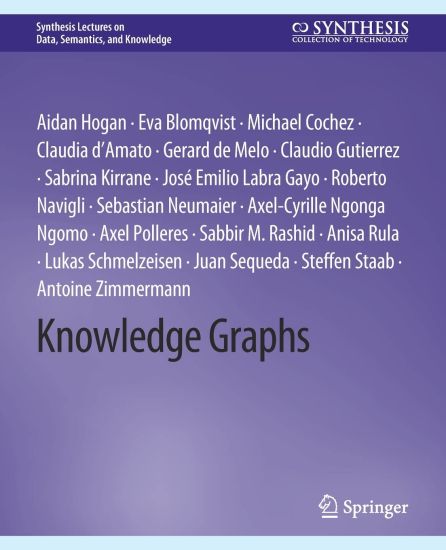
Knowledge Graphs

Knowledge Graphs

Aidan Hogan; Eva Blomqvist; Michael Cochez; Claudia d’Amato; Gerard de Melo; Claudio Gutierrez; Sabrina Kirrane; Jose Emilio Labra Gayo; Roberto Navigli; Sebastian Neumaier; Axel Polleres; Sabbir Rashid; Anisa Rula; Antoine Zimmermann; Lukas Schmelzeisen; Axel-Cyrille Ngonga Ngomo; Juan Sequeda; Steffen Staab

Springer International Publishing AG
2021
nidottu
This book provides a comprehensive and accessible introduction to knowledge graphs, which have recently garnered notable attention from both industry and academia. Knowledge graphs are founded on the principle of applying a graph-based abstraction to data, and are now broadly deployed in scenarios that require integrating and extracting value from multiple, diverse sources of data at large scale. The book defines knowledge graphs and provides a high-level overview of how they are used. It presents and contrasts popular graph models that are commonly used to represent data as graphs, and the languages by which they can be queried before describing how the resulting data graph can be enhanced with notions of schema, identity, and context. The book discusses how ontologies and rules can be used to encode knowledge as well as how inductive techniques—based on statistics, graph analytics, machine learning, etc.—can be used to encode and extract knowledge. It covers techniques for the creation, enrichment, assessment, and refinement of knowledge graphs and surveys recent open and enterprise knowledge graphs and the industries or applications within which they have been most widely adopted. The book closes by discussing the current limitations and future directions along which knowledge graphs are likely to evolve. This book is aimed at students, researchers, and practitioners who wish to learn more about knowledge graphs and how they facilitate extracting value from diverse data at large scale. To make the book accessible for newcomers, running examples and graphical notation are used throughout. Formal definitions and extensive references are also provided for those who opt to delve more deeply into specific topics.
Knowledge Graphs

Knowledge Graphs

Aidan Hogan; Eva Blomqvist; Michael Cochez; Claudia d'Amato; Gerard de Melo; Claudio Gutierrez; Sabrina Kirrane; Jose Emilio Labra Gayo; Roberto Navigli; Sebastian Neumaier; Axel-Cyrille Ngonga Ngomo; Axel Polleres; Sabbir M. Rashid; Anisa Rula; Juan Sequeda; Lukas Schmelzeisen; Steffen Staab; Antoine Zimmermann

MORGAN CLAYPOOL PUBLISHERS
2021
nidottu
This book provides a comprehensive and accessible introduction to knowledge graphs, which have recently garnered notable attention from both industry and academia. Knowledge graphs are founded on the principle of applying a graph-based abstraction to data, and are now broadly deployed in scenarios that require integrating and extracting value from multiple, diverse sources of data at large scale.The book defines knowledge graphs and provides a high-level overview of how they are used. It presents and contrasts popular graph models that are commonly used to represent data as graphs, and the languages by which they can be queried before describing how the resulting data graph can be enhanced with notions of schema, identity, and context. The book discusses how ontologies and rules can be used to encode knowledge as well as how inductive techniques—based on statistics, graph analytics, machine learning, etc.—can be used to encode and extract knowledge. It covers techniques for the creation, enrichment, assessment, and refinement of knowledge graphs and surveys recent open and enterprise knowledge graphs and the industries or applications within which they have been most widely adopted. The book closes by discussing the current limitations and future directions along which knowledge graphs are likely to evolve.This book is aimed at students, researchers, and practitioners who wish to learn more about knowledge graphs and how they facilitate extracting value from diverse data at large scale. To make the book accessible for newcomers, running examples and graphical notation are used throughout. Formal definitions and extensive references are also provided for those who opt to delve more deeply into specific topics.

Grading Knowledge

Grading Knowledge

Steffen Staab

Springer-Verlag Berlin and Heidelberg GmbH Co. K
1999
nidottu
If you are sitting in a basement room without a view - not to mention the bars in front of the windows - and writing a book, then you better have good company. I had the best company you could imagine. Waltraud Hiltl, Katja Markert, Martin Romacker, Klemens Schnattinger, Andreas Klee and I shared very little o?ce space, but plenty of chocolate, co?ee, champagne, and enthusiasm for our research. North German coolness and creativity sprang mostly from my colleagues in the second ?oor. I learned a lot from and laughed a lot with Nobi Broker, Susanne (Sue) Schacht, Manfred Klenner, Peter Neuhaus, Stefan Schulz, and Michael Strube. I thank my friend and partner Angela Rosch for motivational and te- nical support and for living together with someone who cares about strange things, works too much and does not improve in any way over the years. Special thanks go to my family who sometimes wondered what was going on when I started talking enthusiastically about "semantics", but they never let wane their encouragement for me. Kornel Marco provided great service by implementing parts of the system presented in this book. Joe Bush helped me polish up the text with his capabilities as an American native speaker. Remaining errors are entirely my fault and due to my lack of diligence. This book would not have seen the light of day without the dissertation grant through the Graduiertenkolleg "Menschliche & Maschinelle Intelligenz" funded by the Deutsche Forschungsgemeinschaft (DFG).