Kirjojen hintavertailu. Mukana 12 252 741 kirjaa ja 12 kauppaa.

Kirjailija

Stephan Eggersglüß

Kirjat ja teokset yhdessä paikassa: 5 kirjaa, julkaisuja vuosilta 2009-2014, suosituimpien joukossa Test Pattern Generation using Boolean Proof Engines. Vertaile teosten hintoja ja tarkista saatavuus suomalaisista kirjakaupoista.

5 kirjaa

Kirjojen julkaisuhaarukka 2009-2014.

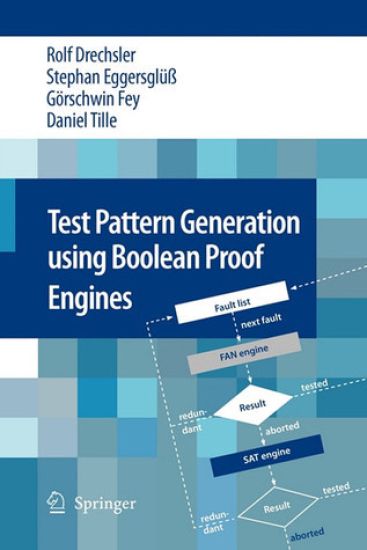
Test Pattern Generation using Boolean Proof Engines

Test Pattern Generation using Boolean Proof Engines

Rolf Drechsler; Stephan Eggersglüß; Görschwin Fey; Daniel Tille

Springer
2009
sidottu
In Test Pattern Generation using Boolean Proof Engines, we give an introduction to ATPG. The basic concept and classical ATPG algorithms are reviewed. Then, the formulation as a SAT problem is considered. As the underlying engine, modern SAT solvers and their use on circuit related problems are comprehensively discussed. Advanced techniques for SAT-based ATPG are introduced and evaluated in the context of an industrial environment. The chapters of the book cover efficient instance generation, encoding of multiple-valued logic, usage of various fault models, and detailed experiments on multi-million gate designs. The book describes the state of the art in the field, highlights research aspects, and shows directions for future work.
High Quality Test Pattern Generation and Boolean Satisfiability

High Quality Test Pattern Generation and Boolean Satisfiability

Stephan Eggersglüß; Rolf Drechsler

Springer-Verlag New York Inc.
2014
nidottu
This book provides an overview of automatic test pattern generation (ATPG) and introduces novel techniques to complement classical ATPG, based on Boolean Satisfiability (SAT). A fast and highly fault efficient SAT-based ATPG framework is presented which is also able to generate high-quality delay tests such as robust path delay tests, as well as tests with long propagation paths to detect small delay defects. The aim of the techniques and methodologies presented in this book is to improve SAT-based ATPG, in order to make it applicable in industrial practice. Readers will learn to improve the performance and robustness of the overall test generation process, so that the ATPG algorithm reliably will generate test patterns for most targeted faults in acceptable run time to meet the high fault coverage demands of industry. The techniques and improvements presented in this book provide the following advantages: Provides a comprehensive introduction to test generation and Boolean Satisfiability (SAT); Describes a highly fault efficient SAT-based ATPG framework; Introduces circuit-oriented SAT solving techniques, which make use of structural information and are able to accelerate the search process significantly;Provides SAT formulations for the prevalent delay faults models, in addition to the classical stuck-at fault model;Includes an industrial perspective on the state-of-the-art in the testing, along with SAT; two topics typically distinguished from each other.
Test digitaler Schaltkreise

Test digitaler Schaltkreise

Stephan Eggersglüß; Görschwin Fey; Ilia Polian

De Gruyter Oldenbourg
2014
isokokoinen pokkari
Eingebettete Systeme übernehmen zentrale Steueraufgaben im täglichen Leben. In der Energieversorgung oder im Transportwesen würde ein Ausfall der Systeme fatale Auswirkungen haben. Der Nutzer verlässt sich aber auf ein fehlerfreies Funktionieren des Systems. Die Funktionstüchtigkeit der Schaltkreise zu garantieren, ist das Ziel des Testens – und das mit geringen Kosten, da jeder Chip nach der Produktion separat getestet werden muss.
High Quality Test Pattern Generation and Boolean Satisfiability

High Quality Test Pattern Generation and Boolean Satisfiability

Stephan Eggersglüß; Rolf Drechsler

Springer-Verlag New York Inc.
2012
sidottu
This book provides an overview of automatic test pattern generation (ATPG) and introduces novel techniques to complement classical ATPG, based on Boolean Satisfiability (SAT). A fast and highly fault efficient SAT-based ATPG framework is presented which is also able to generate high-quality delay tests such as robust path delay tests, as well as tests with long propagation paths to detect small delay defects. The aim of the techniques and methodologies presented in this book is to improve SAT-based ATPG, in order to make it applicable in industrial practice. Readers will learn to improve the performance and robustness of the overall test generation process, so that the ATPG algorithm reliably will generate test patterns for most targeted faults in acceptable run time to meet the high fault coverage demands of industry. The techniques and improvements presented in this book provide the following advantages: Provides a comprehensive introduction to test generation and Boolean Satisfiability (SAT); Describes a highly fault efficient SAT-based ATPG framework; Introduces circuit-oriented SAT solving techniques, which make use of structural information and are able to accelerate the search process significantly;Provides SAT formulations for the prevalent delay faults models, in addition to the classical stuck-at fault model;Includes an industrial perspective on the state-of-the-art in the testing, along with SAT; two topics typically distinguished from each other.
Test Pattern Generation using Boolean Proof Engines

Test Pattern Generation using Boolean Proof Engines

Rolf Drechsler; Stephan Eggersglüß; Görschwin Fey; Daniel Tille

Springer
2010
nidottu
In Test Pattern Generation using Boolean Proof Engines, we give an introduction to ATPG. The basic concept and classical ATPG algorithms are reviewed. Then, the formulation as a SAT problem is considered. As the underlying engine, modern SAT solvers and their use on circuit related problems are comprehensively discussed. Advanced techniques for SAT-based ATPG are introduced and evaluated in the context of an industrial environment. The chapters of the book cover efficient instance generation, encoding of multiple-valued logic, usage of various fault models, and detailed experiments on multi-million gate designs. The book describes the state of the art in the field, highlights research aspects, and shows directions for future work.