Kirjojen hintavertailu. Mukana 12 595 353 kirjaa ja 12 kauppaa.

Kirjailija

Stephan Haggard

Kirjat ja teokset yhdessä paikassa: 19 kirjaa, julkaisuja vuosilta 1990-2021, suosituimpien joukossa Hard Target. Vertaile teosten hintoja ja tarkista saatavuus suomalaisista kirjakaupoista.

19 kirjaa

Kirjojen julkaisuhaarukka 1990-2021.

Backsliding

Backsliding

Stephan Haggard; Robert Kaufman

Cambridge University Press
2021
pokkari
Assaults on democracy are increasingly coming from the actions of duly elected governments, rather than coups. Backsliding examines the processes through which elected rulers weaken checks on executive power, curtail political and civil liberties, and undermine the integrity of the electoral system. Drawing on detailed case studies, including the United States and countries in Latin America, Eastern Europe, and Africa, the book focuses on three, inter-related causal mechanisms: the pernicious effects of polarization; realignments of party systems that enable elected autocrats to gain legislative power; and the incremental nature of derogations, which divides oppositions and keeps them off balance. A concluding chapter looks at the international context of backsliding and the role of new technologies in these processes. An online appendix provides detailed accounts of backsliding in 16 countries, which can be found at www.cambridge.org/backsliding.
Hard Target

Hard Target

Stephan Haggard; Marcus Noland

Stanford University Press
2019
pokkari
Because authoritarian regimes like North Korea can impose the costs of sanctions on their citizens, these regimes constitute "hard targets." Yet authoritarian regimes may also be immune—and even hostile—to economic inducements if such inducements imply reform and opening. This book captures the effects of sanctions and inducements on North Korea and provides a detailed reconstruction of the role of economic incentives in the bargaining around the country's nuclear program. Stephan Haggard and Marcus Noland draw on an array of evidence to show the reluctance of the North Korean leadership to weaken its grip on foreign economic activity. They argue that inducements have limited effect on the regime, and instead urge policymakers to think in terms of gradual strategies. Hard Target connects economic statecraft to the marketization process to understand North Korea and addresses a larger debate over the merits and demerits of "engagement" with adversaries.
Nuclear North Korea

Nuclear North Korea

Victor Cha; David Kang; Stephan Haggard

Columbia University Press
2018
pokkari
Victor D. Cha and David C. Kang’s Nuclear North Korea was first published in 2003 amid the outbreak of a lasting crisis over the North Korean nuclear program. It promptly became a landmark of an ongoing debate in academic and policy circles about whether to engage or contain North Korea. Fifteen years later, as North Korea tests intercontinental ballistic missiles and the U.S. president angrily refers to Kim Jong-un as “Rocket Man,” Nuclear North Korea remains an essential guide to the difficult choices we face.Coming from different perspectives—Kang believes the threat posed by Pyongyang has been inflated and endorses a more open approach, while Cha is more skeptical and advocates harsher measures, though both believe that some form of engagement is necessary—the authors together present authoritative analysis of one of the world’s thorniest challenges. They refute a number of misconceptions and challenge the faulty thinking that surrounds the discussion of North Korea, particularly the idea that North Korea is an irrational actor. Cha and Kang look at the implications of a nuclear North Korea, assess recent and current approaches to sanctions and engagement, and provide a functional framework for constructive policy. With a new chapter on the way forward for the international community in light of continued nuclear tensions, this book is of lasting relevance to understanding the state of affairs on the Korean peninsula.
Nuclear North Korea

Nuclear North Korea

Victor Cha; David Kang; Stephan Haggard

Columbia University Press
2018
sidottu
Victor D. Cha and David C. Kang’s Nuclear North Korea was first published in 2003 amid the outbreak of a lasting crisis over the North Korean nuclear program. It promptly became a landmark of an ongoing debate in academic and policy circles about whether to engage or contain North Korea. Fifteen years later, as North Korea tests intercontinental ballistic missiles and the U.S. president angrily refers to Kim Jong-un as “Rocket Man,” Nuclear North Korea remains an essential guide to the difficult choices we face.Coming from different perspectives—Kang believes the threat posed by Pyongyang has been inflated and endorses a more open approach, while Cha is more skeptical and advocates harsher measures, though both believe that some form of engagement is necessary—the authors together present authoritative analysis of one of the world’s thorniest challenges. They refute a number of misconceptions and challenge the faulty thinking that surrounds the discussion of North Korea, particularly the idea that North Korea is an irrational actor. Cha and Kang look at the implications of a nuclear North Korea, assess recent and current approaches to sanctions and engagement, and provide a functional framework for constructive policy. With a new chapter on the way forward for the international community in light of continued nuclear tensions, this book is of lasting relevance to understanding the state of affairs on the Korean peninsula.
Developmental States

Developmental States

Stephan Haggard

Cambridge University Press
2018
pokkari
The concept of the developmental state emerged to explain the rapid growth of a number of countries in East Asia in the postwar period. Yet the developmental state literature also offered a theoretical approach to growth that was heterodox with respect to prevailing approaches in both economics and political science. Arguing for the distinctive features of developmental states, its proponents emphasized the role of government intervention and industrial policy as well as the significance of strong states and particular social coalitions. This literature blossomed into a wider approach, firmly planted in a much longer heterodox tradition, that explored comparisons with states that were decidedly not developmentalist, thus contributing to our historical understanding of long-run growth. This Element provides a critical but sympathetic overview of this literature and ends with its revival and a look forward at the possibility for developmentalist approaches, both in the advanced and developing world.
Hard Target

Hard Target

Stephan Haggard; Marcus Noland

STANFORD UNIVERSITY PRESS
2017
sidottu
Because authoritarian regimes like North Korea can impose the costs of sanctions on their citizens, these regimes constitute "hard targets." Yet authoritarian regimes may also be immune—and even hostile—to economic inducements if such inducements imply reform and opening. This book captures the effects of sanctions and inducements on North Korea and provides a detailed reconstruction of the role of economic incentives in the bargaining around the country's nuclear program. Stephan Haggard and Marcus Noland draw on an array of evidence to show the reluctance of the North Korean leadership to weaken its grip on foreign economic activity. They argue that inducements have limited effect on the regime, and instead urge policymakers to think in terms of gradual strategies. Hard Target connects economic statecraft to the marketization process to understand North Korea and addresses a larger debate over the merits and demerits of "engagement" with adversaries.
Dictators and Democrats

Dictators and Democrats

Stephan Haggard; Robert R. Kaufman

Princeton University Press
2016
sidottu
From the 1980s through the first decade of the twenty-first century, the spread of democracy across the developing and post-Communist worlds transformed the global political landscape. What drove these changes and what determined whether the emerging democracies would stabilize or revert to authoritarian rule? Dictators and Democrats takes a comprehensive look at the transitions to and from democracy in recent decades. Deploying both statistical and qualitative analysis, Stephen Haggard and Robert Kaufman engage with theories of democratic change and advocate approaches that emphasize political and institutional factors. While inequality has been a prominent explanation for democratic transitions, the authors argue that its role has been limited, and elites as well as masses can drive regime change. Examining seventy-eight cases of democratic transition and twenty-five reversions since 1980, Haggard and Kaufman show how differences in authoritarian regimes and organizational capabilities shape popular protest and elite initiatives in transitions to democracy, and how institutional weaknesses cause some democracies to fail. The determinants of democracy lie in the strength of existing institutions and the public's capacity to engage in collective action. There are multiple routes to democracy, but those growing out of mass mobilization may provide more checks on incumbents than those emerging from intra-elite bargains. Moving beyond well-known beliefs regarding regime changes, Dictators and Democrats explores the conditions under which transitions to democracy are likely to arise.
Dictators and Democrats

Dictators and Democrats

Stephan Haggard; Robert R. Kaufman

Princeton University Press
2016
pokkari
From the 1980s through the first decade of the twenty-first century, the spread of democracy across the developing and post-Communist worlds transformed the global political landscape. What drove these changes and what determined whether the emerging democracies would stabilize or revert to authoritarian rule? Dictators and Democrats takes a comprehensive look at the transitions to and from democracy in recent decades. Deploying both statistical and qualitative analysis, Stephen Haggard and Robert Kaufman engage with theories of democratic change and advocate approaches that emphasize political and institutional factors. While inequality has been a prominent explanation for democratic transitions, the authors argue that its role has been limited, and elites as well as masses can drive regime change. Examining seventy-eight cases of democratic transition and twenty-five reversions since 1980, Haggard and Kaufman show how differences in authoritarian regimes and organizational capabilities shape popular protest and elite initiatives in transitions to democracy, and how institutional weaknesses cause some democracies to fail. The determinants of democracy lie in the strength of existing institutions and the public's capacity to engage in collective action. There are multiple routes to democracy, but those growing out of mass mobilization may provide more checks on incumbents than those emerging from intra-elite bargains. Moving beyond well-known beliefs regarding regime changes, Dictators and Democrats explores the conditions under which transitions to democracy are likely to arise.
Engaging North Korea: The Role of Economic Statecraft

Engaging North Korea: The Role of Economic Statecraft

Stephan Haggard; Marcus Noland

East-West Center
2011
nidottu
This monograph reviews the efficacy of economic statecraft vis- -vis North Korea, with a particular focus on the use of sanctions and inducements on the part of the United States in seeking to achieve nonproliferation and wider foreign policy objectives. Two structural constraints operate: North Korea's particularly repressive state, with a narrowing governing coalition; and the country's changing economic relations. As an empirical matter, there is little evidence that sanctions had effect, or did so only in conjunction with inducements. However, inducements did not yield significant results either, in part because of severe credibility and sequencing problems in the negotiations.
Witness to Transformation – Refugee Insights into North Korea

Witness to Transformation – Refugee Insights into North Korea

Stephan Haggard; Marcus Noland

The Peterson Institute for International Economics
2010
nidottu
Despite its nuclear capability, in certain respects North Korea resembles a failed state sitting uneasily atop a shifting internal foundation. This instability is due in part to the devastating famine of the 1990s and the state's inability to fulfill the economic obligations that it had assumed, forcing institutions, enterprises, and households to cope with the ensuing challenges of maintaining stability with limited cooperation between the Korean government and the international community. The ineffective response to the humanitarian crisis triggered by the famine resulted in the outflow of perhaps tens of thousands of refugees whose narratives are largely overlooked in evaluating the efficacy of the humanitarian aid program. Witness to Transformation: Refugee Insights into North Korea uses extensive surveys with refugees who now reside in China or South Korea to provide extraordinary insight into the changing pathways to power, wealth, and status within North Korea.These refugee testimonies provide an invaluable interpretation of the regime, its motivations, and its capabilities and assess the situation on the ground with the rise of inequality, corruption, and disaffection in the decade since the famine. Through the lens of these surveys, preeminent North Korean experts Stephan Haggard and Marcus Noland carefully document the country's transition from a centrally planned economy to a highly distorted market economy, characterized by endemic corruption and widening inequality. The authors chart refugees' reactions to the current conditions and consider the disparity between the perceived and real benefit of the international humanitarian aid program experienced by this displaced population. Finally, the book examines these refugees' future prospects for integration into a new society.
Famine in North Korea

Famine in North Korea

Stephan Haggard; Marcus Noland; Amartya Sen

Columbia University Press
2009
pokkari
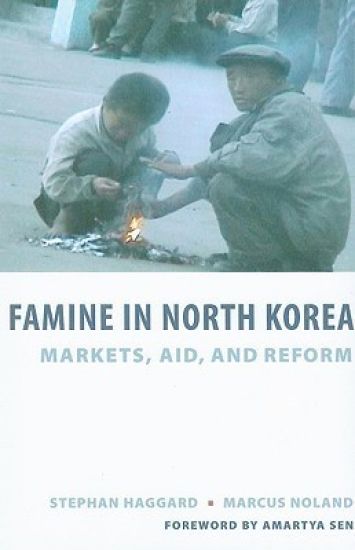
In the mid-1990s, as many as one million North Koreans died in one of the worst famines of the twentieth century. The socialist food distribution system collapsed primarily because of a misguided push for self-reliance, but was compounded by the regime's failure to formulate a quick response-including the blocking of desperately needed humanitarian relief. As households, enterprises, local party organs, and military units tried to cope with the economic collapse, a grassroots process of marketization took root. However, rather than embracing these changes, the North Korean regime opted for tentative economic reforms with ambiguous benefits and a self-destructive foreign policy. As a result, a chronic food shortage continues to plague North Korea today. In their carefully researched book, Stephan Haggard and Marcus Noland present the most comprehensive and penetrating account of the famine to date, examining not only the origins and aftermath of the crisis but also the regime's response to outside aid and the effect of its current policies on the country's economic future. Their study begins by considering the root causes of the famine, weighing the effects of the decline in the availability of food against its poor distribution. Then it takes a close look at the aid effort, addressing the difficulty of monitoring assistance within the country, and concludes with an analysis of current economic reforms and strategies of engagement. North Korea's famine exemplified the depredations that can arise from tyrannical rule and the dilemmas such regimes pose for the humanitarian community, as well as the obstacles inherent in achieving economic and political reform. To reveal the state's culpability in this tragic event is a vital project of historical recovery, one that is especially critical in light of our current engagement with the "North Korean question."
Development, Democracy, and Welfare States

Development, Democracy, and Welfare States

Stephan Haggard; Robert R. Kaufman

Princeton University Press
2008
pokkari
This is the first book to compare the distinctive welfare states of Latin America, East Asia, and Eastern Europe. Stephan Haggard and Robert Kaufman trace the historical origins of social policy in these regions to crucial political changes in the mid-twentieth century, and show how the legacies of these early choices are influencing welfare reform following democratization and globalization. After World War II, communist regimes in Eastern Europe adopted wide-ranging socialist entitlements while conservative dictatorships in East Asia sharply limited social security but invested in education. In Latin America, where welfare systems were instituted earlier, unequal social-security systems favored formal sector workers and the middle class. Haggard and Kaufman compare the different welfare paths of the countries in these regions following democratization and the move toward more open economies. Although these transformations generated pressure to reform existing welfare systems, economic performance and welfare legacies exerted a more profound influence. The authors show how exclusionary welfare systems and economic crisis in Latin America created incentives to adopt liberal social-policy reforms, while social entitlements from the communist era limited the scope of liberal reforms in the new democracies of Eastern Europe. In East Asia, high growth and permissive fiscal conditions provided opportunities to broaden social entitlements in the new democracies. This book highlights the importance of placing the contemporary effects of democratization and globalization into a broader historical context.
Famine in North Korea

Famine in North Korea

Stephan Haggard; Marcus Noland; Amartya Sen

Columbia University Press
2007
sidottu
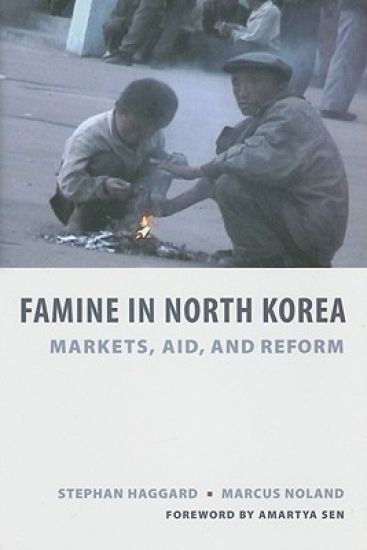
In the mid-1990s, as many as one million North Koreans died in one of the worst famines of the twentieth century. The socialist food distribution system collapsed primarily because of a misguided push for self-reliance, but was compounded by the regime's failure to formulate a quick response-including the blocking of desperately needed humanitarian relief. As households, enterprises, local party organs, and military units tried to cope with the economic collapse, a grassroots process of marketization took root. However, rather than embracing these changes, the North Korean regime opted for tentative economic reforms with ambiguous benefits and a self-destructive foreign policy. As a result, a chronic food shortage continues to plague North Korea today. In their carefully researched book, Stephan Haggard and Marcus Noland present the most comprehensive and penetrating account of the famine to date, examining not only the origins and aftermath of the crisis but also the regime's response to outside aid and the effect of its current policies on the country's economic future. Their study begins by considering the root causes of the famine, weighing the effects of the decline in the availability of food against its poor distribution. Then it takes a close look at the aid effort, addressing the difficulty of monitoring assistance within the country, and concludes with an analysis of current economic reforms and strategies of engagement. North Korea's famine exemplified the depredations that can arise from tyrannical rule and the dilemmas such regimes pose for the humanitarian community, as well as the obstacles inherent in achieving economic and political reform. To reveal the state's culpability in this tragic event is a vital project of historical recovery, one that is especially critical in light of our current engagement with the "North Korean question."
From Silicon Valley to Singapore

From Silicon Valley to Singapore

David G. McKendrick; Richard F. Doner; Stephan Haggard

Stanford University Press
2000
pokkari
Momentous developments in the global economy over the last two decades have dramatically increased the availability of industrial investment sites and lowered the cost of relocating core activities to new countries. But how should these developments be exploited for competitive advantage? Firms face competing pressures: scale economies and the advantages of proximity push them to concentrate activities in one or only a few locations, while low wages and new markets invite dispersal across several countries. This book examines how location decisions have contributed to the global dominance of U.S. firms in the hard disk drive industry. In analyzing the industry since its beginnings some forty years ago, the book explains how American leadership in disk drives has rested on the formation of two complementary industrial clusters. Fundamental research and product development has been located almost entirely in the United States, principally California. Manufacturing has been concentrated in Southeast Asia (initially in Singapore and later in Thailand and Malaysia as well). This duality has proven key to the successful competitive position of the U.S. disk drive industry. Beyond the particulars of the disk drive industry, the authors present new perspectives on the sources of industrial leadership, the strategic behavior of multinational corporations, the geographic evolution of industry, and the creation and endurance of industrial clusters. Managers will gain insight into how location decisions can contribute to organizational effectiveness, and will learn that globalizing production, while keeping innovative activities at home, can contribute to their firms’ competitive advantage. Policy makers will find that first mover advantages may be as important for countries as for companies, since early and systematic efforts to attract a specific industry can generate a critical mass of investments that, over time, will make a location resistant to inducements offered by other countries.
From Silicon Valley to Singapore

From Silicon Valley to Singapore

David G. McKendrick; Richard F. Doner; Stephan Haggard

Stanford University Press
2000
sidottu
Momentous developments in the global economy over the last two decades have dramatically increased the availability of industrial investment sites and lowered the cost of relocating core activities to new countries. But how should these developments be exploited for competitive advantage? Firms face competing pressures: scale economies and the advantages of proximity push them to concentrate activities in one or only a few locations, while low wages and new markets invite dispersal across several countries. This book examines how location decisions have contributed to the global dominance of U.S. firms in the hard disk drive industry. In analyzing the industry since its beginnings some forty years ago, the book explains how American leadership in disk drives has rested on the formation of two complementary industrial clusters. Fundamental research and product development has been located almost entirely in the United States, principally California. Manufacturing has been concentrated in Southeast Asia (initially in Singapore and later in Thailand and Malaysia as well). This duality has proven key to the successful competitive position of the U.S. disk drive industry. Beyond the particulars of the disk drive industry, the authors present new perspectives on the sources of industrial leadership, the strategic behavior of multinational corporations, the geographic evolution of industry, and the creation and endurance of industrial clusters. Managers will gain insight into how location decisions can contribute to organizational effectiveness, and will learn that globalizing production, while keeping innovative activities at home, can contribute to their firms’ competitive advantage. Policy makers will find that first mover advantages may be as important for countries as for companies, since early and systematic efforts to attract a specific industry can generate a critical mass of investments that, over time, will make a location resistant to inducements offered by other countries.
The Political Economy of the Asian Financial Crisis

The Political Economy of the Asian Financial Crisis

Stephan Haggard

The Peterson Institute for International Economics
2000
nidottu
The Asian crisis has sparked a thoroughgoing reappraisal of current international financial norms, the policy prescriptions of the International Monetary Fund, and the adequacy of the existing financial architecture. To draw proper policy conclusions from the crisis, it is necessary to understand exactly what happened and why from both a political and an economic perspective. In this study, renowned political scientist Stephan Haggard examines the political aspects of the crisis in the countries most affected-Korea, Thailand, Malaysia, and Indonesia. Haggard focuses on the political economy of the crisis, emphasizing the longer-run problems of moral hazard and corruption, as well as the politics of crisis management and the political fallout that ensued. He looks at the degree to which each government has rewoven the social safety net and discusses corporate and financial restructuring and greater transparency in business-government relations. Professor Haggard provides a counterpoint to the analysis by examining why Singapore, Taiwan, and the Philippines escaped financial calamity. The volume...provides an excellent overview of both the theories and facts of the crisis.Strongly recommended for academic collections, lower-division undergraduate through research.
The Political Economy of Democratic Transitions

The Political Economy of Democratic Transitions

Stephan Haggard; Robert R. Kaufman

Princeton University Press
1995
pokkari
In the last two decades, there has been a widespread movement from authoritarian to democratic rule among developing countries, often occurring against a backdrop of severe economic crises and the adoption of market-oriented reforms. The coincidence of these events raises long-standing questions about the relationship between economic and political change. In this book, Stephan Haggard and Robert Kaufman explore this relationship, addressing a variety of questions: What role have economic crises played in the current wave of political liberalization and democratization? Can new democracies manage the daunting political challenges posed by economic reform? Under what economic and institutional conditions is democracy most likely to be consolidated? Drawing on contemporary political economy and the experiences of twelve Latin American and Asian countries, they develop a new approach to understanding democratic transitions. Haggard and Kaufman first analyze the relationship between economic crisis and authoritarian withdrawal and then examine how the economic and institutional legacies of authoritarian rule affect the capacity of new democratic governments to initiate and sustain economic policy reform. Finally, the authors analyze the consolidation of political and economic reform over the long run. Throughout, they emphasize the relationship between economic conditions, the interests and power of contending social groups, and the mediating role of representative institutions, particularly political parties.
Developing Nations and the Politics of Global Integration
Developing countries are becoming important players in the world economy. Although they were slow to liberalize trade, they are now joining the more economically advanced nations in implementing trade reforms and in taking steps to deepen global integration. The lowering of trade barriers and the growth of foreign investment have benefited the developing countries but have also created vulnerabilities, including risks of dependence and political interference. Is deeper integration in the best interest of developing countries?In this book, part of the Integrating National Economies series, Stephen Haggard examines the position of the developing countries in the international trade regime. Focusing on the nations of East and Southeast Asia and Latin American, Haggard explores the cause of economic liberalization policies in the developing nations. He argues that various international constraints, such as economic shocks and political pressures from the economically advanced nations, pushed developing countries to open up to internatioal competition and to pursue economic relations with advanced industrial states.Haggard addresses such central questions as: Will developing countries benefit from the deep integration agenda? Will they instead join closed regional blocs that fragment the international economy? Will the developing nations orient themselves toward the multilateral institutions, particularly the World Trade Organization, or will they gravitate toward regional arrangements. Haggard argues that the advanced developing countries have become strong supporters of the multilateral system and that the extent of regionalism has been over stated. He contends that a more serious threat is the lure of biliteralism and the effort of the advanced industrial states to impose standards on developing countries that are inappropriate or politically counterproductive.A volume of Brookings' Integrating National Economies Series
Pathways from the Periphery

Pathways from the Periphery

Stephan Haggard

Cornell University Press
1990
pokkari
Pathways from the Periphery is an innovative interpretation of the development of the newly industrializing countries (NICs) which now dominate Third World industry and manufacturing trade. While such countries as Brazil and Mexico have achieved industrialization through strategies intended to foster self-reliance, the East Asian NICs—South Korea, Taiwan, Hong Kong, and Singapore—have grown rapidly through an aggressive policy promoting the export of manufactured goods. Stephan Haggard provides the first comprehensive comparison of the politics of industrialization in these East Asian and Latin American countries and offers new evidence on current issues in comparative political economy, including the implications of different growth paths for dependency, equity, and democracy. Recognizing the influence on development strategies of external shocks—such as depression, war, and reduced access to foreign capital—Haggard emphasizes the importance of domestic political institutions for economic decision-making. The East Asian NICs are characterized by close but regulated business–government alliances, weak labor movements, and politically insulated and administratively capable states: factors, Haggard shows, that have facilitated flexible and coherent industrial policies. He argues that "domestic" policy choices can shape the external constraints states face. The author considers in detail why Latin America's long-standing efforts to achieve self-reliance have ironically resulted in a dependence on international capital greater than that of the East Asian countries. Addressing a long-standing debate on the relationship between industrialization strategy and regime type, Haggard carefully assesses the connection between growth and democratic politics. Despite their authoritarian growth models the Asian NICs have, he observes, achieved greater equity than their Latin American counterparts. Although the "success" of export-led growth has in the past been associated with authoritarian rule, Haggard argues that no compelling theoretical reasons preclude democratic governments from achieving strong economic performance. Breaking new ground in theoretical inquiry and empirical research, Pathways from the Periphery will be welcomed by political economists, scholars and students of comparative politics, historians of Asian and Latin American public policy, and others concerned with the challenge of economic development.