Kirjojen hintavertailu. Mukana 12 152 606 kirjaa ja 12 kauppaa.

Kirjailija

Stephan W. Koch

Kirjat ja teokset yhdessä paikassa: 11 kirjaa, julkaisuja vuosilta 1994-2019, suosituimpien joukossa Halliday Physik für natur- und ingenieurwissenschaftliche Studiengänge. Vertaile teosten hintoja ja tarkista saatavuus suomalaisista kirjakaupoista.

Mukana myös kirjoitusasut: Stephan W Koch

11 kirjaa

Kirjojen julkaisuhaarukka 1994-2019.

Halliday Physik für natur- und ingenieurwissenschaftliche Studiengänge

Halliday Physik für natur- und ingenieurwissenschaftliche Studiengänge

Stephan W. Koch; David Halliday; Robert Resnick; Jearl Walker

Wiley-VCH Verlag GmbH
2019
sidottu
Das Deluxe-Set aus dem Halliday-Lehrbuch und passendem Übungsbuch für natur- und ingenieurwissenschaftliche Studiengänge ist der ideale Begleiter für alle, die im Studium Physik lernen und Physik-Klausuren und -Prüfungen bestehen müssen. Es bietet einen Überblick über den Stoff typischer einführender Experimentalphysik-Vorlesungen und wurde auf die Bedürfnisse dieser Studierenden zugeschnitten und gestrafft. Außerdem stellt jedes Kapitel einen ausgeprägten Praxisbezug her, um die Anwendung physikalischer Konzepte zu illustrieren. Für die dritte Auflage wurden die Kapitel nicht nur überarbeitet, sondern didaktisch neu strukturiert: die Lerninhalte sind nun in Modulen organisiert, wobei jede Einheit die Lernziele explizit aufführt und die Schlüsselkonzepte zusammenfasst. So können Studentinnen und Studenten zielgerichtet lernen und den Lernerfolg nach der Lektüre selbst überprüfen. Das Übungsbuch hilft bei der Durchdringung des Stoffs: es enthält die Aufgaben und Lösungen inklusive des ausführlichen Lösungswegs zu mehr als 750 Aufgaben unterschiedlichen Schwierigkeitsgrades aus allen Kapiteln des Lehrbuchs.
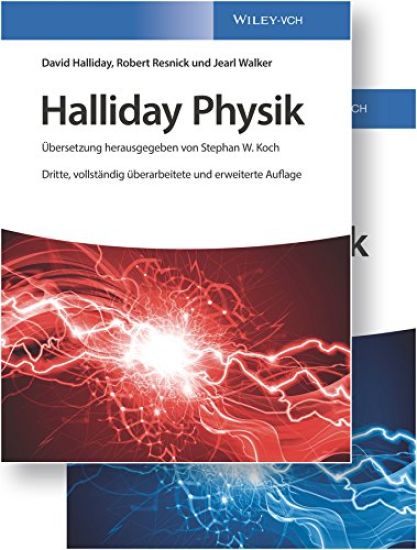
Halliday Physik Deluxe

Halliday Physik Deluxe

Stephan W Koch; David Halliday; Robert Resnick; Jearl Walker; Matthias Delbrück; Michael Bär

Wiley-VCH Verlag GmbH
2017
sidottu
Das Deluxe-Set des "Halliday" aus Lehrbuch und Arbeitsbuch in neuer Auflage ist der ideale Begleiter für ein erfolgreiches Physikstudium. Das Lehrbuch bietet den gesamten Stoff der einführenden Experimentalphysik-Vorlesungen für Hauptfachstudenten. Mehrere Kapitel wurden im Sinne der besseren Verständlichkeit komplett umgeschrieben. Für die dritte Auflage wurden die Kapitel nicht nur überarbeitet, sondern didaktisch neu strukturiert: die Lerninhalte sind nun in Modulen organisiert, wobei jede Einheit die Lernziele explizit aufführt und die Schlüsselkonzepte zusammenfasst. Das Arbeitsbuch hilft bei der Durchdringung des Stoffs: es enthält die Lösungen inklusive des ausführlichen Lösungswegs zu mehr als 2500 Aufgaben unterschiedlichen Schwierigkeitsgrades aus allen Kapiteln des Lehrbuchs.
Semiconductor Quantum Optics

Semiconductor Quantum Optics

Mackillo Kira; Stephan W. Koch

Cambridge University Press
2011
sidottu
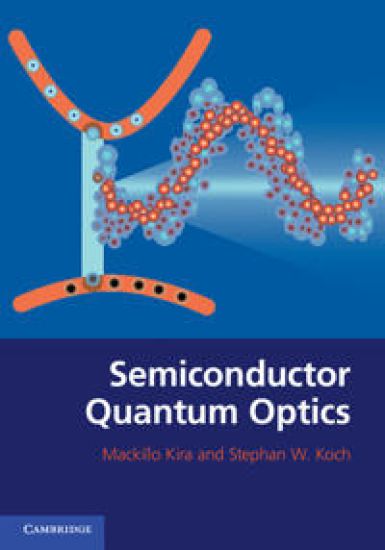
The emerging field of semiconductor quantum optics combines semiconductor physics and quantum optics, with the aim of developing quantum devices with unprecedented performance. In this book researchers and graduate students alike will reach a new level of understanding to begin conducting state-of-the-art investigations. The book combines theoretical methods from quantum optics and solid-state physics to give a consistent microscopic description of light-matter- and many-body-interaction effects in low-dimensional semiconductor nanostructures. It develops the systematic theory needed to treat semiconductor quantum-optical effects, such as strong light-matter coupling, light-matter entanglement, squeezing, as well as quantum-optical semiconductor spectroscopy. Detailed derivations of key equations help readers learn the techniques and nearly 300 exercises help test their understanding of the materials covered. The book is accompanied by a website hosted by the authors, containing further discussions on topical issues, latest trends and publications on the field. The link can be found at www.cambridge.org/9780521875097.
Semiconductor-Laser Physics

Semiconductor-Laser Physics

Weng W. Chow; Stephan W. Koch; Murray III Sargent

Springer-Verlag Berlin and Heidelberg GmbH Co. K
2011
nidottu
Semiconductor-Laser Physics discusses the underlying physics and operational principles of semiconductor lasers. The optical and electronic properties of the semiconductor medium are analyzed in detail, including quantum confinement and gain engineering effects. A semiclassical and a quantum version of the laser theory are presented, including an analysis of single- and multimode operation, instabilities, laser arrays, unstable resonators, and microcavity lasers.
Semiconductor-Laser Fundamentals

Semiconductor-Laser Fundamentals

Weng W. Chow; Stephan W. Koch

Springer-Verlag Berlin and Heidelberg GmbH Co. K
2010
nidottu
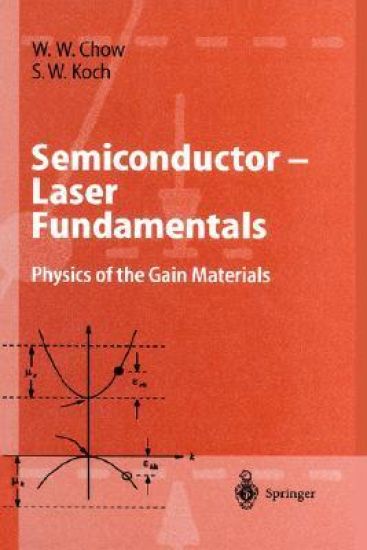
Since Fall of 1993, when we completed the manuscript of our book "Semi­ conductor-Laser Physics" [W.W. Chow, S.W. Koch, and M. Sargent III (Springer, Berlin, Heidelberg, 1994)] many new and exciting developments have taken place in the world of semiconductor lasers. Novel laser and ampli­ fier structures were developed, and others, for example, the VCSEL (vertical cavity surface emitting laser) and monolithic MOPA (master oscillator power amplifier), made the transition from research and development to production. When investigating some of these systems, we discovered instances when de­ vice performance, and thus design depend critically on details of the gain medium properties, e.g., spectral shape and carrier density dependence of the gain and refractive index. New material systems were also introduced, with optical emission wave­ lengths spanning from the mid-infrared to the ultraviolet. Particularly note­ worthy are laser and light-emitting diodes based on the wide-bandgap group-III nitride and II~VI compounds. These devices emit in the visible to ultra-violet wavelength range, which is important for the wide variety of optoelectronic applications. While these novel semiconductor-laser materi­ als show many similarities with the more conventional near-infrared systems, they also possess rather different material parameter combinations. These dif­ ferences appear as band structure modifications and as increased importance of Coulomb effects, such that, e.g., excitonic signatures resulting from the at­ tractive electron-hole interaction are generally significantly more prominent in the wide bandgap systems.
Coherent Semiconductor Optics

Coherent Semiconductor Optics

Torsten Meier; Peter Thomas; Stephan W. Koch

Springer-Verlag Berlin and Heidelberg GmbH Co. K
2010
nidottu
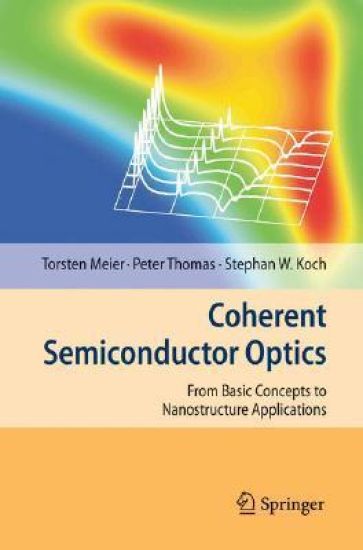
This book could not have been written without the extensive work of many diploma and Ph.D. students in our Theoretical Semiconductor Physics Group at the Philipps-Universit¨ at in Marburg. They have contributed to the f- damental understanding and to many applications in the area of coherent semiconductor optics. The one-dimensional tight-binding model, which is exclusively treated in the present book, has been the basis of many of their diploma and Ph.D. theses. The reader will ?nd references to their results and also their names as authors of the publications listed in the sections “S- gested Reading”. In particular, the authors wish to thank Irina Kuznetsova, who prepared a large number of the ?gures and recalculated the underlying data on the basis of the equations presented in this book in cases where parameters or presentation had to be changed and/or optimized. Someoftheproblems,inparticular,thoseconnectedtothemoreintrod- tory chapters, were solved by Swantje Horst and Joachim Kalden. They made valuable suggestions for improved formulation of the problems and pointed out a number of hints we should give our readers in order to help them with the solutions. Furthermore, we wish to thank all our numerous collaborators, together with whom we have performed research in the area of coherent semiconductor optics in the past and present, for many valuable discussions. In particular, without the close cooperation between experiment and theory this research ?eld would not have advanced to the present level.
Quantum Theory Of The Optical And Electronic Properties Of Semiconductors (5th Edition)

Quantum Theory Of The Optical And Electronic Properties Of Semiconductors (5th Edition)

Hartmut Haug; Stephan W Koch

World Scientific Publishing Co Pte Ltd
2009
nidottu
This invaluable textbook presents the basic elements needed to understand and research into semiconductor physics. It deals with elementary excitations in bulk and low-dimensional semiconductors, including quantum wells, quantum wires and quantum dots. The basic principles underlying optical nonlinearities are developed, including excitonic and many-body plasma effects. Fundamentals of optical bistability, semiconductor lasers, femtosecond excitation, the optical Stark effect, the semiconductor photon echo, magneto-optic effects, as well as bulk and quantum-confined Franz-Keldysh effects, are covered. The material is presented in sufficient detail for graduate students and researchers with a general background in quantum mechanics.This fifth edition includes an additional chapter on 'Quantum Optical Effects' where the theory of quantum optical effects in semiconductors is detailed. Besides deriving the 'semiconductor luminescence equations' and the expression for the stationary luminescence spectrum, results are presented to show the importance of Coulombic effects on the semiconductor luminescence and to elucidate the role of excitonic populations.
Quantum Theory Of The Optical And Electronic Properties Of Semiconductors (5th Edition)

Quantum Theory Of The Optical And Electronic Properties Of Semiconductors (5th Edition)

Hartmut Haug; Stephan W Koch

World Scientific Publishing Co Pte Ltd
2009
sidottu
This invaluable textbook presents the basic elements needed to understand and research into semiconductor physics. It deals with elementary excitations in bulk and low-dimensional semiconductors, including quantum wells, quantum wires and quantum dots. The basic principles underlying optical nonlinearities are developed, including excitonic and many-body plasma effects. Fundamentals of optical bistability, semiconductor lasers, femtosecond excitation, the optical Stark effect, the semiconductor photon echo, magneto-optic effects, as well as bulk and quantum-confined Franz-Keldysh effects, are covered. The material is presented in sufficient detail for graduate students and researchers with a general background in quantum mechanics.This fifth edition includes an additional chapter on 'Quantum Optical Effects' where the theory of quantum optical effects in semiconductors is detailed. Besides deriving the 'semiconductor luminescence equations' and the expression for the stationary luminescence spectrum, results are presented to show the importance of Coulombic effects on the semiconductor luminescence and to elucidate the role of excitonic populations.
Coherent Semiconductor Optics

Coherent Semiconductor Optics

Torsten Meier; Peter Thomas; Stephan W. Koch

Springer-Verlag Berlin and Heidelberg GmbH Co. K
2006
sidottu
This book could not have been written without the extensive work of many diploma and Ph.D. students in our Theoretical Semiconductor Physics Group at the Philipps-Universit¨ at in Marburg. They have contributed to the f- damental understanding and to many applications in the area of coherent semiconductor optics. The one-dimensional tight-binding model, which is exclusively treated in the present book, has been the basis of many of their diploma and Ph.D. theses. The reader will ?nd references to their results and also their names as authors of the publications listed in the sections “S- gested Reading”. In particular, the authors wish to thank Irina Kuznetsova, who prepared a large number of the ?gures and recalculated the underlying data on the basis of the equations presented in this book in cases where parameters or presentation had to be changed and/or optimized. Someoftheproblems,inparticular,thoseconnectedtothemoreintrod- tory chapters, were solved by Swantje Horst and Joachim Kalden. They made valuable suggestions for improved formulation of the problems and pointed out a number of hints we should give our readers in order to help them with the solutions. Furthermore, we wish to thank all our numerous collaborators, together with whom we have performed research in the area of coherent semiconductor optics in the past and present, for many valuable discussions. In particular, without the close cooperation between experiment and theory this research ?eld would not have advanced to the present level.
Semiconductor-Laser Fundamentals

Semiconductor-Laser Fundamentals

Weng W. Chow; Stephan W. Koch

Springer-Verlag Berlin and Heidelberg GmbH Co. K
1999
sidottu
Since Fall of 1993, when we completed the manuscript of our book "Semi­ conductor-Laser Physics" [W.W. Chow, S.W. Koch, and M. Sargent III (Springer, Berlin, Heidelberg, 1994)] many new and exciting developments have taken place in the world of semiconductor lasers. Novel laser and ampli­ fier structures were developed, and others, for example, the VCSEL (vertical cavity surface emitting laser) and monolithic MOPA (master oscillator power amplifier), made the transition from research and development to production. When investigating some of these systems, we discovered instances when de­ vice performance, and thus design depend critically on details of the gain medium properties, e.g., spectral shape and carrier density dependence of the gain and refractive index. New material systems were also introduced, with optical emission wave­ lengths spanning from the mid-infrared to the ultraviolet. Particularly note­ worthy are laser and light-emitting diodes based on the wide-bandgap group-III nitride and II~VI compounds. These devices emit in the visible to ultra-violet wavelength range, which is important for the wide variety of optoelectronic applications. While these novel semiconductor-laser materi­ als show many similarities with the more conventional near-infrared systems, they also possess rather different material parameter combinations. These dif­ ferences appear as band structure modifications and as increased importance of Coulomb effects, such that, e.g., excitonic signatures resulting from the at­ tractive electron-hole interaction are generally significantly more prominent in the wide bandgap systems.
Quantum Theory Of The Optical And Electronic Properties Of Semiconductors (3rd Edition)

Quantum Theory Of The Optical And Electronic Properties Of Semiconductors (3rd Edition)

Hartmut Haug; Stephan W Koch

World Scientific Publishing Co Pte Ltd
1994
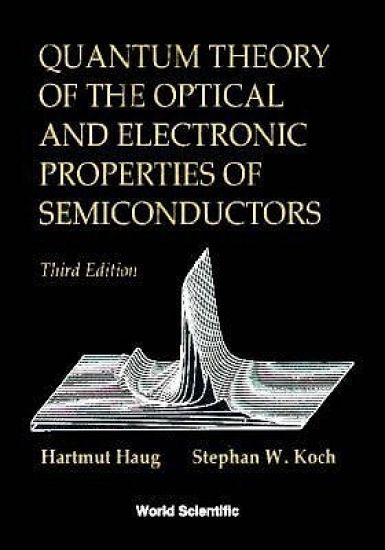
nidottu
This textbook presents the basic elements needed to understand and engage in research in semiconductor physics. It deals with elementary excitations in bulk and low-dimensional semiconductors, including quantum wells, quantum wires and quantum dots. The basic principles underlying optical nonlinearities are developed, including excitonic and many-body plasma effects. The fundamentals of optical bistability, semiconductor lasers, femtosecond excitation, optical Stark effect, semiconductor photon echo, magneto-optic effects, as well as bulk and quantum-confined Franz-Keldysh effects are covered. The material is presented in sufficient detail for graduate students and researchers who have a general background in quantum mechanics.