Kirjojen hintavertailu. Mukana 12 152 606 kirjaa ja 12 kauppaa.

Kirjailija

Stephanie Pezard

Kirjat ja teokset yhdessä paikassa: 36 kirjaa, julkaisuja vuosilta 2011-2024, suosituimpien joukossa Report on the Arctic Capabilities of the U.S. Armed Forces. Vertaile teosten hintoja ja tarkista saatavuus suomalaisista kirjakaupoista.

36 kirjaa

Kirjojen julkaisuhaarukka 2011-2024.

Report on the Arctic Capabilities of the U.S. Armed Forces

Report on the Arctic Capabilities of the U.S. Armed Forces

Abbie Tingstad; Scott Savitz; Benjamin J Sacks; Yuliya Shokh; Irina a Chindea; Scott R Stephenson; Michael T Wilson; James G Kallimani; Kristin Van Abel; Stephanie Pezard; Isabelle Winston; Inez Khan; Dan Abel; Clay McKinney; Yvonne K Crane; Katheryn Giglio; Sherrill Lingel; Lyle J Morris

RAND Corporation
2023
pokkari
This report summarizes the findings of research on U.S. and other armed forces' capabilities in the Arctic, the extent to which non-U.S. entities are operating where U.S. forces cannot, and how those operations might affect U.S. national interests. The authors found that the United States is lacking in capacity and, to a lesser extent, capability and that this creates risk for U.S. security.
Insights from the Plan Blue 21 Game

Insights from the Plan Blue 21 Game

Elizabeth M Bartels; David A Ochmanek; Nathaniel Edenfield; Brien Alkire; Katherine Anania; Michael Bohnert; Julia Brackup; Hannah Jane Byrne; Rachel Costello; Alyssa Demus; John J Drennan; Emily Ellinger; David R Frelinger; Michelle Grisé; Russell Hanson; Mace Moesner; Stephanie Pezard; Stephanie Anne Pillion; Clint Reach; Melissa Shostak; Gabrielle Tarini; Abbie Tingstad

RAND Corporation
2024
pokkari
This report describes the 2021 U.S. Air Force-sponsored Plan Blue game, which examined competition against Russia in the Arctic with a focus on the role of sensing in competition and featured robust participation from regional partners and allies. The purpose of the game was to increase understanding of the capabilities, postures, and alliance command, control, and communication relationships that may be called for in future Arctic operations.
Overcoming Barriers to Working with Highly Capable Allies and Partners in the Air, Space, and Cyber Domains

Overcoming Barriers to Working with Highly Capable Allies and Partners in the Air, Space, and Cyber Domains

Jennifer D P Moroney; Stephanie Pezard; David E Thaler; Gene Germanovich; Beth Grill; Bruce McClintock; Karen Schwindt; Mary Kate Adgie; Anika Binnendijk; Kevin J Connolly; Katie Feistel; Jeffrey W Hornung; Alison K Hottes; Moon Kim; Isabelle Nazha; Gabrielle Tarini; Mark Toukan; Jalen Zeman

RAND Corporation
2023
pokkari
In this report, the authors use 11 case studies to create a typology of the barriers that impede U.S. security cooperation with highly capable allies and partners; identify some of the more specific barriers in the air, space, and cyber domains; suggest mitigation strategies for each of these barriers; and propose a preliminary approach for implementing some of these mitigation strategies.
China's Strategy and Activities in the Arctic

China's Strategy and Activities in the Arctic

Stephanie Pezard; Stephen J Flanagan; Scott W Harold; Irina a Chindea; Benjamin J Sacks; Abbie Tingstad; Tristan Finazzo; Soo Kim

RAND Corporation
2023
pokkari
This report assesses China's strategy and diplomacy in the Arctic and the potential implications of Chinese investments and activities there for the regional rules-based order and for regional and transatlantic security. The authors scrutinize Chinese activities that have been problematic in other parts of the world and assess whether they could also arise in the Arctic. The authors also recommend mitigative U.S. actions.
Security Cooperation in a Strategic Competition

Security Cooperation in a Strategic Competition

Michael J Mazarr; Nathan Beauchamp-Mustafaga; Jonah Blank; Samuel Charap; Michael S Chase; Beth Grill; Derek Grossman; Dara Massicot; Jennifer D P Moroney; Lyle J Morris; Alexander Noyes; Stephanie Pezard; Ashley L Rhoades; Alice Shih; Mark Stalczynski; Melissa Shostak; David E Thaler; Dori Walker

RAND Corporation
2022
pokkari
In this study, RAND researchers examined the current role of security cooperation efforts as a tool in the emerging strategic competition among the United States, Russia, and China. In particular, they sought to identify how, where, and to what degree the three major competitors?plus Australia, Japan, India, and several countries in Europe?are using security cooperation.
Evaluation of the Strength Aptitude Test and Other Fitness Tests to Qualify Air Force Recruits for Physically Demanding Specialties

Evaluation of the Strength Aptitude Test and Other Fitness Tests to Qualify Air Force Recruits for Physically Demanding Specialties

Sean Robson; Stephanie Pezard; Maria C Lytell; Carra S Sims; John E Boon; Jason Michel Etchegaray; Michael Robbins; David Schulker; Jerry M Sollinger; Jason H Campbell; Anthony Atler; Stephan B Seabrook; Deborah L Gebhardt; Todd A Baker; Erica K Volpe; Kathryn A Linnenkohl

RAND
2018
nidottu
The Air Force uses the Strength Aptitude Test (SAT) to determine whether recruits meet the fitness levels needed to perform the duties of various Air Force specialties with physical strength requirements. However, these duties may have changed since the SAT was developed. This report evaluates the SAT and related fitness tests to identify strategies for ensuring airmen can meet job-related physical requirements.
Factoring Security Cooperation Into Core U.S. Air Force Decisionmaking Processes

Factoring Security Cooperation Into Core U.S. Air Force Decisionmaking Processes

David E Thaler; Beth Grill; Jefferson P Marquis; Jennifer D P Moroney; Stephanie Pezard

RAND
2018
nidottu
Security cooperation is an important mission of the U.S. Air Force. This report reviews two core Air Force decisionmaking processes--the strategy, planning, and programming process and the concept development and acquisition process--to determine the extent to which decisionmakers consider security cooperation impact and to recommend ways to make such considerations systematic and explicit.
The Center for Excellence in Disaster Management and Humanitarian Assistance (Cfe-Dmha)

The Center for Excellence in Disaster Management and Humanitarian Assistance (Cfe-Dmha)

Stephanie Pezard; David E. Thaler; Beth Grill; Ariel Klein; Sean Robson

RAND
2016
pokkari
The Department of Defense s Center for Excellence in Disaster Management and Humanitarian Assistance (CFE-DMHA) was established in 1994 to provide and facilitate education, training, and research in civil-military operations. This report examines CFE-DMHA s history, activities, and roles to determine how its missions can best be performed to achieve the objectives of the Department of Defense in this domain."
Defense Institution Building in Africa

Defense Institution Building in Africa

Michael J. McNerney; Stuart E. Johnson; Stephanie Pezard; David Stebbins; Renanah Miles; Angela O'Mahony; Chaoling Feng; Tim Oliver

RAND
2016
pokkari
This report assesses U.S. efforts in defense institution building (DIB) in Africa and suggests possible improvements to planning and execution. It defines DIB and reviews some best practices from DIB and security sector reform experiences. It also highlights how DIB activities serve U.S. official strategic guidance for Africa.
Lessons from U.S. Allies in Security Cooperation with Third Countries

Lessons from U.S. Allies in Security Cooperation with Third Countries

Jennifer D. P. Moroney; Celeste Ward Gventer; Stephanie Pezard; Laurence Smallman

RAND
2011
pokkari
Several key U.S. allies engage in security cooperation, albeit on a smaller scale than the United States. To see what the U.S. Air Force can learn from these efforts, the authors examined how and why three allies--Australia, France, and the United Kingdom--provide security cooperation and highlight three key areas that could benefit from further collaboration: staff talks, exercises, and training followed by exercises.
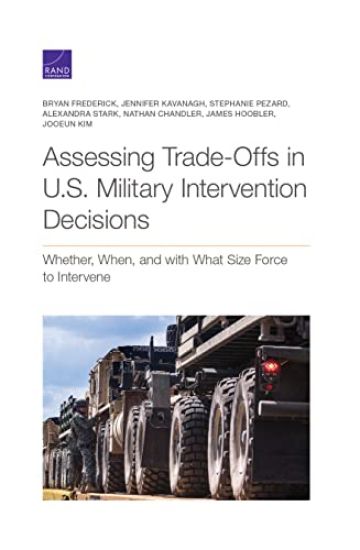
Assessing Trade-Offs in U.S. Military Intervention Decisions

Assessing Trade-Offs in U.S. Military Intervention Decisions

Bryan Frederick; Jennifer Kavanagh; Stephanie Pezard

RAND
2022
nidottu
In this report, the authors create a framework that can be used to rigorously consider the trade-offs involved in U.S. military intervention decisions following the outbreak of a war or crisis. This framework can provide a better understanding of the relationships between intervention timing, intervention size, and intervention outcomes to inform future debates about whether, when, and with what size force to undertake a military intervention.
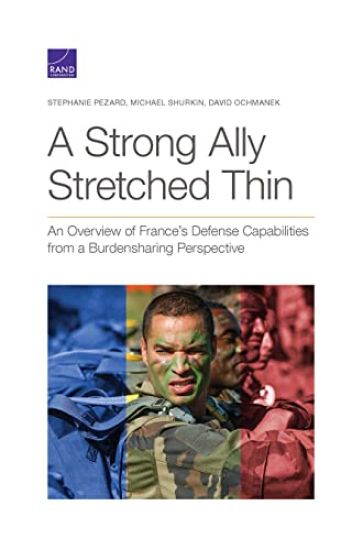
A Strong Ally Stretched Thin

A Strong Ally Stretched Thin

Stephanie Pezard; Michael Shurkin; David Ochmanek

RAND
2021
nidottu
In this report, researchers examine the role that the French military might play as a coalition partner in a hypothetical high-intensity conventional conflict in Europe. Researchers drew on a wide range of publications in French and English, as well as on conversations with French defense experts.
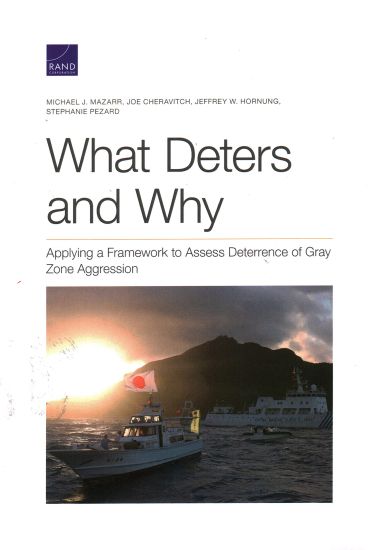
What Deters and Why

What Deters and Why

Michael J Mazarr; Joe Cheravitch; Jeffrey W Hornung; Stephanie Pezard

RAND
2021
nidottu
In this report, RAND researchers identify eight common characteristics of gray zone aggression, develop a framework for assessing the health of U.S. and partner deterrence in the gray zone, and apply the framework to three case studies: China's actions in the Senkaku Islands, Russia's actions in the Baltic states, and North Korea's actions in South Korea.
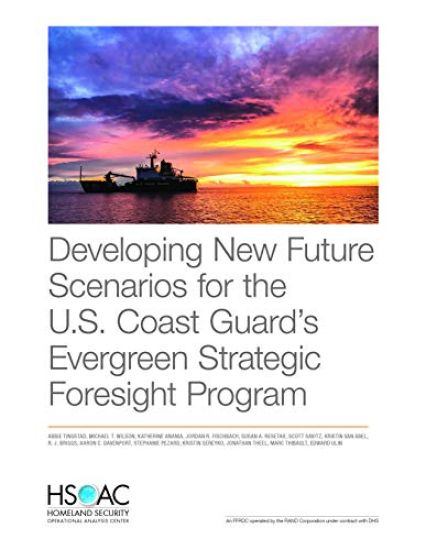
Developing New Future Scenarios for the U.S. Coast Guard's Evergreen Strategic Foresight Program

Developing New Future Scenarios for the U.S. Coast Guard's Evergreen Strategic Foresight Program

Abbie Tingstad; Michael T Wilson; Katherine Anania; Jordan R Fischbach; Susan A Resetar; Scott Savitz; Kristin Van Abel; R J Briggs; Aaron C Davenport; Stephanie Pezard; Kristin Sereyko; Jonathan Theel; Marc Thibault; Edward Ulin

RAND
2020
nidottu
The U.S. Coast Guard's motto is Semper Paratus--always ready. But for what? This report describes an approach to developing scenarios to aid in decisionmaking under deep uncertainty through the Evergreen strategic foresight initiative. The scenarios presented here focus on readiness, but the approach can be adapted for other contexts.
Detecting Malign or Subversive Information Efforts over Social Media

Detecting Malign or Subversive Information Efforts over Social Media

William Marcellino; Krystyna Marcinek; Stephanie Pezard

RAND
2020
nidottu
The authors examine scalable analytics to detect malign or subversive information efforts, using the 2018 World Cup as a case study. The report has operational relevance to the U.S. government. It may benefit both researchers interested in going beyond post hoc recognition of malign or subversive information campaigns to in-time detection and social media companies interested in preventing their platforms from being co-opted by malign actors.
Russia's Hostile Measures

Russia's Hostile Measures

Ben Connable; Stephanie Young; Stephanie Pezard; Andrew Radin; Raphael S Cohen; Katya Migacheva; James Sladden

RAND
2020
nidottu
Russia has historically succeeded in using various hostile measures to sow disorder, weaken democratic institutions, and undermine Western alliances. However, it also has a long track record of strategic shortfalls and even ineptitude. Exploring opportunities to deter, prevent, and counter Russian hostile behavior will benefit NATO and other Western powers in the so-called gray zone short of war, as well as in a conventional warfare scenario.