Kirjojen hintavertailu. Mukana 12 390 323 kirjaa ja 12 kauppaa.

Kirjailija

STEPHEN BATCHELOR

Kirjat ja teokset yhdessä paikassa: 26 kirjaa, julkaisuja vuosilta 1994-2026, suosituimpien joukossa Elogio de la soledad. Vertaile teosten hintoja ja tarkista saatavuus suomalaisista kirjakaupoista.

26 kirjaa

Kirjojen julkaisuhaarukka 1994-2026.

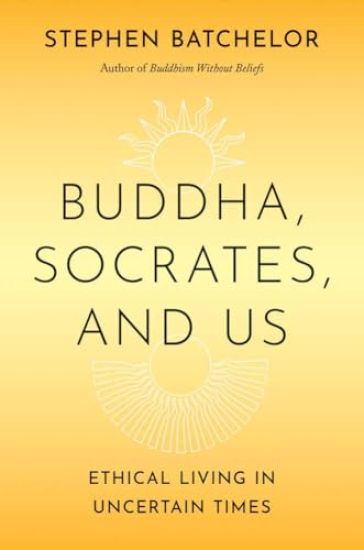
Buddha, Socrates, and Us

Buddha, Socrates, and Us

Stephen Batchelor

YALE UNIVERSITY PRESS
2025
sidottu
A renowned Buddhist teacher turns to two of the most influential figures in history for guidance on how to face the ethical challenges of our time The Buddha’s revolutionary teachings transformed Asia, and his contemporary Socrates laid the foundations of Western philosophy. Although they never met, Socrates and the Buddha each addressed in a radically new and surprisingly similar way the core questions of how to lead a good, just, and dignified life amid turbulence and violence. Common to their teachings was an ethics of uncertainty: both refused to make truth claims about the ultimate nature of reality, insisting on the primacy of critical self-evaluation as the basis of an ethical life. In this illuminating book, best-selling author Stephen Batchelor explores the philosophical, social, and political worlds of the Buddha and Socrates, showing how their teachings continue to provide lessons in how to lead a flourishing and engaged life. Keenly aware of the fickle and conflicted nature of the human mind, Gotama and Socrates inspired their followers to act with humility and courage, risk and resolve, doubt and confidence. Drawing on their insights, and those of their followers, Batchelor uncovers a middle way between Buddhist dharma and Greek philosophy that can serve as a starting point for a “secular faith” that addresses the most pressing spiritual and planetary issues of our age.
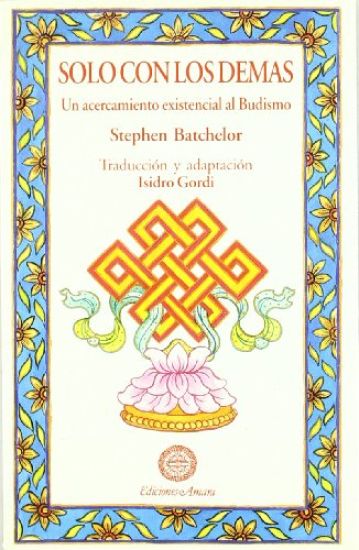
Solo con los demás: Un acercamiento existencial al budismo
Solo con los Dem s. Un acercamiento existencial al Budismo es una ense anza contempor nea necesaria para comprender el mensaje intemporal del Budismo y su incidencia en las relaciones humanas.Est inspirado en Gu a a la Forma de Vida del Bodhisatva, de Shantideva (traducida del tibetano por el mismo autor), en instrucciones orales de maestros budistas modernos, en el cl sico Ser y Tiempo, de Heidegger, y en los escritos de los te logos cristianos Paul Tillich y John MacQuarrie. "Est escrito con una claridad poco usual que hace accesibles temas complejos. Del modo m s sensible, inteligente y cuidadoso llena un serio vac o en el dialogo Oriente-Occidente. Es pionero el uso de la fenomenolog a y el existencialismo, pero a pesar de ello, los t rminos utilizados por estas disciplinas no impiden un encuentro veraz con una tradici n diferente. La estrategia de Batchelor (valerse de estas disciplinas occidentales para hacer accesible el Budismo) es un acierto".David Michael Levin, Profesor Asociado del Departamento de Filosot a Northwestern University Magn fico, inspirador Este excelente libro ha sido para mi un texto revelador, a pesar de mis casi sesenta a os de inter s en el Budismo.El acercamiento de Batchelor inspirar a muchos lectores que nunca han considerado el Budismo como algo relevante para ellos mismos.Del prefacio de John Blofield.
Klimat och ekologi med buddhistiska ögon

Klimat och ekologi med buddhistiska ögon

Stephen Batchelor; Bhikkhu Bodhi; Dekila Chungyalpa; Mark Coleman; Matthew Gindin; Paul Hawken; David Loy; Joanna Macy

Dana Förlag
2023
nidottu
Mänskligheten står inför utmaningar på många plan, med det allt varmare klimatet, utarmningen av jordens resurser och förstörelsen av livsmiljöer för djur och människor. Hur kan vi tackla allt detta, så att både planetens och vår personliga hälsa värnas?Bland västerländska buddhister är dialogen kring de existentiella utmaningar vi nu står inför livlig och engagerad. Inte minst i USA blomstrar det digitala samtal som inspirerats av buddhistiska tankar och andliga praktiker. I Sverige har dock perspektiven från dessa samtal om de stora ödesfrågorna hittills inte fått bred spridning.Boken presenterar ett urval tongivande texter från detta tankeutbyte. Utgångspunkten är att vi inte har någon tid att förlora. Innehållet spänner över allt från socialt engagerad buddhism och kritik av vår moderna civilisation till meditation, djup naturkontakt och kontemplation till hjälp för oss alla. Även metoder och projekt med lösningar för klimatet lyfts fram.Som en röd tråd i boken löper tanken att den ekologiska krisen också är en andlig och psykologisk kris. En kris som samtidigt öppnar för att finna nya perspektiv, styrka och stöd - enskilt och tillsammans.BOKENS FÖRFATTAREStephen Batchelor, Bikkhu Bodhi, Dekila Chungyalpa, Mark Coleman, Matthew Gindin, Paul Hawken, David Loy, Joanna Macy.
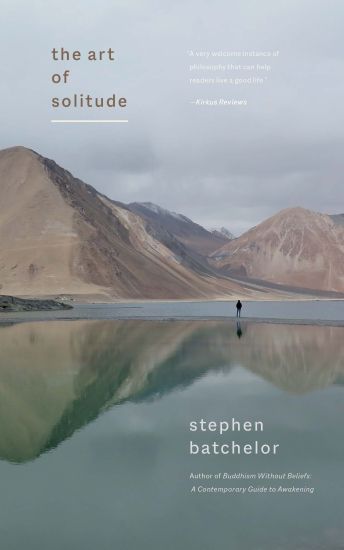
The Art of Solitude

The Art of Solitude

Stephen Batchelor

Yale University Press
2022
pokkari
In a time of social distancing and isolation, a meditation on the beauty of solitude from renowned Buddhist writer Stephen Batchelor A Los Angeles Review of Books “Best of the Year” selection “Whatever a soul is, the author goes a long way toward soothing it. A very welcome instance of philosophy that can help readers live a good life.”—Kirkus Reviews “Elegant and formally ingenious.”—Geoff Wisner, Wall Street Journal When world renowned Buddhist writer Stephen Batchelor turned sixty, he took a sabbatical from his teaching and turned his attention to solitude, a practice integral to the meditative traditions he has long studied and taught. He aimed to venture more deeply into solitude, discovering its full extent and depth. This beautiful literary collage documents his multifaceted explorations. Spending time in remote places, appreciating and making art, practicing meditation and participating in retreats, drinking peyote and ayahuasca, and training himself to keep an open, questioning mind have all contributed to Batchelor’s ability to be simultaneously alone and at ease. Mixed in with his personal narrative are inspiring stories from solitude’s devoted practitioners, from the Buddha to Montaigne, from Vermeer to Agnes Martin. In a hyperconnected world that is at the same time plagued by social isolation, this book shows how to enjoy the inescapable solitude that is at the heart of human life.
Secular Buddhism

Secular Buddhism

Stephen Batchelor

Yale University Press
2018
pokkari
An essential collection of Stephen Batchelor’s most probing and important work on secular Buddhism As the practice of mindfulness permeates mainstream Western culture, more and more people are engaging in a traditional form of Buddhist meditation. However, many of these people have little interest in the religious aspects of Buddhism, and the practice occurs within secular contexts such as hospitals, schools, and the workplace. Is it possible to recover from the Buddhist teachings a vision of human flourishing that is secular rather than religious without compromising the integrity of the tradition? Is there an ethical framework that can underpin and contextualize these practices in a rapidly changing world? In this collected volume of Stephen Batchelor’s writings on these themes, the author explores the complex implications of Buddhism’s secularization. Ranging widely—from reincarnation, religious belief, and agnosticism to the role of the arts in Buddhist practice—he offers a detailed picture of contemporary Buddhism and its attempt to find a voice in the modern world.
Waking, Dreaming, Being

Waking, Dreaming, Being

Evan Thompson; Stephen Batchelor

Columbia University Press
2017
pokkari
A renowned philosopher of the mind, also known for his groundbreaking work on Buddhism and cognitive science, Evan Thompson combines the latest neuroscience research on sleep, dreaming, and meditation with Indian and Western philosophy of mind, casting new light on the self and its relation to the brain. Thompson shows how the self is a changing process, not a static thing. When we are awake we identify with our body, but if we let our mind wander or daydream, we project a mentally imagined self into the remembered past or anticipated future. As we fall asleep, the impression of being a bounded self distinct from the world dissolves, but the self reappears in the dream state. If we have a lucid dream, we no longer identify only with the self within the dream. Our sense of self now includes our dreaming self, the "I" as dreamer. Finally, as we meditate-either in the waking state or in a lucid dream-we can observe whatever images or thoughts arise and how we tend to identify with them as "me." We can also experience sheer awareness itself, distinct from the changing contents that make up our image of the self. Contemplative traditions say that we can learn to let go of the self, so that when we die we can witness its dissolution with equanimity. Thompson weaves together neuroscience, philosophy, and personal narrative to depict these transformations, adding uncommon depth to life's profound questions. Contemplative experience comes to illuminate scientific findings, and scientific evidence enriches the vast knowledge acquired by contemplatives.
After Buddhism

After Buddhism

Stephen Batchelor

Yale University Press
2017
pokkari
A renowned Buddhist teacher’s magnum opus, based on his fresh reading of the tradition’s earliest texts Some twenty-five centuries after the Buddha started teaching, his message continues to inspire people across the globe, including those living in predominantly secular societies. What does it mean to adapt religious practices to secular contexts? Stephen Batchelor, an internationally known author and teacher, is committed to a secularized version of the Buddha’s teachings. The time has come, he feels, to articulate a coherent ethical, contemplative, and philosophical vision of Buddhism for our age. After Buddhism, the culmination of four decades of study and practice in the Tibetan, Zen, and Theravada traditions, is his attempt to set the record straight about who the Buddha was and what he was trying to teach. Combining critical readings of the earliest canonical texts with narrative accounts of five members of the Buddha’s inner circle, Batchelor depicts the Buddha as a pragmatic ethicist rather than a dogmatic metaphysician. He envisions Buddhism as a constantly evolving culture of awakening whose long survival is due to its capacity to reinvent itself and interact creatively with each society it encounters. This original and provocative book presents a new framework for understanding the remarkable spread of Buddhism in today’s globalized world. It also reminds us of what was so startling about the Buddha’s vision of human flourishing.
The Faith To Doubt

The Faith To Doubt

Stephen Batchelor

Counterpoint
2015
nidottu
Kierkegaard said that faith without doubt is simply credulity, the will to believe too readily, especially without adequate evidence, and that  in Doubt can Faith begin." All people involved in spiritual practice, of whatever persuasion, must confront doubt at one time or another, and find a way beyond it to belief, however temporary. But  faith is not equivalent to mere belief. Faith is the condition of ultimate confidence that we have the capacity to follow the path of doubt to its end. And courage."In this engaging spiritual memoir, Stephen Batchelor describes his own training, first as a Tibetan Buddhist and then as a Zen practitioner, and his own direct struggles along his path.  It is most uncanny that we are able to ask questions, for to question means to acknowledge that we do not know something. But it is more than an acknowledgement: it includes a yearning to confront an unknown and illuminate it through understanding. Questioning is a quest."Batchelor is a contemporary Buddhist teacher and writer, best known for his secular or agnostic approach to Buddhism. He considers Buddhism to be a constantly evolving culture of awakening rather than a religious system based on immutable dogmas and beliefs. Buddhism has survived for the past 2,500 years because of its capacity to reinvent itself in accord with the needs of the different Asian societies with which it has creatively interacted throughout its history. As Buddhism encounters modernity, it enters a vital new phase of its development. Through his writings, translations and teaching, Stephen engages in a critical exploration of Buddhism's role in the modern world, which has earned him both condemnation as a heretic and praise as a reformer.
Waking, Dreaming, Being

Waking, Dreaming, Being

Evan Thompson; Stephen Batchelor

Columbia University Press
2014
sidottu
A renowned philosopher of the mind, also known for his groundbreaking work on Buddhism and cognitive science, Evan Thompson combines the latest neuroscience research on sleep, dreaming, and meditation with Indian and Western philosophy of mind, casting new light on the self and its relation to the brain. Thompson shows how the self is a changing process, not a static thing. When we are awake we identify with our body, but if we let our mind wander or daydream, we project a mentally imagined self into the remembered past or anticipated future. As we fall asleep, the impression of being a bounded self distinct from the world dissolves, but the self reappears in the dream state. If we have a lucid dream, we no longer identify only with the self within the dream. Our sense of self now includes our dreaming self, the "I" as dreamer. Finally, as we meditate-either in the waking state or in a lucid dream-we can observe whatever images or thoughts arise and how we tend to identify with them as "me." We can also experience sheer awareness itself, distinct from the changing contents that make up our image of the self. Contemplative traditions say that we can learn to let go of the self, so that when we die we can witness its dissolution with equanimity. Thompson weaves together neuroscience, philosophy, and personal narrative to depict these transformations, adding uncommon depth to life's profound questions. Contemplative experience comes to illuminate scientific findings, and scientific evidence enriches the vast knowledge acquired by contemplatives.
The Awakening of the West

The Awakening of the West

Stephen Batchelor

Echo Point Books Media
2011
pokkari
The Awakening of the West is an insightful and elegantly written history chronicling the developing relationship between Buddhism and Western culture. As anyone familiar with the work of Stephen Batchelor (best-selling author of Buddhism Without Beliefs) would expect, The Awakening of the West is presented in a fresh and lively way and backed by thorough research. Using the innovative approach of starting with the present and working back in time, Batchelor makes it easy to connect familiar contemporary Buddhist teachers to their historical roots. He breathes life into history by capturing the personalities and times of famous and lesser-known but important Buddhist figures. After absorbing these stories and their context, readers will not only have a greater appreciation of Buddhism as a religion but can gain insights that can help them develop their own discerning wisdom. The Awakening of the West is a unique, engaging and important book for anyone seeking a greater understanding of Buddhism.
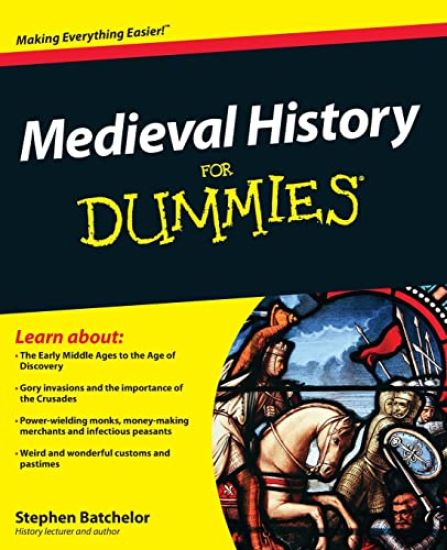
Medieval History For Dummies

Medieval History For Dummies

Stephen Batchelor

John Wiley Sons Inc
2010
nidottu
Rattle through 1000 years of horrible history, from the fifth century to the sixteenth century Famine, plague and public execution – the medieval period wasn't the best time for some, but heroic rulers like Charlemagne, William the Conqueror and Henry V made sure that it was full of action. Brimming with facts, this book helps you get under the skin of the people who lived at the time, from impoverished peasants to opulent monarchs. From the Dark Ages to the Renaissance and all the upheavals in between, this book takes the pain out of medieval history. The Black Death – assess the deadly pandemic that swept through Britain and Europe killing millions of peopleThe Holy Roman Empire strikes back – understand how the empire fought to maintain its positionFalling apart – witness the arrival of powerful armies from the east and invaders from the north, and the dramatic effects of religious schismsHeading for the Holy Land – uncover the reasons why crusading became so popular, and ultimately so unsuccessful, between the eleventh and fourteenth centuriesLiving in the medieval world – understand the lives of monks and monarchs, peasants and popes, and travellers and traders of the periodWaging conflicts, battles and wars – a look through the troubles that shaped the medieval age; from the fall of the Roman Empire to the Wars of the Roses Open the book and find: Why the peasants revoltedWhere Chaucer gained inspiration to write The Canterbury TalesWhich religious groups fought for powerHow the Magna Carta shaped our present-day legal systemWhy the Vikings may have got to America before ColumbusProfiles of the best and worst medieval monarchsHow Joan of Arc made her nameThe great and grisly histories of surviving medieval castles Go to Dummies.com for videos, step-by-step examples, how-to articles or to shop!
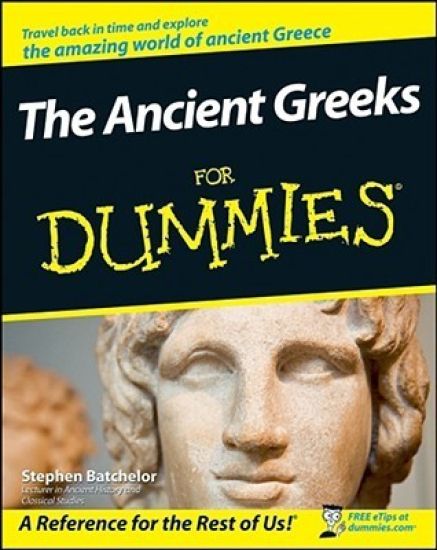
The Ancient Greeks For Dummies

The Ancient Greeks For Dummies

Stephen Batchelor

John Wiley Sons Inc
2008
nidottu
The civilisation of the Ancient Greeks has been immensely influential on the language, politics, educational systems, philosophy, science and arts of Western culture. As well as instigating itself as the birthplace of the Olympics, Ancient Greece is famous for its literature, philosophy, mythology and the beautiful architecture- to which thousands of tourists flock every year. This entertaining guide introduces readers to the amazing world of the Ancient Greeks. It offers a complete rundown of Greek history alongside fascinating insights into daily life in Ancient Greece and a captivating overview of Greek mythology. Readers will discover how this ancient culture came to be the cornerstone of Western civilisation and the enormous influence it has had on our language, politics, education, philosophy, science, arts and sport. The history of Ancient Greece remains a wide topic of interest, particularly renowned for its influential and diverse cultureThis basic guide will allow greater access to this vibrant area of study, and provide a distinct and light-hearted approach to this vast area historyCovers dozens of topics, including; the early civilisations, war & fighting, home & family, day-to-day life and much, much more! About the author Steve Batchelor is a lecturer in Classics at Richmond College and has been teaching ancient history for 10 years. He has written reviews for various publications, including History Today, and he has also been involved in running guided historical tours of Greece.