Kirjojen hintavertailu. Mukana 12 595 353 kirjaa ja 12 kauppaa.

Kirjailija

Stephen Bell

Kirjat ja teokset yhdessä paikassa: 10 kirjaa, julkaisuja vuosilta 2004-2022, suosituimpien joukossa Rebel, Priest and Prophet: A Biography of Edward McGlynn. Vertaile teosten hintoja ja tarkista saatavuus suomalaisista kirjakaupoista.

10 kirjaa

Kirjojen julkaisuhaarukka 2004-2022.

Banking on Growth Models

Banking on Growth Models

Stephen Bell; Hui Feng

CORNELL UNIVERSITY PRESS
2022
sidottu
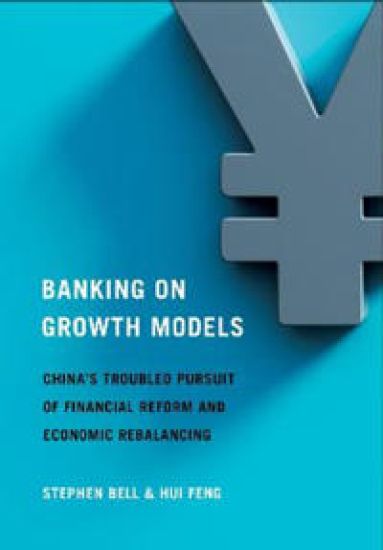
Banking on Growth Models contends that China's rapid economic rise from the late 1970s to today has been built on and shaped by a highly politicized and inefficient bank-centric financial system. Stephen Bell and Hui Feng argue that if the Chinese growth model drives how key economic sectors interact, no amount of incremental reform can have much impact on the financial system—meaningful reform can stem only from a revised growth model. For a time after the global financial crisis, it appeared that the expansion of a more market-oriented shadow banking system might help sustain China's economic growth. Since around 2015, however, Xi Jinping's regime has reversed this trajectory and placed China's financial system under heavy state control, resulting in slowed economic development and skyrocketing national debt. China's market transition and economic rebalancing are now in doubt, as is the fate of the nation's economy. By pinpointing finance as a vital element of the growth model, Bell and Feng provide a convincing assessment of financial risks and the prospects for economic rebalancing in China. Banking on Growth Models demystifies the world of Chinese banking and finance as it investigates an ever-rising national debt, a declining rate of economic growth, and the possibility of dire and drastic reform by the Asian superpower's government.
Fair Share

Fair Share

Stephen Bell; Michael Keating

Melbourne University Press
2018
sidottu
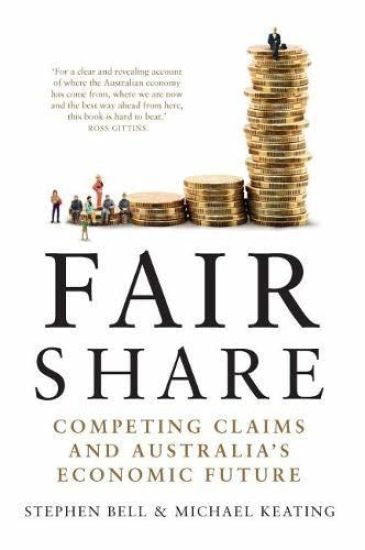
Winners and losers: it's the brutal reality in most advanced economies. Increased inequality, economic stagnation and financial instability are the consequences of technological change, globalisation and the massive increase in financial systems. Governments struggle to deal with the unrest this creates and to resolve competing claims for the spoils of growth.Australia's egalitarian traditions and past reforms have served the country well, but the risks of weakening demand, stagnating living standards and structural unemployment are growing and require urgent attention. Does Australia have the fiscal and political capacity to achieve a reform agenda? Can the Australian political system manage these vital changes? Will voters support them? Fair Share ignites the necessary debate to instigate action.
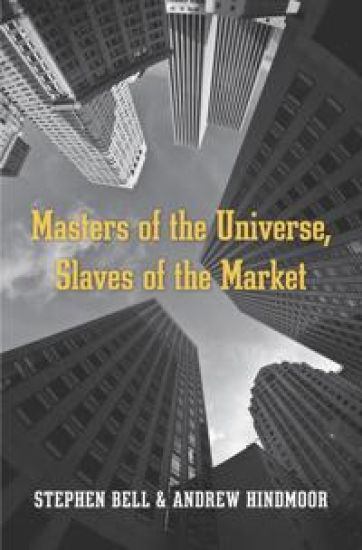
Masters of the Universe, Slaves of the Market

Masters of the Universe, Slaves of the Market

Stephen Bell; Andrew Hindmoor

Harvard University Press
2015
sidottu
This account of the financial crisis of 2008–2009 compares banking systems in the United States and the United Kingdom to those of Canada and Australia and explains why the system imploded in the former but not the latter. Central to this analysis are differences in bankers’ beliefs and incentives in different banking markets.A boom mentality and fear of being left behind by competitors drove many U.S. and British bank executives to take extraordinary risks in creating new financial products. Intense market competition, poorly understood trading instruments, and escalating system complexity both drove and misled bankers. Formerly illiquid assets such as mortgages and other forms of debt were repackaged into complex securities, including collateralized debt obligations (CDOs). These were then traded on an industrial scale, and in 2007 and 2008, when their value collapsed, economic activity fell into a deep freeze. The financial crisis threatened not just investment banks and their insurers but also individual homeowners and workers at every level. In contrast, because banks in Canada and Australia could make good profits through traditional lending practices, they did not confront the same pressures to reinvent themselves as did banks in the United States and the United Kingdom, thus allowing them to avoid the fate of their overseas counterparts.Stephen Bell and Andrew Hindmoor argue that trading and systemic risk in the banking system need to be reined in. However, prospects for this are not promising given the commitment of governments in the crisis-hit economies to protect the “international competitiveness” of the London and New York financial markets.
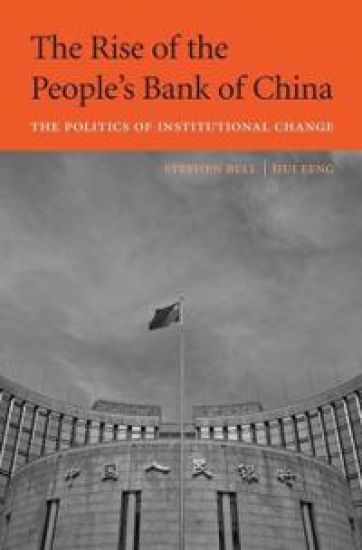
The Rise of the People’s Bank of China

The Rise of the People’s Bank of China

Stephen Bell; Hui Feng

Harvard University Press
2013
sidottu
With $4.5 trillion in total assets, the People’s Bank of China now surpasses the U.S. Federal Reserve as the world’s biggest central bank. The Rise of the People’s Bank of China investigates how this increasingly authoritative institution grew from a Leninist party-state that once jealously guarded control of banking and macroeconomic policy. Relying on interviews with key players, this book is the first comprehensive and up-to-date account of the evolution of the central banking and monetary policy system in reform China.Stephen Bell and Hui Feng trace the bank’s ascent to Beijing’s policy circle, and explore the political and institutional dynamics behind its rise. In the early 1990s, the PBC—benefitting from political patronage and perceptions of its unique professional competency—found itself positioned to help steer the Chinese economy toward a more liberal, market-oriented system. Over the following decades, the PBC has assumed a prominent role in policy deliberations and financial reforms, such as fighting inflation, relaxing China’s exchange rate regime, managing reserves, reforming banking, and internationalizing the renminbi. Today, the People’s Bank of China confronts significant challenges in controlling inflation on the back of runaway growth, but it has established a strong track record in setting policy for both domestic reform and integration into the global economy.
Genome Duplication

Genome Duplication

Melvin DePamphilis; Stephen Bell

Focal Press
2010
nidottu
Genome Duplication provides a comprehensive and readable overview of the underlying principles that govern genome duplication in all forms of life, from the simplest cell to the most complex multicellular organism. Using examples from the three domains of life - bacteria, archaea, and eukarya - Genome Duplication shows how all living organisms store their genome as DNA and how they all use the same evolutionary-conserved mechanism to duplicate it: semi-conservative DNA replication by the replication fork. The text shows how the replication fork determines where organisms begin genome duplication, how they produce a complete copy of their genome each time a cell divides, and how they link genome duplication to cell division. Genome Duplication explains how mistakes in genome duplication are associated with genetic disorders and cancer, and how understanding genome duplication, its regulation, and how the mechanisms differ between different forms of life, is critical to the understanding and treatment of human disease.
A Life in Shadow

A Life in Shadow

Stephen Bell

Stanford University Press
2010
sidottu
French naturalist and medical doctor Aimé Bonpland (1773–1858) was one of the most important scientific explorers of South America in the early nineteenth century. From 1799 to 1804, he worked alongside Alexander von Humboldt as the latter carried out his celebrated research in northern South America, but he later returned to conduct his own research farther south. A Life in Shadow accounts for the entire span of Bonpland's remarkable and diverse career in South America—in Argentina, Paraguay (where he was imprisoned for nearly a decade), Uruguay, and southernmost Brazil—based on extensive archival material. The study reconnects Bonpland's divided records in Europe and South America and delves into his studies of rural resources in interior regions of South America, including experimental cultivation techniques. This is a fascinating account of a man—a doctor, farmer, rancher, scientific explorer, and political conspirator—who interacted in many revealing ways with the evolving societies and institutions of South America.
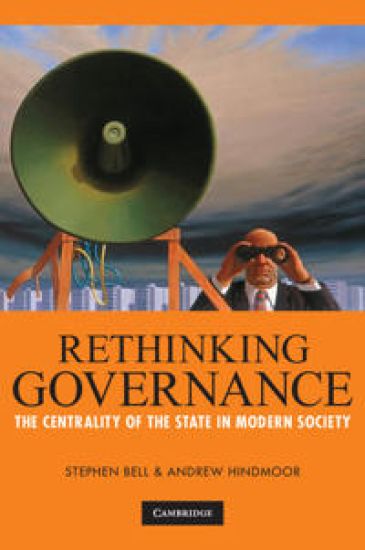
Rethinking Governance

Rethinking Governance

Stephen Bell; Andrew Hindmoor

Cambridge University Press
2009
pokkari
Several problems plague contemporary thinking about governance. From the multiple definitions that are often vague and confusing, to the assumption that governance strategies, networks and markets represent attempts by weakening states to maintain control. Rethinking Governance questions this view and seeks to clarify how we understand governance. Arguing that it is best understood as 'the strategies used by governments to help govern', the authors counter the view that governments have been decentred. They show that far from receding, states are in fact enhancing their capacity to govern by developing closer ties with non-government sectors. Identifying five 'modes' of government (governance through hierarchy, persuasion, markets and contracts, community engagement, and network associations), Stephen Bell and Andrew Hindmoor use practical examples to explore the strengths and limitations of each. In so doing, they demonstrate how modern states are using a mixture of governance modes to address specific policy problems. This book demonstrates why the argument that states are being 'hollowed out' is overblown.
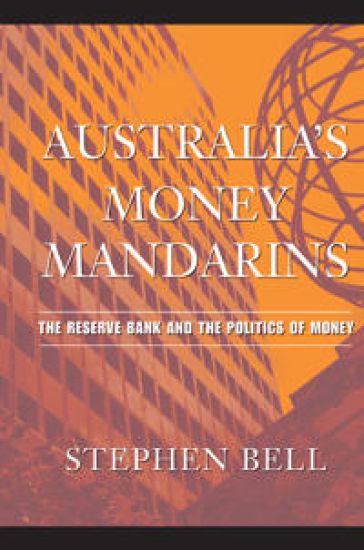
Australia's Money Mandarins

Australia's Money Mandarins

Stephen Bell

Cambridge University Press
2006
pokkari
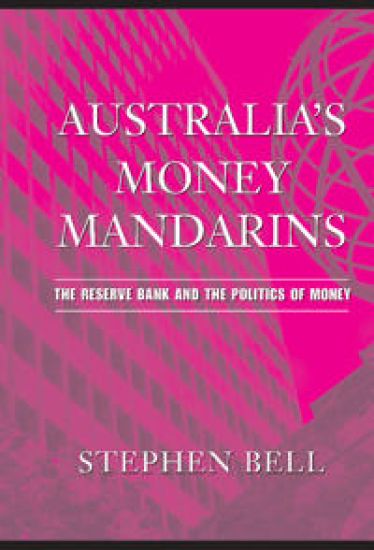
For most of its life the Reserve Bank of Australia (RBA) has led a fairly conservative existence. However, since the early 1980s the economy has experienced financial and market deregulation and general economic liberalisation. The RBA has been caught up with the turbulent policy debates that have ensued. Australia's Money Mandarins, first published in 2004, tells the story of the RBA since the early 1980s. It discusses how the Bank operated in the new political environment created by deregulation and the fight against inflation. It describes the conflicts with the government and the Department of Treasury, and how the bank dealt with the rough and tumble of politics and managed to assert a level of independence in the 1990s. Including frank interviews with key figures like Bob Johnson, Bernie Fraser, Ian Macfarlane and Paul Keating this book will appeal to anyone with an interest in the politics of money.
Australia's Money Mandarins

Australia's Money Mandarins

Stephen Bell

Cambridge University Press
2004
sidottu
For most of its life the Reserve Bank of Australia (RBA) has lead a fairly conservative existence. However, since the early 1980s the economy has experienced financial and market deregulation and general economic liberalisation. The RBA has been caught up with the turbulent policy debates that have ensued. Australia’s Money Mandarins tells the story of the RBA over the past two decades. It discusses how the Bank operated in the new political environment created by deregulation and the fight against inflation. It describes the conflicts with the government and the Department of Treasury, and how the bank dealt with the rough and tumble of politics and managed to assert a level of independence in the 1990s. Including frank interviews with key figures like Bob Johnson, Bernie Fraser, Ian Macfarlane and Paul Keating this book will appeal to anyone with an interest in the politics of money.