Kirjojen hintavertailu. Mukana 12 390 323 kirjaa ja 12 kauppaa.

Kirjailija

Stephen Bullivant

Kirjat ja teokset yhdessä paikassa: 10 kirjaa, julkaisuja vuosilta 2012-2027, suosituimpien joukossa Trads. Vertaile teosten hintoja ja tarkista saatavuus suomalaisista kirjakaupoista.

10 kirjaa

Kirjojen julkaisuhaarukka 2012-2027.

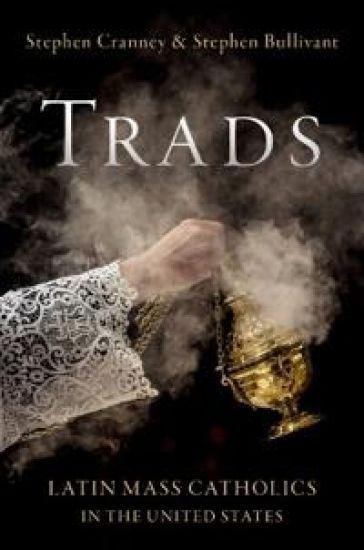
Trads

Trads

Stephen Cranney; Stephen Bullivant

Oxford University Press
2027
sidottu
Who are "Trad" Catholics? And what can they tell us about the future of Catholicism? They've been called divisive, extreme, and even cult-like. They've also been hailed as the future of Catholicism. From The View to the Vatican, from Vanity Fair to the Vice-President, everyone seems to have an opinion about Catholics who attend the Traditional Latin Mass Catholics--or "Trads"--but who are they really? In Trads: Latin Mass Catholics in the United States, sociologists Stephen Cranney and Stephen Bullivant provide the first full-scale, data-driven portrait of this strikingly resilient movement. Blending ethnographic observation, original survey data, and in-depth interviews, they reveal who attends Mass in Latin--a language that they (for the most part) don't speak--what motivates them, how they differ from other American Catholics, and what their growth means for the Church's future. Are they mostly young, edgy converts? Or are they rigid extremists warned about by church authorities? Do they reject Vatican II and the modern Church, or are they simply seeking beauty, reverence, and tradition in their worship? How have papal reforms affected their communities, and what does the future hold for this movement that seems to generate outsized feeling--both positive and negative--wherever it is discussed? Trads separates myth from reality, offering crucial insights for anyone seeking to understand one of the most fascinating phenomena in contemporary American religion. The result is a surprising account of a community far more complex than either its champions or critics might expect.
God and Astrobiology

God and Astrobiology

Richard Playford; Stephen Bullivant; Janet Siefert

Cambridge University Press
2024
sidottu
The perception that life on other planets would be, problematic for religious people, and indeed for religion itself, is a longstanding one. It is partially rooted in fact: astrobiological speculations have, on occasion, engendered religious controversies. Historical discussions are often far more nuanced, and less one-sided than often imagined. 'Exotheology' is a lively subdiscipline within several religious traditions. This Element offers a wide-ranging introduction to the multifarious 'problems of God and astrobiology', real and perceived. It covers major topics within Christian theology (e.g., creation, incarnation, salvation), as well as issues specific to Judaism, Islam, Buddhism, and Hinduism. It also discusses the very different perspectives offered by other (non)religious traditions, including Mormonism, various 'alien-positive' new religious movements (e.g., Heaven's Gate, Scientology, Raëlism), and the 'Ancient Astronaunt' theories popularized by Erich von Daniken and the History channel's Ancient Aliens.
God and Astrobiology

God and Astrobiology

Richard Playford; Stephen Bullivant; Janet Siefert

Cambridge University Press
2024
pokkari
The perception that life on other planets would be, problematic for religious people, and indeed for religion itself, is a longstanding one. It is partially rooted in fact: astrobiological speculations have, on occasion, engendered religious controversies. Historical discussions are often far more nuanced, and less one-sided than often imagined. 'Exotheology' is a lively subdiscipline within several religious traditions. This Element offers a wide-ranging introduction to the multifarious 'problems of God and astrobiology', real and perceived. It covers major topics within Christian theology (e.g., creation, incarnation, salvation), as well as issues specific to Judaism, Islam, Buddhism, and Hinduism. It also discusses the very different perspectives offered by other (non)religious traditions, including Mormonism, various 'alien-positive' new religious movements (e.g., Heaven's Gate, Scientology, Raëlism), and the 'Ancient Astronaunt' theories popularized by Erich von Daniken and the History channel's Ancient Aliens.
Nonverts

Nonverts

Stephen Bullivant

OXFORD UNIVERSITY PRESS INC
2023
sidottu
An entertaining and insightful exploration of the American ex-religious The United States is in the midst of a religious revolution. Or, perhaps it is better to say a non-religious revolution. Around a quarter of US adults now say they have no religion. The great majority of these religious "nones" also say that they used to belong to a religion but no longer do. These are the nonverts: think "converts," but from having religion to having none. There are currently has about 59 million of them in the United States. Nonverts explores who they are, and why they joined the rising tide of the ex-religious. One of world's leading experts on contemporary atheism and nonreligiosity, sociologist and theologian Stephen Bullivant draws on dozens of interviews, original analysis of high-quality survey data, and a wealth of cutting-edge studies, to present an entertaining and insightful exploration of America's ex-religious landscape. Bullivant criss-crosses the country, talking to everyone from ex-Mormons in Utah to ex-Catholics in Pennsylvania, from ex-Evangelicals in Georgia to ex-Muslims in California, showing not only what they have in common but also how the traditions they left behind continue to shape them. While American religion is not going to die out any time soon, ex-Christian America is a growing presence in national life. America's religious revolution is not just a religious revolution -- it is catalyzing a profound social, cultural, moral, and political impact. Nonverts will serve as an indispensable guide to this shifting landscape, as well as the future of American life.
Vatican II

Vatican II

Shaun Blanchard; Stephen Bullivant

Oxford University Press
2023
nidottu
Very Short Introductions: Brilliant, Sharp, Inspiring The Second Vatican Council (1962-1965), or Vatican II, is arguably the most significant event in the life of the Catholic Church since the Reformation. The Council initiated, intentionally or not, profound changes not simply within Catholic theology, but in the religious, social, and moral lives of the world's billion Catholics. It also reconfigured, intellectually and practically, the Church's engagements with those outside of it - most obviously with regard to other religions. The sixteen documents formally issued by Vatican II constitute some of the most influential writings of the whole twentieth century. Debates over their correct interpretation and authority are constant, but they remain an indispensable point-of-reference for all areas of Catholic life, from liturgy and sacraments, to the Church's vast network of charitable and educational endeavours the world over. In this Very Short Introduction, Shaun Blanchard and Stephen Bullivant present the backstory to this event. Vatican II is explored in light of the wider history of the Catholic Church and placed in the tumultuous context of the 1960s. It distils the research on Vatican II, employing the first-hand accounts of participants and observers, and the official proceedings of the Council to paint a rich picture of one of the most important events of the last century. ABOUT THE SERIES: The Very Short Introductions series from Oxford University Press contains hundreds of titles in almost every subject area. These pocket-sized books are the perfect way to get ahead in a new subject quickly. Our expert authors combine facts, analysis, perspective, new ideas, and enthusiasm to make interesting and challenging topics highly readable.
Catholics in Contemporary Britain

Catholics in Contemporary Britain

Ben Clements; Stephen Bullivant

Oxford University Press
2022
sidottu
Catholics in Contemporary Britain showcases findings from a wide-ranging, empirical study of Catholics living in Britain. It offers a sociologically-informed study, placing the contemporary Catholic community in the wider contexts of their society and the global faith of which they are a part. The book has been animated by a set of compelling broader questions : Who are the Catholics in Britain? How do they engage with their faith and with the Church? What do they think about issue within, and the leadership of, their Church? What are their views on wider social issues and of the party-political landscape? The study is thematically broad in scope, focusing on demography, religiosity (addressing the three 'Bs' of 'believing', 'belonging', and 'behaving'), social-moral issues, church leadership and schooling, and party support and voting behaviour. The book presents a rich and fascinating demographic, religious, and attitudinal profile of Britain's Catholics in the 21st Century.
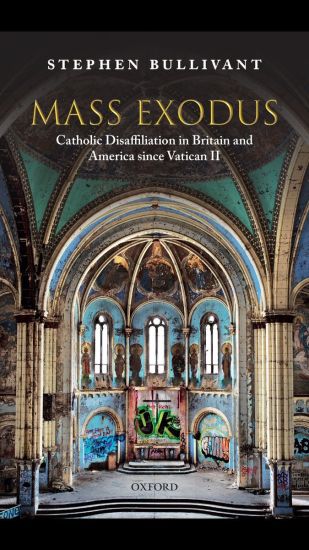
Mass Exodus

Mass Exodus

Stephen Bullivant

Oxford University Press
2020
nidottu
Of those raised Catholic, just 13% still attend Mass weekly, and 37% say they have 'no religion'. But is this all the fault of Vatican II, and its runaway reforms? Or are wider social, cultural, and moral forces primarily to blame? In 1962, Pope John XXIII opened the Second Vatican Council with the prophecy that 'a new day is dawning on the Church, bathing her in radiant splendour'. Desiring 'to impart an ever increasing vigour to the Christian life of the faithful', the Council Fathers devoted particular attention to the laity, and set in motion a series of sweeping reforms. The most significant of these centred on refashioning the Church's liturgy--'the source and summit of the Christian life'--in order to make 'it pastorally efficacious to the fullest degree'. Over fifty years on, however, the statistics speak for themselves. In America, only 15% of cradle Catholics say that they attend Mass on a weekly basis; meanwhile, 35% no longer even tick the 'Catholic box' on surveys. In Britain, the signs are direr still. Catholicism is not the only Christian group to have suffered serious declines since the 1960s. If anything Catholics exhibit higher church attendance, and better retention, than most Protestant churches do. If Vatican II is not the cause of Catholicism's crisis, might it instead be the secret to its comparative success? Mass Exodus is the first serious historical and sociological study of Catholic lapsation and disaffiliation. Drawing on a wide range of theological, historical, and sociological sources, Stephen Bullivant offers a comparative study of secularization across two famously contrasting religious cultures: Britain and the USA.
Mass Exodus

Mass Exodus

Stephen Bullivant

Oxford University Press
2019
sidottu
In 1962, Pope John XXIII opened the Second Vatican Council with the prophecy that 'a new day is dawning on the Church, bathing her in radiant splendour'. Desiring 'to impart an ever increasing vigour to the Christian life of the faithful', the Council Fathers devoted particular attention to the laity, and set in motion a series of sweeping reforms. The most significant of these centred on refashioning the Church's liturgy--'the source and summit of the Christian life'--in order to make 'it pastorally efficacious to the fullest degree'. Over fifty years on, however, the statistics speak for themselves. In America, only 15% of cradle Catholics say that they attend Mass on a weekly basis; meanwhile, 35% no longer even tick the 'Catholic box' on surveys. In Britain, the signs are direr still. Of those raised Catholic, just 13% still attend Mass weekly, and 37% say they have 'no religion'. But is this all the fault of Vatican II, and its runaway reforms? Or are wider social, cultural, and moral forces primarily to blame? Catholicism is not the only Christian group to have suffered serious declines since the 1960s. If anything Catholics exhibit higher church attendance, and better retention, than most Protestant churches do. If Vatican II is not the cause of Catholicism's crisis, might it instead be the secret to its comparative success? Mass Exodus is the first serious historical and sociological study of Catholic lapsation and disaffiliation. Drawing on a wide range of theological, historical, and sociological sources, Stephen Bullivant offers a comparative study of secularization across two famously contrasting religious cultures: Britain and the USA.
Faith and Unbelief

Faith and Unbelief

Stephen Bullivant

Canterbury Press Norwich
2013
nidottu
Most Christian books on atheism set out to critique the writings of well-known figures such as Richard Dawkins and Christopher Hitchens, who represent one, albeit very vocal, expression of a more pervasive, subtle and widespread phenomenon that exerts a powerful influence in many areas of public life. This book is distinct in offering a rounded understanding of the development of atheism, its many faces, and a guide to the topics at the interface between the Christian faith and our modern-day culture of unbelief. It asks: Can a rational person still believe in God? What does the rise in atheism in Christian countries say about the church? Can unbelieving friends and family members be saved? How can Christians present the gospel in a world of unbelief? In exploring the roots and reasons for atheism, and key questions of dialogue and evangelism, this will equip Christians for serious engagement with today’s many forms of atheism.
The Salvation of Atheists and Catholic Dogmatic Theology

The Salvation of Atheists and Catholic Dogmatic Theology

Stephen Bullivant

Oxford University Press
2012
sidottu
Since the Second Vatican Council (1962-5), the Catholic Church has formally declared the possibility of salvation for atheists: 'those who, without fault, have not yet arrived at an express recognition of God' (Lumen Gentium 16). However, in the very same document, the Council also reiterates the traditional doctrine of the necessity of faith, baptism, and the mediation of Church in order for someone to be saved (Lumen Gentium 14). This monograph explores how these two seemingly contradictory claims may satisfactorily be reconciled. Specifically, it asks - and ultimately answers - the question: How, within the parameters of Catholic dogmatic theology, is it possible for an atheist to be saved? As the first full-length study of this topic since Vatican II, the book discusses crucial foundational issues - the understanding of 'atheist' in Catholic theology; the developing views on both unbelief, and the salvation of non-Christians, in the decades preceding the Council - before tackling the conciliar teaching itself. Considerable attention is then given to the classic solution of imputing an 'implicit' faith to righteous atheists, best known from Karl Rahner's theory of 'anonymous Christians' (though the basic idea was advocated by many other major figures, including Ratzinger, Schillebeeckx, de Lubac, Balthasar, and Küng). After discussing Rahner's specific proposals in detail, this kind of approach is however shown to be untenable. In its place, a new way of understanding Vatican II's optimism for atheists is developed in detail, in light of scripture, tradition, and magisterium. This draws principally on Christ's descent into Hell, a renewed understanding of invincible ignorance, and a literal interpretation of Matthew 25.