Kirjojen hintavertailu. Mukana 12 390 323 kirjaa ja 12 kauppaa.

Kirjailija

Stephen D. Smith

Kirjat ja teokset yhdessä paikassa: 13 kirjaa, julkaisuja vuosilta 2004-2026, suosituimpien joukossa Holocaust XR. Vertaile teosten hintoja ja tarkista saatavuus suomalaisista kirjakaupoista.

Mukana myös kirjoitusasut: Stephen D Smith

13 kirjaa

Kirjojen julkaisuhaarukka 2004-2026.

Holocaust XR

Holocaust XR

Stephen D. Smith

TAYLOR FRANCIS LTD
2026
nidottu
As the last Holocaust survivors bear witness in an age of deepfakes, avatars, and AI, the authenticity of witness is at stake as never before. Holocaust XR examines immersive and extended reality technologies through the lens of testimonial methodology, ethics, representation, and authenticity. Written by a principal architect of the field of immersive testimony—Dimensions in Testimony, The Last Goodbye, IWalk—this volume moves from the philosophy of Walter Benjamin and Martin Buber to the technologies of virtual reality and conversational AI, asking a single urgent question: what methods do we use to preserve the agency of the eyewitness in an agentic world? At the book's ethical center is the “first person first” principle: the conviction that survivors must remain co-creators in the final act of witness. Scholars and students in Holocaust studies, memory studies, digital humanities, and immersive media will find here both a theoretical framework and a practitioner's guide — one that equips readers to navigate the ethical, representational, and technological choices that will define Holocaust memory for generations to come.
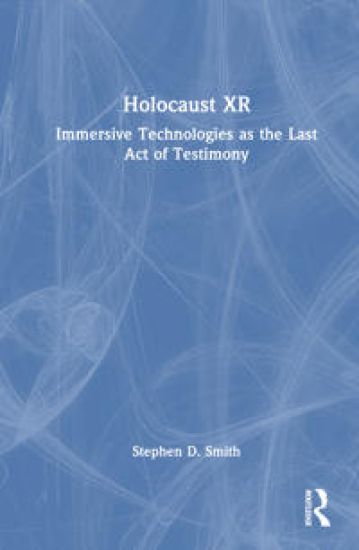
Holocaust XR

Holocaust XR

Stephen D. Smith

TAYLOR FRANCIS LTD
2026
sidottu
As the last Holocaust survivors bear witness in an age of deepfakes, avatars, and AI, the authenticity of witness is at stake as never before. Holocaust XR examines immersive and extended reality technologies through the lens of testimonial methodology, ethics, representation, and authenticity. Written by a principal architect of the field of immersive testimony—Dimensions in Testimony, The Last Goodbye, IWalk—this volume moves from the philosophy of Walter Benjamin and Martin Buber to the technologies of virtual reality and conversational AI, asking a single urgent question: what methods do we use to preserve the agency of the eyewitness in an agentic world? At the book's ethical center is the “first person first” principle: the conviction that survivors must remain co-creators in the final act of witness. Scholars and students in Holocaust studies, memory studies, digital humanities, and immersive media will find here both a theoretical framework and a practitioner's guide — one that equips readers to navigate the ethical, representational, and technological choices that will define Holocaust memory for generations to come.
The Trajectory of Holocaust Memory

The Trajectory of Holocaust Memory

Stephen D. Smith

TAYLOR FRANCIS LTD
2022
sidottu
The Trajectory of Holocaust Memory: The Crisis of Testimony in Theory and Practice re-considers survivor testimony, moving from a subject-object reading of the past to a subject-subject encounter in the present. It explores how testimony evolves in relationship to the life of eyewitnesses across time. This book breaks new ground based on three principles. The first draws on Martin Buber’s “I-Thou” concept, transforming the object of history into an encounter between subjects. The second employs the Jungian concept of identity, whereby the individual (internal identity) and the persona (external identity) reframe testimony as an extension of the individual. They are a living subject, rather than merely a persona or narrative. The third principle draws on Daniel Kahneman’s concept of the experiencing self, which relives events as they occurred, and the remembering self, which reflects on their meaning in sum. Taken together, these principles comprise a new literacy of testimony that enables the surviving victim and the listener to enter a relationship of trust. Designed for readers of Holocaust history and literature, this book defines the modalities of memory, witness, and testimony. It shows how encountering the individual who lived through the past changes how testimony is understood, and therefore what it can come to mean.
The Trajectory of Holocaust Memory

The Trajectory of Holocaust Memory

Stephen D. Smith

TAYLOR FRANCIS LTD
2022
nidottu
The Trajectory of Holocaust Memory: The Crisis of Testimony in Theory and Practice re-considers survivor testimony, moving from a subject-object reading of the past to a subject-subject encounter in the present. It explores how testimony evolves in relationship to the life of eyewitnesses across time. This book breaks new ground based on three principles. The first draws on Martin Buber’s “I-Thou” concept, transforming the object of history into an encounter between subjects. The second employs the Jungian concept of identity, whereby the individual (internal identity) and the persona (external identity) reframe testimony as an extension of the individual. They are a living subject, rather than merely a persona or narrative. The third principle draws on Daniel Kahneman’s concept of the experiencing self, which relives events as they occurred, and the remembering self, which reflects on their meaning in sum. Taken together, these principles comprise a new literacy of testimony that enables the surviving victim and the listener to enter a relationship of trust. Designed for readers of Holocaust history and literature, this book defines the modalities of memory, witness, and testimony. It shows how encountering the individual who lived through the past changes how testimony is understood, and therefore what it can come to mean.
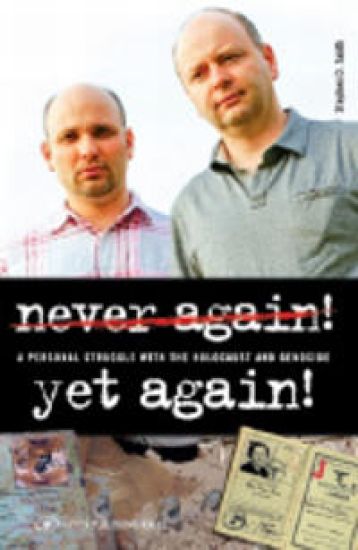
Never Again! Yet Again!

Never Again! Yet Again!

Stephen D Smith

Gefen Publishing House
2010
nidottu
In this remarkable introduction, Stephen D Smith, the new Executive Director of the USC Shoah Foundation Institute for Visual History and Education, describes the inspiring journey he and his family took in creating the first Holocaust centre in Britain. This story was written in response to many questions. It replies with a powerful challenge to all who think that 'never again' is really worth the struggle. The Australian Centre for Jewish Civilisation hosts this lecture by Stephen Smith, the new director of the Shoah Foundation Institute at the University of Southern California and co-founder of the Aegis Trust. In his powerful address, Smith discusses the past century of crimes against humanity and genocide: the links between them, and the ways to understand them in order to avoid them in the future.
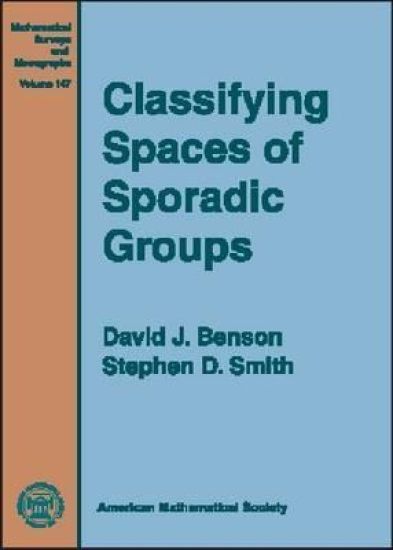
Classifying Spaces of Sporadic Groups

Classifying Spaces of Sporadic Groups

David J. Benson; Stephen D. Smith

Amer Mathematical Society
2008
sidottu
For each of the 26 sporadic finite simple groups, the authors construct a 2-completed classifying space using a homotopy decomposition in terms of classifying spaces of suitable 2-local subgroups. This construction leads to an additive decomposition of the mod 2 group cohomology. The authors also summarize the current status of knowledge in the literature about the ring structure of the mod 2 cohomology of sporadic simple groups.
Boozers, Ballcocks and Bail

Boozers, Ballcocks and Bail

Stephen D. Smith

Neville-douglas Publishing Ltd
2007
pokkari
When Steve and his partner Wilf set up their legal practice, they aren't expecting the high life, but they aren't expecting such weird and wonderful lowlifes, either. This book recounts their sometimes hilarious, sometimes tragic and other experiences.
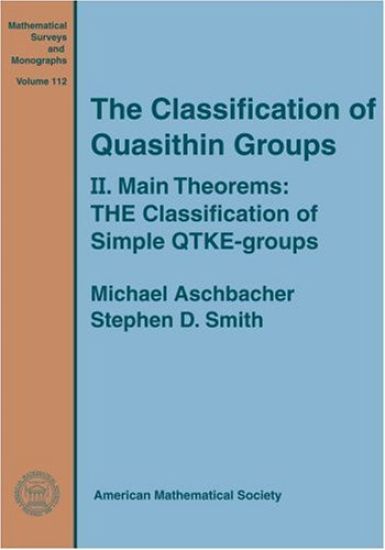
The Classification Of Quasithin Groups: II

The Classification Of Quasithin Groups: II

Michael Aschbacher; Stephen D. Smith

Amer Mathematical Society
2004
sidottu
Around 1980, G. Mason announced the classification of a certain subclass of an important class of finite simple groups known as 'quasithin groups'. The classification of the finite simple groups depends upon a proof that there are no unexpected groups in this subclass. Unfortunately Mason neither completed nor published his work. In the "Main Theorem" of this two-part book (Volumes 111 and 112 in the AMS series, "Mathematical Surveys and Monographs") the authors provide a proof of a stronger theorem classifying a larger class of groups, which is independent of Mason's arguments.In particular, this allows the authors to close this last remaining gap in the proof of the classification of all finite simple groups. An important corollary of the Main Theorem provides a bridge to the program of Gorenstein, Lyons, and Solomon (Volume 40 in the AMS series, "Mathematical Surveys and Monographs") which seeks to give a new, simplified proof of the classification of the finite simple groups. Part I (Volume 111) contains results which are used in the proof of the Main Theorem.Some of the results are known and fairly general, but their proofs are scattered throughout the literature; others are more specialized and are proved here for the first time. Part II of the work (the current volume) contains the proof of the Main Theorem, and the proof of the corollary classifying quasithin groups of even type. The book is suitable for graduate students and researchers interested in the theory of finite groups.
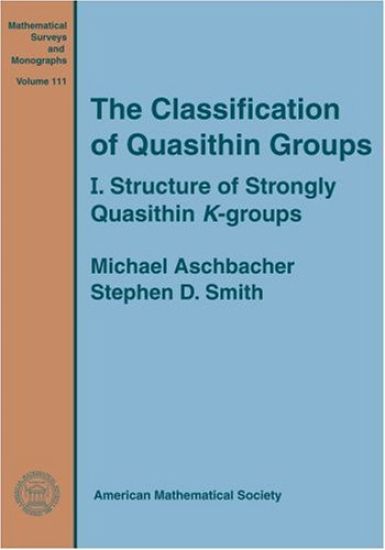
The Classification Of Quasithin Groups: I

The Classification Of Quasithin Groups: I

Michael Aschbacher; Stephen D. Smith

Amer Mathematical Society
2004
sidottu
Around 1980, G. Mason announced the classification of a certain subclass of an important class of finite simple groups known as 'quasithin groups'. The classification of the finite simple groups depends upon a proof that there are no unexpected groups in this subclass. Unfortunately Mason neither completed nor published his work. In the "Main Theorem" of this two-part book (Volumes 111 and 112 in the AMS series, "Mathematical Surveys and Monographs") the authors provide a proof of a stronger theorem classifying a larger class of groups, which is independent of Mason's arguments.In particular, this allows the authors to close this last remaining gap in the proof of the classification of all finite simple groups. An important corollary of the Main Theorem provides a bridge to the program of Gorenstein, Lyons, and Solomon (Volume 40 in the AMS series, "Mathematical Surveys and Monographs") which seeks to give a new, simplified proof of the classification of the finite simple groups. Part I (the current volume) contains results which are used in the proof of the Main Theorem.Some of the results are known and fairly general, but their proofs are scattered throughout the literature; others are more specialized and are proved here for the first time. Part II of the work (Volume 112) contains the proof of the Main Theorem, and the proof of the corollary classifying quasithin groups of even type. The book is suitable for graduate students and researchers interested in the theory of finite groups.