Kirjojen hintavertailu. Mukana 12 657 676 kirjaa ja 12 kauppaa.

Kirjailija

Stephen E. Finn

Kirjat ja teokset yhdessä paikassa: 13 kirjaa, julkaisuja vuosilta 1996-2026, suosituimpien joukossa Therapeutic Assessment and Interpersonal Neurobiology. Vertaile teosten hintoja ja tarkista saatavuus suomalaisista kirjakaupoista.

13 kirjaa

Kirjojen julkaisuhaarukka 1996-2026.

Therapeutic Assessment and Interpersonal Neurobiology
Therapeutic Assessment and Interpersonal Neurobiology shows how collaborative assessment can function as a potent therapeutic intervention—reducing shame, strengthening epistemic trust, and catalyzing meaningful change. Integrating research on affect regulation, memory reconsolidation, and intersubjectivity with richly detailed case examples, the book demonstrates how psychological tests can be used not only to understand clients, but to help them experience themselves differently. The author highlights common traps that therapists fall into and provides strategies for them to improve their practical skills and enhance the course of treatment to transform clients’ lives. The book emphasizes the importance of client collaboration, secure attachment, mentalization, addressing shame, and epistemic trust during psychological interventions. Bridging psychological assessment and modern psychotherapy, this volume provides assessment professionals and trainees with a rigorous, humane, and clinically actionable framework for using tests as instruments of psychological healing. As a sequel to his influential book, In Our Clients’ Shoes: Theory and Techniques of Therapeutic Assessment, the author offers a renewed and transformative vision of psychological assessment grounded in contemporary neuroscience, attachment theory, and decades of clinical practice. This is an invaluable resource for psychologists, particularly those who use the MMPI-2, MMPI-3, Rorschach, AAP, and EMP.

Therapeutic Assessment and Interpersonal Neurobiology
Therapeutic Assessment and Interpersonal Neurobiology shows how collaborative assessment can function as a potent therapeutic intervention—reducing shame, strengthening epistemic trust, and catalyzing meaningful change. Integrating research on affect regulation, memory reconsolidation, and intersubjectivity with richly detailed case examples, the book demonstrates how psychological tests can be used not only to understand clients, but to help them experience themselves differently. The author highlights common traps that therapists fall into and provides strategies for them to improve their practical skills and enhance the course of treatment to transform clients’ lives. The book emphasizes the importance of client collaboration, secure attachment, mentalization, addressing shame, and epistemic trust during psychological interventions. Bridging psychological assessment and modern psychotherapy, this volume provides assessment professionals and trainees with a rigorous, humane, and clinically actionable framework for using tests as instruments of psychological healing. As a sequel to his influential book, In Our Clients’ Shoes: Theory and Techniques of Therapeutic Assessment, the author offers a renewed and transformative vision of psychological assessment grounded in contemporary neuroscience, attachment theory, and decades of clinical practice. This is an invaluable resource for psychologists, particularly those who use the MMPI-2, MMPI-3, Rorschach, AAP, and EMP.
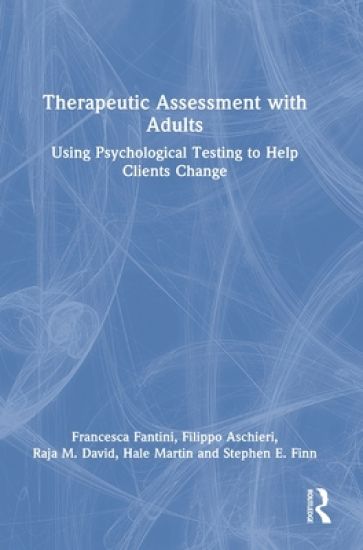
Therapeutic Assessment with Adults

Therapeutic Assessment with Adults

Francesca Fantini; Filippo Aschieri; Raja M. David; Hale Martin; Stephen E. Finn

TAYLOR FRANCIS LTD
2022
nidottu
This book is a comprehensive guide to Therapeutic Assessment (TA) with adults, showing how to collaboratively engage clients in psychological testing to help them achieve major and long-lasting change.This guide clearly lays out each step of TA with adults, including its rationale and detailed instructions on how to handle a range of clinical situations. Additionally, in part one, the authors fully describe the development of TA, its theoretical bases, and the most up-to-date research on the model. In the second part of the book, the authors describe the structure and techniques of TA, and illustrate each step with transcripts from a clinical case. Further clinical illustrations help the reader understand how to conduct a TA with different types of clients, including those from culturally diverse backgrounds. This book is essential for all clinicians, therapists and trainees working with adult clients; along with students in assessment courses.
Therapeutic Assessment with Adults

Therapeutic Assessment with Adults

Francesca Fantini; Filippo Aschieri; Raja M. David; Hale Martin; Stephen E. Finn

TAYLOR FRANCIS LTD
2022
sidottu
This book is a comprehensive guide to Therapeutic Assessment (TA) with adults, showing how to collaboratively engage clients in psychological testing to help them achieve major and long-lasting change.This guide clearly lays out each step of TA with adults, including its rationale and detailed instructions on how to handle a range of clinical situations. Additionally, in part one, the authors fully describe the development of TA, its theoretical bases, and the most up-to-date research on the model. In the second part of the book, the authors describe the structure and techniques of TA, and illustrate each step with transcripts from a clinical case. Further clinical illustrations help the reader understand how to conduct a TA with different types of clients, including those from culturally diverse backgrounds. This book is essential for all clinicians, therapists and trainees working with adult clients; along with students in assessment courses.
Therapeutic Assessment with Children

Therapeutic Assessment with Children

Deborah J. Tharinger; Dale I. Rudin; Marita Frackowiak; Stephen E. Finn

TAYLOR FRANCIS LTD
2022
nidottu
Therapeutic Assessment with Children presents a ground-breaking paradigm of psychological assessment in which children and families collaborate with the psychologist assessor to understand persistent problems and find new ways of repairing their relationships and moving forward with their lives. This paradigm is systemic, client-centered, and culturally sensitive and is applicable to families from many different backgrounds who often feel misunderstood and disempowered by traditional assessment methods. In this book, the reader will find a step-by-step description of Therapeutic Assessment with Children (TA-C), with ample teaching examples to make each step come alive. Each chapter includes detailed transcripts of assessment sessions with Henry, a ten-year-old boy, and his parents as they progress through a Therapeutic Assessment and find new ways of appreciating each other and being together. The combination of didactic and clinical material will give even new clinicians a groundwork from which to begin to practice TA-C. The volume demonstrates how the core values of TA-C—collaboration, respect, humility, compassion, openness, and curiosity—can be embedded in psychological assessment with children and families.Therapeutic Assessment with Children will be invaluable for graduate assessment courses in clinical, counseling, and school psychology and for seasoned professionals wanting to learn the TA-C model.
Therapeutic Assessment with Children

Therapeutic Assessment with Children

Deborah J. Tharinger; Dale I. Rudin; Marita Frackowiak; Stephen E. Finn

TAYLOR FRANCIS LTD
2022
sidottu
Therapeutic Assessment with Children presents a ground-breaking paradigm of psychological assessment in which children and families collaborate with the psychologist assessor to understand persistent problems and find new ways of repairing their relationships and moving forward with their lives. This paradigm is systemic, client-centered, and culturally sensitive and is applicable to families from many different backgrounds who often feel misunderstood and disempowered by traditional assessment methods. In this book, the reader will find a step-by-step description of Therapeutic Assessment with Children (TA-C), with ample teaching examples to make each step come alive. Each chapter includes detailed transcripts of assessment sessions with Henry, a ten-year-old boy, and his parents as they progress through a Therapeutic Assessment and find new ways of appreciating each other and being together. The combination of didactic and clinical material will give even new clinicians a groundwork from which to begin to practice TA-C. The volume demonstrates how the core values of TA-C—collaboration, respect, humility, compassion, openness, and curiosity—can be embedded in psychological assessment with children and families.Therapeutic Assessment with Children will be invaluable for graduate assessment courses in clinical, counseling, and school psychology and for seasoned professionals wanting to learn the TA-C model.
In Our Clients' Shoes

In Our Clients' Shoes

Stephen E. Finn

Routledge
2015
nidottu
In Our Clients’ Shoes conveniently assembles a number of important papers on the Therapeutic Assessment approach in one resource, explicating its history, theory, techniques, as well as its impact on clients and assessors. Author Stephen E. Finn incorporates pieces presented at various conferences over the past 13 years, in addition to previously unpublished work, with the intent to allow psychologists greater insight into their clients’ perspectives.Arranged in three sections, the first set of papers describes the history and development of Therapeutic Assessment, including personal experiences of the author, which ultimately led him to focus on psychological assessment as a potential therapeutic intervention. The second section follows with a variety of essays to illustrate particular techniques of collaborative and Therapeutic Assessment. In this section, readers gain an understanding of how to integrate test findings, engage clients in discussing their experiences of a test, conduct assessment intervention sessions, and teach Therapeutic Assessment to graduate students. Finn concludes by drawing a link between Therapeutic Assessment and two major schools of psychotherapy: intersubjectivity theory and control-mastery theory. He also discusses how assessors grow and change as a result of practicing psychological assessment, and addresses practical matters such as when to apply the approach, how to bill for Therapeutic Assessment sessions, how to market Therapeutic Assessment, and where to find professional support for this kind of work.In Our Clients’ Shoes is appropriate for all clinicians who wish to further impact the lives of their clients and enhance their own wisdom, compassion, and personal and professional development.
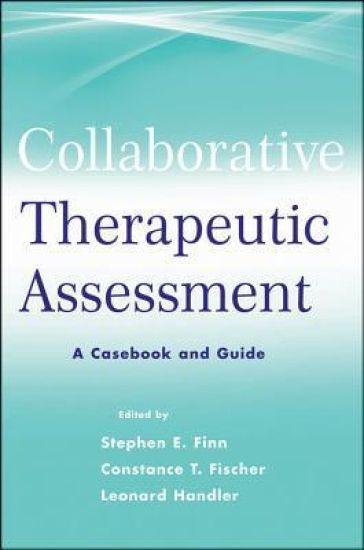
Collaborative / Therapeutic Assessment

Collaborative / Therapeutic Assessment

Stephen E. Finn; Constance T. Fischer; Leonard Handler

John Wiley Sons Inc
2012
nidottu
A guide to conducting Collaborative/Therapeutic Assessment to promote client growth Mental health professionals are increasingly enthusiastic about and ready to use psychological test data, research, and theory in life-relevant ways to improve diagnosis, client care, and treatment outcomes. With Collaborative/Therapeutic Assessment (C/TA), clients participate actively with the assessor in exploring how their test scores and patterns reflect who they are in their daily lives and how they can learn to help themselves cope with life's challenges. Using a case study approach to demonstrate how to apply C/TA in practice, Collaborative/Therapeutic Assessment provides practitioners with a variety of flexible and adaptable case examples featuring adults, children, adolescents, couples, and families from different backgrounds in need of treatment for assorted concerns. Designed for both experienced and novice clinicians, the book begins with a brief history of C/TA, and provides clear definitions of the distinctions among many common approaches. It uniquely presents: Eighteen diverse C/TA assessments covering: depression, multiple suicide attempts, severe abuse, dissociation, an adolescent psychiatric ward, custody evaluation, a couple in crisis, and collaborative neuropsychology Guidance on how both client and clinician can agree on the best course of action through joint exploration of assessment procedures, results, and implications Closely related approaches to psychological testing, including Individualized Assessment, Collaborative Assessment, Therapeutic Model of Assessment, Collaborative/Therapeutic Neuropsychological Assessment, and Rorschach-based psychotherapy Clearly labeled Teaching Points in each chapter Collaborative/Therapeutic Assessment provides psychologists in all areas of assessment, and at all levels of experience, with powerful C/TA examples that can dramatically illuminate and improve clients' lives.
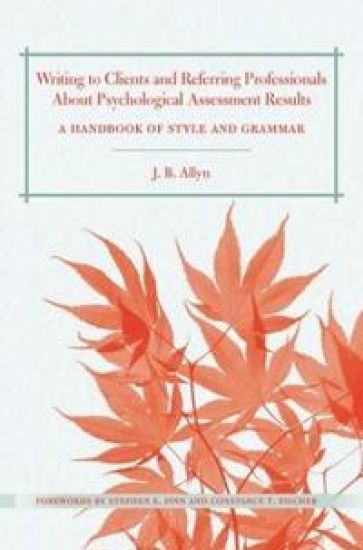
Writing to Clients and Referring Professionals about Psychological Assessment Results

Writing to Clients and Referring Professionals about Psychological Assessment Results

J. B. Allyn; Stephen E. Finn; Constance T. Fischer

Routledge
2012
sidottu
This book is the first on the craft of effective writing structured expressly for the psychologist-assessor. Author J. B. Allyn, a professional writer who specializes in psychology, combines reference book with tutorial. She blends information on the qualities that create a writer’s unique presence on the page with illustrations of correct English grammar. All of the questions, answers, and illustrations evolved from the concerns of psychologist-assessors, as did the examples, which are grounded in their writing and communication needs. The result creates a guide for report writing that can be used by either practicing professionals or graduate psychology students. The book divides into three sections: The first and third sections discuss various aspects of effective communication, while the second is a handbook of common grammar problems. Helpful elements guide the reader through the text, including frequent bullet lists, tables and graphs, and grammar and style examples that are framed around assessment reports. It is also written in a conversational tone, which creates the same style it proposes for effectively written reports, and is a key tool for clear and appropriate communication. Readers will refer back to this book, both for quick tips on style and grammar, which are appropriate for any mental health practitioner, and for more detailed advice on writing and communication in assessment reports.
Writing to Clients and Referring Professionals about Psychological Assessment Results

Writing to Clients and Referring Professionals about Psychological Assessment Results

J. B. Allyn; Stephen E. Finn; Constance T. Fischer

Routledge
2012
nidottu
This book is the first on the craft of effective writing structured expressly for the psychologist-assessor. Author J. B. Allyn, a professional writer who specializes in psychology, combines reference book with tutorial. She blends information on the qualities that create a writer’s unique presence on the page with illustrations of correct English grammar. All of the questions, answers, and illustrations evolved from the concerns of psychologist-assessors, as did the examples, which are grounded in their writing and communication needs. The result creates a guide for report writing that can be used by either practicing professionals or graduate psychology students. The book divides into three sections: The first and third sections discuss various aspects of effective communication, while the second is a handbook of common grammar problems. Helpful elements guide the reader through the text, including frequent bullet lists, tables and graphs, and grammar and style examples that are framed around assessment reports. It is also written in a conversational tone, which creates the same style it proposes for effectively written reports, and is a key tool for clear and appropriate communication. Readers will refer back to this book, both for quick tips on style and grammar, which are appropriate for any mental health practitioner, and for more detailed advice on writing and communication in assessment reports.
Masculinity and Femininity in the MMPI-2 and MMPI-A

Masculinity and Femininity in the MMPI-2 and MMPI-A

Hale Martin; Stephen E. Finn

University of Minnesota Press
2010
sidottu
Masculinity and femininity remain among the more confounding constructs in the history of personality psychology and psychological assessment. In spite of years of research and thousands of empirical studies, masculinity and femininity are still so fraught with confusion and political controversy that several prominent psychologists have suggested that the terms be abandoned. In this informative book, Hale Martin and Stephen E. Finn bring clarity to this topic by comprehensively reviewing past research and theory and extensively exploring "masculinity" and "femininity" as they are measured in the widely used MMPI instruments.Martin and Finn consider the factor structure and correlates of masculinity and femininity in the MMPI in multiple samples. Through their analyses, they are able to address such questions as: Is there such a thing as masculinity/femininity? If so, are masculinity and femininity separate constructs, or are they opposite ends of a bipolar dimension? What are the core aspects of masculinity and femininity? Are they the same for men and women? Do the meanings of masculinity and femininity vary across the human life span and in different cultures? To what extent are masculinity and femininity biologically or socially determined? Can masculinity and femininity be adequately measured by the MMPI-2 and MMPI-A?This insightful work uses solid empirical methods to clarify significant constructs. It will be an essential resource for researchers in the areas of personality, psychological assessment, and gender studies, as well as for clinicians working with clients who have nontraditional gender identities.
In Our Clients' Shoes

In Our Clients' Shoes

Stephen E. Finn

Routledge Member of the Taylor and Francis Group
2007
sidottu
In Our Clients’ Shoes conveniently assembles a number of important papers on the Therapeutic Assessment approach in one resource, explicating its history, theory, techniques, as well as its impact on clients and assessors. Author Stephen E. Finn incorporates pieces presented at various conferences over the past 13 years, in addition to previously unpublished work, with the intent to allow psychologists greater insight into their clients’ perspectives.Arranged in three sections, the first set of papers describes the history and development of Therapeutic Assessment, including personal experiences of the author, which ultimately led him to focus on psychological assessment as a potential therapeutic intervention. The second section follows with a variety of essays to illustrate particular techniques of collaborative and Therapeutic Assessment. In this section, readers gain an understanding of how to integrate test findings, engage clients in discussing their experiences of a test, conduct assessment intervention sessions, and teach Therapeutic Assessment to graduate students. Finn concludes by drawing a link between Therapeutic Assessment and two major schools of psychotherapy: intersubjectivity theory and control-mastery theory. He also discusses how assessors grow and change as a result of practicing psychological assessment, and addresses practical matters such as when to apply the approach, how to bill for Therapeutic Assessment sessions, how to market Therapeutic Assessment, and where to find professional support for this kind of work.In Our Clients’ Shoes is appropriate for all clinicians who wish to further impact the lives of their clients and enhance their own wisdom, compassion, and personal and professional development.
Manual for Using the MMPI-2 as a Therapeutic Intervention

Manual for Using the MMPI-2 as a Therapeutic Intervention

Stephen E. Finn

University of Minnesota Press
1996
nidottu
This manual provides a step-by-step procedure, tested in controlled research and illustrated with case examples, for using the MMPI-2 as a therapeutic intervention. Finn covers all stages of the MMPI-2 assessment, from the initial interview, through the scoring and interpretation of the test, and culminating in the feedback session. The goal of this approach is to gather accurate information about clients with the MMPI-2 and then to use this information to help clients understand themselves and make positive changes in their lives.Finn's appraoch advocates the dynamic involvement of client and assessor both before and after testing. This appraoch to assessment is very timely given the demands that managed care is making for demonstration of treatment efficacy.Stephen Finn is Director of the Center for Therapeutic Assessment in Austin, Texas.