Kirjojen hintavertailu. Mukana 12 390 323 kirjaa ja 12 kauppaa.

Kirjailija

Stephen E. Hanson

Kirjat ja teokset yhdessä paikassa: 5 kirjaa, julkaisuja vuosilta 2001-2026, suosituimpien joukossa The Assault on the State. Vertaile teosten hintoja ja tarkista saatavuus suomalaisista kirjakaupoista.

5 kirjaa

Kirjojen julkaisuhaarukka 2001-2026.

The Assault on the State

The Assault on the State

Stephen E. Hanson; Jeffrey S. Kopstein

Polity Press
2026
nidottu
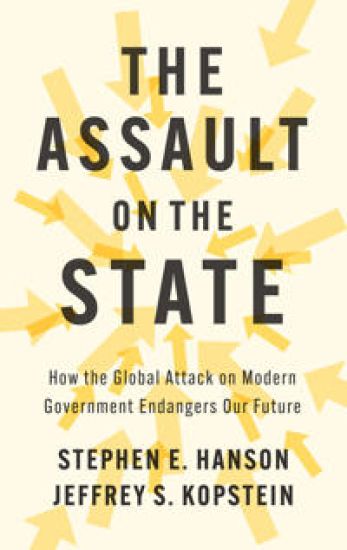
What if the state as we know it didn’t exist? Our air would be poisonous, our votes uncounted, and our markets dysfunctional. Yet across the world, in countries as diverse as Hungary, Israel, the U.K., and the U.S., attacks on the modern state and its workforce are intensifying. They are morphing into power grabs by self-aggrandizing politicians who attempt to seize control of the state for themselves and their cronies. What replaces the modern state once it is fatally undermined is not the free market and the flowering of personal liberty. Instead, the death of government agencies organized under the rule of law inevitably leads to the only realistic alternative: the rule of men. In The Assault on the State, political scientists Stephen Hanson and Jeffrey Kopstein offer an impassioned plea to defend modern government against those who seek to destroy it. They dissect the attack on the machinery of government from its origins in post-Soviet Russia to the core powers of Western democracy. The dangers of state erosion imperil every aspect of our lives. Hanson and Kopstein outline a strategy that can reverse this destructive trend before humanity is plunged back into the pathological personalistic politics of premodern times. Also available as an audiobook.
The Assault on the State

The Assault on the State

Stephen E. Hanson; Jeffrey S. Kopstein

JOHN WILEY AND SONS LTD
2024
sidottu
What if the state as we know it didn’t exist? Our air would be poisonous, our votes uncounted, and our markets dysfunctional. Yet across the world, in countries as diverse as Hungary, Israel, the U.K., and the U.S., attacks on the modern state and its workforce are intensifying. They are morphing into power grabs by self-aggrandizing politicians who attempt to seize control of the state for themselves and their cronies. What replaces the modern state once it is fatally undermined is not the free market and the flowering of personal liberty. Instead, the death of government agencies organized under the rule of law inevitably leads to the only realistic alternative: the rule of men.In The Assault on the State, political scientists Stephen Hanson and Jeffrey Kopstein offer an impassioned plea to defend modern government against those who seek to destroy it. They dissect the attack on the machinery of government from its origins in post-Soviet Russia to the core powers of Western democracy. The dangers of state erosion imperil every aspect of our lives. Hanson and Kopstein outline a strategy that can reverse this destructive trend before humanity is plunged back into the pathological personalistic politics of premodern times.Also available as an audiobook.
Post-Imperial Democracies

Post-Imperial Democracies

Stephen E. Hanson

Cambridge University Press
2010
sidottu
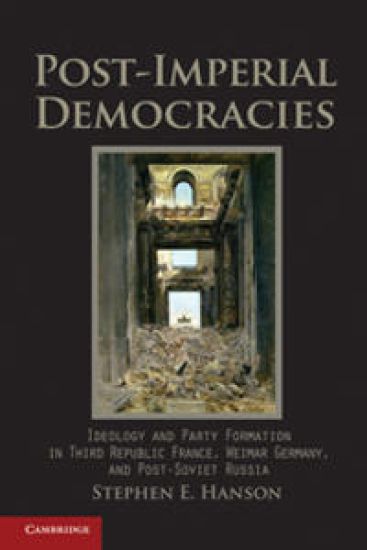
This book examines the causal impact of ideology through a comparative-historical analysis of three cases of 'post-imperial democracy': the early Third Republic in France (1870–86); the Weimar Republic in Germany (1918–34); and post-Soviet Russia (1992–2008). Hanson argues that political ideologies are typically necessary for the mobilization of enduring, independent national party organizations in uncertain democracies. By presenting an explicit and desirable picture of the political future, successful ideologues induce individuals to embrace a long-run strategy of cooperation with other converts. When enough new converts cooperate in this way, it enables sustained collective action to defend and extend party power. Successful party ideologies thus have the character of self-fulfilling prophecies: by portraying the future polity as one organized to serve the interests of those loyal to specific ideological principles, they help to bring political organizations centered on these principles into being.
Post-Imperial Democracies

Post-Imperial Democracies

Stephen E. Hanson

Cambridge University Press
2010
pokkari
This book examines the causal impact of ideology through a comparative-historical analysis of three cases of 'post-imperial democracy': the early Third Republic in France (1870–86); the Weimar Republic in Germany (1918–34); and post-Soviet Russia (1992–2008). Hanson argues that political ideologies are typically necessary for the mobilization of enduring, independent national party organizations in uncertain democracies. By presenting an explicit and desirable picture of the political future, successful ideologues induce individuals to embrace a long-run strategy of cooperation with other converts. When enough new converts cooperate in this way, it enables sustained collective action to defend and extend party power. Successful party ideologies thus have the character of self-fulfilling prophecies: by portraying the future polity as one organized to serve the interests of those loyal to specific ideological principles, they help to bring political organizations centered on these principles into being.
Postcommunism and the Theory of Democracy

Postcommunism and the Theory of Democracy

Richard D. Anderson; M. Steven Fish; Stephen E. Hanson; Philip G. Roeder

Princeton University Press
2001
pokkari
Why did the wave of democracy that swept the former Soviet Union and Eastern Europe starting more than a decade ago develop in ways unexpected by observers who relied on existing theories of democracy? In Postcommunism and the Theory of Democracy, four distinguished scholars conduct the first major assessment of democratization theory in light of the experience of postcommunist states. Richard Anderson, Steven Fish, Stephen Hanson, and Philip Roeder not only apply theory to practice, but using a wealth of empirical evidence, draw together the elements of existing theory into new syntheses. The authors each highlight a development in postcommunist societies that reveals an anomaly or lacuna in existing theory. They explain why authoritarian leaders abandon authoritarianism, why democratization sometimes reverses course, how subjects become citizens by beginning to take sides in politics, how rulers become politicians by beginning to seek popular support, and not least, how democracy becomes consolidated. Rather than converging on a single approach, each author shows how either a rationalist, institutionalist, discursive, or Weberian approach sheds light on this transformation. They conclude that the experience of postcommunist democracy demands a rethinking of existing theory. To that end, they offer rich new insights to scholars, advanced students, policymakers, and anyone interested in postcommunist states or in comparative democratization.