Kirjojen hintavertailu. Mukana 12 390 323 kirjaa ja 12 kauppaa.

Kirjailija

Stephen H. Kaisler

Kirjat ja teokset yhdessä paikassa: 9 kirjaa, julkaisuja vuosilta 2005-2021, suosituimpien joukossa Obtaining Value from Big Data for Service Systems, Volume II. Vertaile teosten hintoja ja tarkista saatavuus suomalaisista kirjakaupoista.

9 kirjaa

Kirjojen julkaisuhaarukka 2005-2021.

Obtaining Value from Big Data for Service Systems, Volume II

Obtaining Value from Big Data for Service Systems, Volume II

Stephen H. Kaisler; Frank Armour; J. Alberto Espinosa; William Money

Business Expert Press
2019
nidottu
Volume II of this series discusses the technology used to implement a big data analysis capability within a service-oriented organization. It discusses the technical architecture necessary to implement a big data analysis capability, some issues and challenges in big data analysis and utilization that an organization will face, and how to capture value from it.It will help readers understand what technology is required for a basic capability and what the expected benefits are from establishing a big data capability within their organization.
Obtaining Value from Big Data for Service Systems, Volume I

Obtaining Value from Big Data for Service Systems, Volume I

Stephen H. Kaisler; Frank Armour; J. Alberto Espinosa; William H. Money

Business Expert Press
2019
nidottu
Volume I of this two-volume series focuses on the role of big data in service delivery systems. It discusses the definition and orientation to big data, applications of it in service delivery systems, how to obtain results that can affect/enhance service delivery, and how to build an effective big data organization.This volume will assist readers in fitting big data analysis into their service-based organizations. It will also help readers understand how to improve the use of big data to enhance their service-oriented organizations.
The Univac Corporation

The Univac Corporation

Stephen H. Kaisler

CAMBRIDGE SCHOLARS PUBLISHING
2021
sidottu
Univac Corporation (now Unisys) has been an innovator in computer systems since the early 1960s. Univac (then Remington Rand), built the first commercial computer, the Univac I. This volume continues the story of Univac (later Unisys) computer systems from the Univac 1105. Its successors—the early Univac 1100 machines—helped to establish the concept of a family of computer systems. It was one of the first to develop and deploy a multidimensional operating system that supported interactive, real-time, and batch processing. Ease of access and operation in all modes was especially attractive to scientific and academic communities. It was instrumental in developing COBOL and DMS-1100 for business data processing. The upward compatibility of the Univac 1100 series machines from the Univac 1107 to the Sperry 2200 series demonstrated how evolutionary development could protect its customer's investment while continually enhancing performance. As one of the founders of the computing industry, Univac has survived over 60 years of expansion and consolidation to survive as part of Unisys as one of the two remaining mainframe manufacturers.
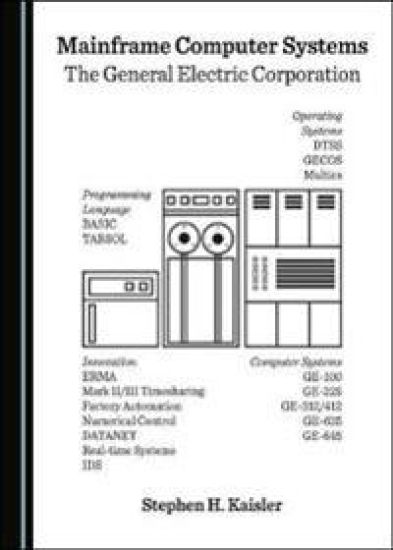
Mainframe Computer Systems

Mainframe Computer Systems

Stephen H. Kaisler

Cambridge Scholars Publishing
2020
sidottu
This volume describes General Electric Corporation's venture into developing second and third generation mainframe computer systems.The General Electric Corporation (GE), which began its life as the Edison Electric Co., was long involved in electrical appliances and industrial machines. It was also a founder of the Radio Corporation of America, which eventually became one of its competitors, and developed many electrical systems in order to control different types of industrial machines. Its breakthrough into computing came with its winning bid to provide the computing systems for the Electronic Recording Method of Accounting) system developed for the Bank of America by the Stanford Research Institute. The success of this project led GE to develop the GE-200 series which was the foundation for commercial timesharing. The GE-235 was selected by Dartmouth for its Dartmouth Time Sharing System (DTSS), an innovative academic time-sharing system. BASIC was developed on the GE-235 computer system under DTSS. GE enhanced it to develop its Mark II/III Time Sharing System, apparently the first commercial time sharing service in the world. GE develop the GE-300/-400 systems for industrial process control. The GE-600 series replaced the GE-200 series and demonstrated innovation in time-sharing systems. The GE-645 was selected to host Multics, which was developed by MIT. However, GE felt that it could not compete in computing against IBM, Univac, and other mainframes competitors, so it folded its tent and sold its Computer Division to Honeywell, Inc. Nevertheless, GE will be remembered for many innovations which continue to be used in modern computing systems.
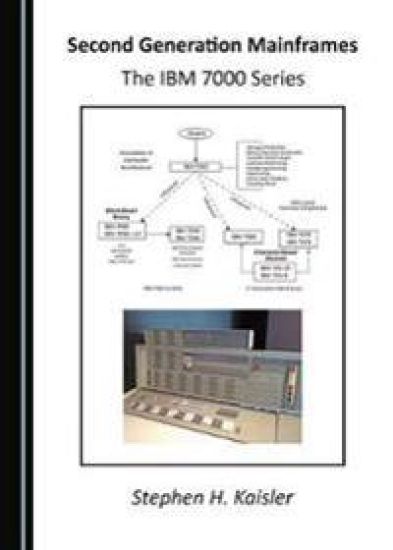
Second Generation Mainframes

Second Generation Mainframes

Stephen H. Kaisler

Cambridge Scholars Publishing
2019
sidottu
Second Generation Mainframes: The IBM 7000 Series describes IBM's second generation of mainframe computers which introduced new technology, new peripherals and advanced software. These systems were continuations of the instruction sets of the IBM 700 series with significant enhancements, but supported upwards compatibility that preserved customers' investment in the earlier series. The use of magnetic cores, fast magnetic tapes and disks, and transistors yielded computation speeds that opened new domains for computation. Programming languages continued to be developed and enhanced, and new ones were developed for specific domains, such as SNOBOL, COBOL, and Macro Assemblers. Robust subroutine libraries for mathematical applications appeared. New operating systems provided many capabilities to programmers for data management and file systems, limited multiprocessing, timesharing, programming language support, and better error handling and control of peripherals. Early concepts in persistent file systems on magnetic disks were developed that changed the nature of job processing. The IBM 7000 series led the way in many innovative concepts that helped to establish IBM as the foremost manufacturer of computer systems. However, the diversity of the models put significant strain on IBM's financial resources and development teams, which ultimately led to OBM's development of the System/360 family of machines.
First Generation Mainframes

First Generation Mainframes

Stephen H. Kaisler

Cambridge Scholars Publishing
2018
sidottu
This volume describes several different models of IBM computer systems, characterized by different data representations and instruction sets that strongly influenced computer system architecture in the 1950s and early 1960s. They focused on a common system architecture that allowed peripherals to be used on different systems, albeit with specific adapters. These systems were modular, which made them easy to manufacture, configure, and service. Computing with UNIVAC, they used reliable Williams Tubes for memory, and later introduced magnetic core memory. IBM developed its own magnetic tape drives and magnetic drums that were both faster and more reliable than UNIVAC's peripherals. The first software systems that could reasonably be called "operating systems" enabled more efficient use of programmer time and system resources. The development of programming languages, notably FORTRAN, and assembly language processors, notably Autocoder, improved the productivity of programmers. In addition, IBM developed one of the finest product marketing, sales and servicing organizations in the world. The legacy of the IBM 700 series is found in their popular successors, the IBM 7000 Series, which will be described in a forthcoming volume.
Birthing the Computer

Birthing the Computer

Stephen H. Kaisler

Cambridge Scholars Publishing
2016
sidottu
Birthing the Computer: From Relays to Vacuum Tubes is the first in a multi-volume series on historical computing machines. This series will span the development of computer systems from the Zuse machines of the early 1930s to about 1995 when microprocessors began to be commoditized. Each volume will focus on a range of technologies, or a class of machines or a particular vendor, and will describe the hardware of the machines and its peripherals, the operating system and system software, and its influence upon programming languages. This volume begins with the Zuse machines which were constructed from relays, but contained the basic elements of a computer system, namely input, computing engine, and output. Early machines from Atanasoff and Berry, Aiken, Stibitz, and IBM are described. The transition from relays to vacuum tubes increased speed and performance significantly, and led to the first true computers in ENIAC, EDSAC, and EDVAC which used paper tape and Williams tubes for I/O and storage. These machines were built by universities.Several early machines were purpose built such as Colossus and BINAC, and created with government support and industrial know-how. By the mid-to-late '50s, computing machines were being built by universities (the SSEM, Whirlwind, and IAS machines), governments (the NBS SEAC and SWAC, and several other machines), and industry (the UNIVAC series and the English Electric DEUCE). Most of these machines were constructed using the von Neumann architecture, and represent an evolution of thinking in how computing machines were to operate along with some innovative ideas in software and programming languages. By the end of the 1950s, the design, development, programming and use of computing machines were in full ferment as many new ideas were proposed, many different machines were designed and some were constructed. Computing machines became a commercial enterprise. Governments receded from building machines to levying requirements and funding construction, while universities continued to explore new architectures, new operating systems, and new programming languages.
Obtaining Value from Big Data for Service Delivery

Obtaining Value from Big Data for Service Delivery

Stephen H. Kaisler; Frank Armour

Business Expert Press
2015
nidottu
Big data is an emerging phenomenon that has enormous implications and impacts upon business strategy, profitability, and process improvements. All service systems generate big data these days, especially human-centered service systems. It has been characterized as the collection, analysis and use of data characterized by the five Vs: volume, velocity, variety, veracity, and value (of data). This booklet will help middle, senior, and executive managers to understand what big data is; how to recognize, collect, process, and analyze it; how to store and manage it; how to obtain useful information from it; and how to assess its contribution to operational, tactical, and strategic decision-making in service-oriented organizations.
Software Paradigms

Software Paradigms

Stephen H. Kaisler

John Wiley Sons Inc
2005
sidottu
Software Paradigms provides the first complete compilation of software paradigms commonly used to develop large software applications, with coverage ranging from discrete problems to full-scale applications. The book focuses on providing a structure for understanding a hierarchy of software development approaches, and showing the relationships between the different models. Coverage includes paradigms in design patterns, software components, software architectures, and frameworks. Chapters within each of these sections include design issues related to building and using the paradigm as well as numerous real world applications. A practical overview of the hierarchy of development paradigms, Software Paradigms is an excellent teaching tool for undergraduates and graduates, and a comprehensive and reliable reference for software engineers.