Kirjojen hintavertailu. Mukana 12 595 353 kirjaa ja 12 kauppaa.

Kirjailija

Stephen Kosack

Kirjat ja teokset yhdessä paikassa: 5 kirjaa, julkaisuja vuosilta 2005-2012, suosituimpien joukossa Globalization and the Nation State. Vertaile teosten hintoja ja tarkista saatavuus suomalaisista kirjakaupoista.

5 kirjaa

Kirjojen julkaisuhaarukka 2005-2012.

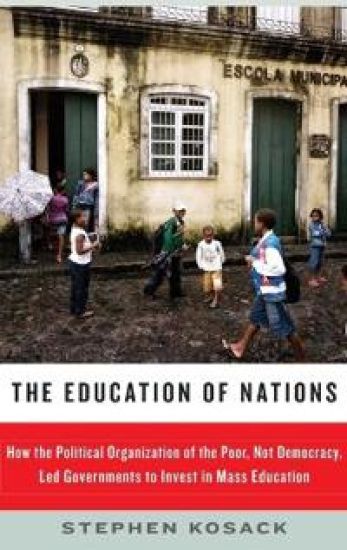
The Education of Nations

The Education of Nations

Stephen Kosack

Oxford University Press Inc
2012
sidottu
What causes a government to invest--or not invest--in poor citizens, especially mass education? In The Education of Nations, Stephen Kosack focuses on three radically different developing countries whose developmental trajectories bear little resemblance to each other--Brazil, Ghana, and Taiwan--and offers an elegant and pragmatic answer to this crucially important question. Quite simply, the level of investment in mass education is the product of one of two simple conditions, one political and one economic. The first condition is the nature and success of political entrepreneurs at organizing the poor politically; the second is the flexibility of the labor market faced by employers who need skilled workers. Drawing from a half-century of evidence, he has found that irrespective of every other factor, these two conditions alone explain whether education is available to the poor or restricted to elites as well as many of the key features of education systems. An empirically rich and theoretically novel study, The Education of Nations will change how we think about the developing world's approach to education and development.
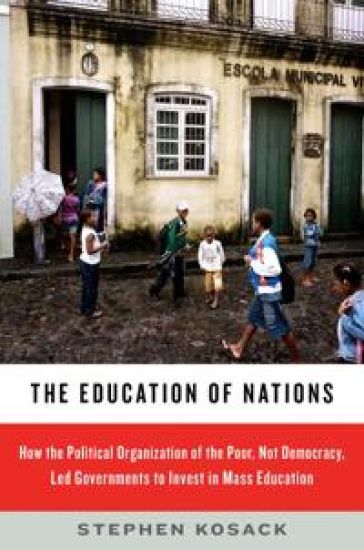
The Education of Nations

The Education of Nations

Stephen Kosack

Oxford University Press Inc
2012
nidottu
What causes a government to invest--or not invest--in poor citizens, especially mass education? In The Education of Nations, Stephen Kosack focuses on three radically different developing countries whose developmental trajectories bear little resemblance to each other--Brazil, Ghana, and Taiwan--and offers an elegant and pragmatic answer to this crucially important question. Quite simply, the level of investment in mass education is the product of one of two simple conditions, one political and one economic. The first condition is the nature and success of political entrepreneurs at organizing the poor politically; the second is the flexibility of the labor market faced by employers who need skilled workers. Drawing from a half-century of evidence, he has found that irrespective of every other factor, these two conditions alone explain whether education is available to the poor or restricted to elites as well as many of the key features of education systems. An empirically rich and theoretically novel study, The Education of Nations will change how we think about the developing world's approach to education and development.
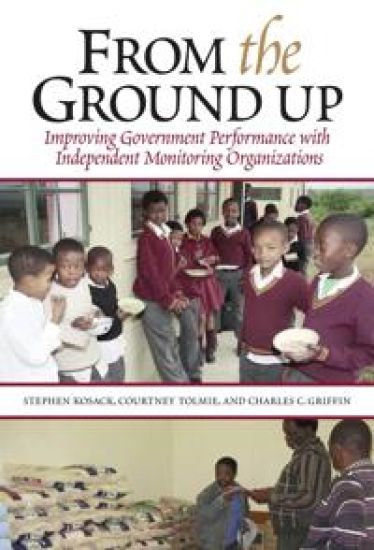
From the Ground Up

From the Ground Up

Stephen Kosack; Courtney Tolmie; Charles C. Griffin

Brookings Institution
2010
nidottu
This book is based on a simple concept: no one is in a better position to hold a government accountable than those it governs. When governments fail to meet the needs of their citizens, the international community often turns to large external organizations such as the International Monetary Fund or the World Bank. These analysts and monitors may have the resources and expertise to analyze and advise on public spending and governance, but where do they go when the time comes to implement new policies? And can they really have a more nuanced understanding of the country's problems than its own citizens? Who is there to watch day and night to hold the government accountable? From the Ground Up proposes that the international community's efforts to improve public expenditure and budget execution decisions would be more effective if done in collaboration with local independent monitoring organizations. Stephen Kosack, Courtney Tolmie, and Charles Griffin track the work of sixteen independent monitoring organizations from across the developing world, demonstrating how these relatively small groups of local researchers produce both thoughtful analysis and workable solutions. They achieve these results because their vantage point allows them to more effectively discern problems with governance and to communicate with their fellow citizens about the ideals and methods of good governance. The authors also outline some disadvantages facing independent monitoring organizations, such as insufficient resources, inadequate access to data, and too little influence with high government officials. Collaboration with larger international organizations could help independent monitoring organizations overcome such obstacles, increasing their chances of improving governance —from the ground up.
Globalization and the Nation State

Globalization and the Nation State

Stephen Kosack; Gustav Ranis; James Vreeland

Routledge
2007
nidottu
This book brings together an international team of contributors to assess the political economy of the IMF and World Bank programmes. The cutting-edge techniques of the new political economy are thus brought to bear on international issues for the first time. The book includes contributions from leading North American economists - Stephen Coate, Stephen Morris, Ravi Kanbur and Allen Drazen - as well as European-based analysts including Graham Bird and Frances Stewart.
Globalization and the Nation State

Globalization and the Nation State

Stephen Kosack; Gustav Ranis; James Vreeland

Routledge
2005
sidottu
This book brings together an international team of contributors to assess the political economy of the IMF and World Bank programmes. The cutting-edge techniques of the new political economy are thus brought to bear on international issues for the first time. The book includes contributions from leading North American economists - Stephen Coate, Stephen Morris, Ravi Kanbur and Allen Drazen - as well as European-based analysts including Graham Bird and Frances Stewart.