Kirjojen hintavertailu. Mukana 12 390 323 kirjaa ja 12 kauppaa.

Kirjailija

Stephen L. Harp

Kirjat ja teokset yhdessä paikassa: 7 kirjaa, julkaisuja vuosilta 1998-2023, suosituimpien joukossa The Riviera, Exposed. Vertaile teosten hintoja ja tarkista saatavuus suomalaisista kirjakaupoista.

7 kirjaa

Kirjojen julkaisuhaarukka 1998-2023.

The Riviera, Exposed

The Riviera, Exposed

Stephen L. Harp; Eric G. E. Zuelow

CORNELL UNIVERSITY PRESS
2023
pokkari
A sweeping social and environmental history, The Riviera, Exposed illuminates the profound changes to the physical space that we know as the quintessential European tourist destination. Stephen L. Harp uncovers the behind-the-scenes impact of tourism following World War II, both on the environment and on the people living and working on the Riviera, particularly North African laborers, who not only did much of the literal rebuilding of the Riviera but also suffered in that process. Outside of Paris, the Riviera has been the most visited region in France, depending almost exclusively on tourism as its economic lifeline. Until recently, we knew a great deal about the tourists but much less about the social and environmental impacts of their activities or about the life stories of the North African workers upon whom the Riviera's prosperity rests. The technologies embedded in roads, airports, hotels, water lines, sewers, beaches, and marinas all required human intervention—and travelers were encouraged to disregard this intervention. Harp's sharp analysis explores the impacts of massive construction and public works projects, revealing the invisible infrastructure of tourism, its environmental effects, and the immigrants who built the Riviera. The Riviera, Exposed unearths a gritty history, one of human labor and ecological degradation that forms the true foundation of the glamorous Riviera of tourist mythology.
The Riviera, Exposed

The Riviera, Exposed

Stephen L. Harp; Eric G. E. Zuelow

CORNELL UNIVERSITY PRESS
2022
sidottu
A sweeping social and environmental history, The Riviera, Exposed illuminates the profound changes to the physical space that we know as the quintessential European tourist destination. Stephen L. Harp uncovers the behind-the-scenes impact of tourism following World War II, both on the environment and on the people living and working on the Riviera, particularly North African laborers, who not only did much of the literal rebuilding of the Riviera but also suffered in that process. Outside of Paris, the Riviera has been the most visited region in France, depending almost exclusively on tourism as its economic lifeline. Until recently, we knew a great deal about the tourists but much less about the social and environmental impacts of their activities or about the life stories of the North African workers upon whom the Riviera's prosperity rests. The technologies embedded in roads, airports, hotels, water lines, sewers, beaches, and marinas all required human intervention—and travelers were encouraged to disregard this intervention. Harp's sharp analysis explores the impacts of massive construction and public works projects, revealing the invisible infrastructure of tourism, its environmental effects, and the immigrants who built the Riviera. The Riviera, Exposed unearths a gritty history, one of human labor and ecological degradation that forms the true foundation of the glamorous Riviera of tourist mythology.

A World History of Rubber

A World History of Rubber

Stephen L. Harp

John Wiley Sons Inc
2015
nidottu
A World History of Rubber helps readers understand and gain new insights into the social and cultural contexts of global production and consumption, from the nineteenth century to today, through the fascinating story of one commodity. Divides the coverage into themes of race, migration, and labor; gender on plantations and in factories; demand and everyday consumption; World Wars and nationalism; and resistance and independenceHighlights the interrelatedness of our world long before the age of globalization and the global social inequalities that persist todayDiscusses key concepts of the nineteenth and twentieth centuries, including imperialism, industrialization, racism, and inequality, through the lens of rubberProvides an engaging and accessible narrative for all levels that is filled with archival research, illustrations, and maps
A World History of Rubber

A World History of Rubber

Stephen L. Harp

John Wiley Sons Inc
2015
sidottu
A World History of Rubber helps readers understand and gain new insights into the social and cultural contexts of global production and consumption, from the nineteenth century to today, through the fascinating story of one commodity. Divides the coverage into themes of race, migration, and labor; gender on plantations and in factories; demand and everyday consumption; World Wars and nationalism; and resistance and independenceHighlights the interrelatedness of our world long before the age of globalization and the global social inequalities that persist todayDiscusses key concepts of the nineteenth and twentieth centuries, including imperialism, industrialization, racism, and inequality, through the lens of rubberProvides an engaging and accessible narrative for all levels that is filled with archival research, illustrations, and maps
Au Naturel

Au Naturel

Stephen L. Harp

Louisiana State University Press
2014
sidottu
Each year in France approximately 1.5 million people practice naturisme or ""naturism,"" an activity more commonly referred to as ""nudism."" Because of France's unique tolerance for public nudity, the country also hosts hundreds of thousands of nudists from other European nations, an influx that has contributed to the most extensive infrastructure for nude tourism in the world. In Au Naturel, historian Stephen L. Harp explores how the evolution of European tourism encouraged public nudity in France, connecting this cultural shift with important changes in both individual behaviors and collective understandings of the body, morality, and sexuality.Harp's study, the first in-depth historical analysis of nudism in France, challenges widespread assumptions that ""sexual liberation"" freed people from ""repression,"" a process ostensibly reflected in the growing number of people practicing public nudity. Instead, he contends, naturism gained social acceptance because of the bodily control required to participate in it. New social codes emerged governing appropriate nudist behavior, including where one might look, how to avoid sexual excitation, what to wear when cold, and whether even the most modest displays of affection -- -including hand-holding and pecks on the cheek -- were permissible between couples.Beginning his study in 1927 -- when naturist doctors first advocated nudism in France as part of ""air, water, and sun cures"" -- Harp focuses on the country's three earliest and largest nudist centers: the Île du Levant in the Var, Montalivet in the Gironde, and the Cap d'Agde in Hérault. These places emerged as thriving tourist destinations, Harp shows, because the municipalities -- by paradoxically reinterpreting inde-cency as a way to foster European tourism to France -- worked to make public nudity more acceptable.Using the French naturist movement as a lens for examining the evolving notions of the body and sexuality in twentieth-century Europe, Harp reveals how local practices served as agents of national change.
Marketing Michelin

Marketing Michelin

Stephen L. Harp

Johns Hopkins University Press
2002
sidottu
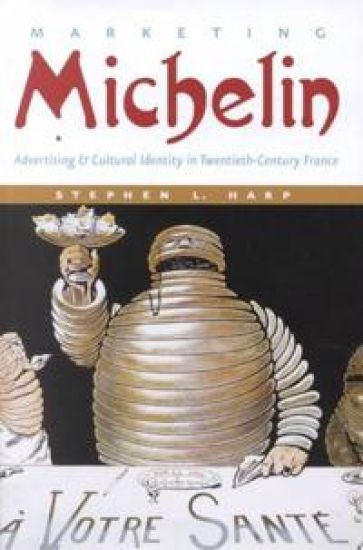
One of the world's largest tire makers and an international corporation with interests in countries around the world, Michelin is also a uniquely French company, one that throughout its history has closely identified itself with the country's people and culture. In the process, it has helped shape the self-image of twentieth-century France. In Marketing Michelin, Stephen Harp provides a provocative history of the company and its innovative advertising campaigns between 1898, when Bibendum-the company's iconic "Michelin Man"-was first introduced, to 1940, when France fell to the Nazis and the company's top executive, Edouard Michelin, died. Both events indelibly changed the company and the national context in which it operated. Harp uses the familiar figure of Bibendum and the promotional campaigns designed around him to analyze the cultural assumptions of belle-epoque France, including representations of gender, race, and class. He also considers Michelin's efforts to promote automobile tourism in France and Europe through its famous Red Guide (first introduced in 1900), noting that, in the aftermath of World War I, the company sold tour guides to the battlefields of the Western Front and favorably positioned France's participation in the war as purely defensive and unavoidable. Throughout this period, the company successfully identified the name of Michelin with many aspects of French society, from cuisine and local culture to nationalism and colonialism. Michelin also introduced Fordism and Taylorism to France, and Harp offers a nuanced understanding of how the firm effected Americanization and modernization despite the protests of the French public. Through its marketing efforts, Harp concludes, Michelin exerted a profound impact on France's cultural identity in the twentieth century. His ambitious study offers a fresh perspective on both French social history in these years and the relationship between corporate culture and popular culture in the twentieth century.
Learning to Be Loyal

Learning to Be Loyal

Stephen L. Harp

Northern Illinois University Press
1998
sidottu
How do nations inculcate loyalty? In Learning to Be Loyal, Harp explorers the role of primary education as the means by which both France and Germany used the teaching of national language, culture, geography, and history to transform ordinary people's local and religious identities into national ones.