Kirjailija
Stephen Morse
Kirjat ja teokset yhdessä paikassa: 28 kirjaa, julkaisuja vuosilta 2002-2026, suosituimpien joukossa Resilient Participation. Vertaile teosten hintoja ja tarkista saatavuus suomalaisista kirjakaupoista.
28 kirjaa
Kirjojen julkaisuhaarukka 2002-2026.
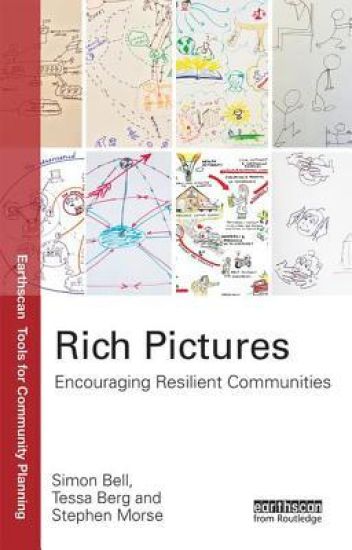
Rich Pictures focuses on the value of developing visual narratives – Rich Pictures – as an important component and starting point for community participation. A key device for the community to share ideas and perspectives on current and potential future situations, Rich Pictures provide a shared space for members to set out ideas and negotiate.While Rich Pictures are widely and globally used, this is the first book discussing their use, and how and when to use this technique for maximum participatory value. A valuable read for community engagement professionals, planners, politicians, and members of affected communities, Rich Pictures is richly illustrated with examples and authors’ testimonials.
Stakeholder or public participation has become something of a modern mantra employed in all sorts of contexts to give people a voice. There are many variants on this 'participation' but traditionally they all share a desire to maximise involvement and provide desired 'outputs' of a required quality as quickly and as cheaply as possible. Difference tends to be reduced and compromise encouraged as the outputs or even just the appearance of participation are emphasised. This book explores the large and diverse range of participatory methods currently in use, examines the problems and gaps in these methods and sets out an innovative new methodology which overcomes these shortcomings. Uniquely, this method builds from the assumption that it is not just the outputs that matter in participation - it is also the journey. 'Triple Task' is designed to help groups explore their current situation and develop a path by which they can improve their functioning and ultimately make a positive contribution to the lives of others. The book includes in-depth case studies of Triple Task in action across a range of contexts and countries, with particular focus on an EU project concerning indicators in policy-making. This new approach can be used in any context and with any sort of group to help them produce more informative 'outputs' in which a deep reflection of how the group works is allied to an analysis of how problems can be solved.
Presents practical advice on how to develop measurements that will work in real-life development contexts. The book describes and analyzes how to derive, validate and apply indicators in the course of an actual development project - in this case, the Mediterranean Action Plan.
' Measuring the sustainability of development is crucial to achieving it, and is one of the most actively studied issues in the area. To date, most studies of measurements or indicators have been largely theoretical. However, this book, a follow-on to Bell and Morse's highly influential Sustainability Indicators (1999), presents valuable practical advice on how to develop measurements that will work in real-life development contexts. It describes and analyses how to derive, validate and apply indicators in the course of an actual development project - in this case the Mediterranean Action Plan in Malta. The authors explain the trade-offs and constraints involved and how it is possible to combine the open-ended and flexible perspectives of sustainability with the more linear processes and fixed targets of specific projects through the use of pragmatic and reflective methodologies.
This book offers a comprehensive analysis of the background, practice, potential and challenges associated with developing and using perceptual indicators for assessing sustainability. Sustainability indicators (SIs) are usually described and portrayed as quantitative metrics that rest above the human realm of subjectivity, opinion and bias. Thus, they are the basis for objectively measuring progress towards the attainment of targets in sustainable development. Unlike the ‘hard’ metrics described above, the way in which we experience the world and frame our personal decisions based on that experience, past and present, is founded on perceptions and these can be inherently subjective. This book argues that perception-based indicators are an important subset of sustainability indicators in assessing sustainability, environmental quality and well-being. The chapters draw upon examples such as the Corruption Perception Index (CPI) produced by Transparency International, and a variety of happiness indices amongst many others. Divided into two parts, the first section provides a broad review of the field of SIs, addressing the challenges involved in identifying, defining and populating SIs, especially for countries in the Global South. The second part of the book summarises the range of participatory approaches that have often been used to develop perception-based indicators of sustainability, along with their respective pros and cons. This book will be useful for students studying social sciences, economics, environmental studies, human geography, politics and international development. The book may also appeal to students taking courses in business studies.
Social Networks and Food Security in the Urban Fringe
Stephen Morse; The Reverend Sister Nora MacNamara
Springer Nature Switzerland AG
2021
nidottu
This book explores how social groups in the urban fringe of Abuja, Nigeria, engaged with a series of development projects spanning 15 years (2003 to 2018) which focused on the enhancement of food security for farming households. The groups were at the heart of these development projects and the book presents the many insights that were gained by farmers and project agents working within these partnerships and provides advice for those seeking to do the same. The book also explores how the social groups attempted to lever benefits from being near to the fastest growing city in Africa and a centre of economic and political power. While much has been written about social groups and their embeddedness within wider social networks in Africa and in other parts of the world, the exploration of the role of social groups within development projects is an area that remains relatively unchartered and this book seeks to fill that important gap in knowledge. It provides an important contribution for all those researching and working with social groups in the developing world.
Social Networks and Food Security in the Urban Fringe
Stephen Morse; The Reverend Sister Nora MacNamara
Springer Nature Switzerland AG
2020
sidottu
This book explores how social groups in the urban fringe of Abuja, Nigeria, engaged with a series of development projects spanning 15 years (2003 to 2018) which focused on the enhancement of food security for farming households. The groups were at the heart of these development projects and the book presents the many insights that were gained by farmers and project agents working within these partnerships and provides advice for those seeking to do the same. The book also explores how the social groups attempted to lever benefits from being near to the fastest growing city in Africa and a centre of economic and political power. While much has been written about social groups and their embeddedness within wider social networks in Africa and in other parts of the world, the exploration of the role of social groups within development projects is an area that remains relatively unchartered and this book seeks to fill that important gap in knowledge. It provides an important contribution for all those researching and working with social groups in the developing world.
Jawetz Melnick & Adelbergs Medical Microbiology 28 E
Stefan Riedel; Stephen Morse; Timothy Mietzner; Steve Miller
McGraw-Hill Education
2019
nidottu
Understand the clinically relevant aspects of microbiology with this student-acclaimed, full-color review-bolstered by case studies and hundreds of USMLE®-style review questionsA Doody's Core Title for 2022!Since 1954, Jawetz, Melnick & Adelberg’s Medical Microbiology has been hailed by students, instructors, and clinicians as the single-best resource for understanding the roles microorganisms play in human health and illness. Concise and fully up to date, this trusted classic links fundamental principles with the diagnosis and treatment of microbial infections. Along with brief descriptions of each organism, you will find vital perspectives on pathogenesis, diagnostic laboratory tests, clinical findings, treatment, and epidemiology. The book also includes an entire chapter of case studies that focuses on differential diagnosis and management of microbial infections.Here’s why Jawetz, Melnick & Adelberg’s Medical Microbiology is essential for USMLE® review:640+ USMLE-style review questions350+ illustrations140+ tables22 case studies to sharpen your differential diagnosis and management skillsAn easy-to-access list of medically important microorganismsCoverage that reflects the latest techniques in laboratory and diagnostic technologiesFull-color images and micrographsChapter-ending summariesChapter concept checksJawetz, Melnick & Adelberg’s Medical Microbiology, Twenty-Eighth Edition effectively introduces you to basic clinical microbiology through the fields of bacteriology, mycology, and parasitology, giving you a thorough yet understandable review of the discipline. Begin your review with it and see why there is nothing as time tested or effective.
This book makes indicators more accessible, in terms of what they are, who created them and how they are used. It examines the subjectivity and human frailty behind these quintessentially ‘hard’ and technical measures of the world.To achieve this goal, The Rise and Rise of Indicators presents the world in terms of a selected set of indicators. The emphasis is upon the origins of the indicators and the motivation behind their creation and evolution. The ideas and assumptions behind the indicators are made transparent to demonstrate how changes to them can dramatically alter the ranking of countries that emerge. They are, after all, human constructs and thus embody human biases. The book concludes by examining the future of indicators and the author sets out some possible trajectories, including the growing emphasis on indicators as important tools in the Sustainable Development Goals that have been set for the world up until 2030.This is a valuable resource for undergraduate and postgraduate students in the areas of economics, sociology, geography, environmental studies, development studies, area studies, business studies, politics and international relations.
This title was first published in 2000: Sustainable development has grown to compass cultural, socio-economic, political and environmental issues, and the use of Sustainability indicators (SIs) is seen by many as central to its implementation. After all, how can one ’do’ sustainable development unless one knows when it has been attained? The adoption of SIs in such a context is logical, but does present a number of practical difficulties. So far much of the published material consists of theoretical SI frameworks, with little practical experience on their use in development scenarios. In contrast, this volume is based on the results of a six year project designed to develop and evaluate the use of SLs in a Nigerian village. For the first time this takes into consideration the views and perspectives of the local population, and in doing so addresses key issues that are vital for anyone attempting to put sustainable development into practice.
Microbiology & Infectious Diseases Flashcards, Third Edition
Kenneth Somers; Stephen Morse; Molly Hughes
McGraw-Hill Education
2018
sidottu
Publisher's Note: Products purchased from Third Party sellers are not guaranteed by the publisher for quality, authenticity, or access to any online entitlements included with the product.200 high-yield cards with a clinical vignette on every disease-specific cardLANGE Flash Cards: Microbiology and Infectious Diseases, Third Edition are a quick, concise, and effective way to review the essential concepts of microbiology. These cards help you learn the medically important aspects of the subject and cover the basic and clinical aspects of bacteriology, virology, mycology, parasitology, and infectious diseases.One side of the card features a clinical vignette that is a mini-case study of the disease and the flip side presents the etiology and epidemiology, pathogenesis, clinical manifestations, laboratory diagnosis, and treatment and prevention of the disorder.Features• A super-effective portable learning tool • Covers major microbial diseases caused by bacteria, viruses, fungi, and parasites • Teaches medical microbiology in the context of clinical cases • Great for last minute exam preparation
This title was first published in 2000: Sustainable development has grown to compass cultural, socio-economic, political and environmental issues, and the use of Sustainability indicators (SIs) is seen by many as central to its implementation. After all, how can one ’do’ sustainable development unless one knows when it has been attained? The adoption of SIs in such a context is logical, but does present a number of practical difficulties. So far much of the published material consists of theoretical SI frameworks, with little practical experience on their use in development scenarios. In contrast, this volume is based on the results of a six year project designed to develop and evaluate the use of SLs in a Nigerian village. For the first time this takes into consideration the views and perspectives of the local population, and in doing so addresses key issues that are vital for anyone attempting to put sustainable development into practice.
Sustainable Development and Corporate Social Responsibility
Dongyong Zhang; Stephen Morse; Uma Kambhampati
Routledge
2017
sidottu
Corporate Social Responsibility (CSR) has become an important concept in the last few decades. Although it originated in the developed countries of the West, the concept has been embraced and adapted by corporations and policy-making agencies in many developing countries. Not surprisingly, given the importance of growth and development as policy objectives in these countries, CSR has had a significant impact on sustainable development.Sustainable Development and Corporate Social Responsibility explores the evolution of CSR across the developed and developing world, with a particular focus on China and sustainable development. Through an extensive review of the literature and relevant case studies, the book examines whether CSR can make a contribution to sustainable development, how the patterns of CSR in developed Western economies compare to that in the rapidly growing economy of China, what trade-offs take place between CSR and economic growth as well as the future of CSR and its possible impact on the global sustainable development agenda.This book is a valuable resource for academics and upper-level undergraduate and postgraduate students in the fields of human/social geography, economics, business studies, sustainable development, development studies and environmental studies.
Sustainable Development and Corporate Social Responsibility
Dongyong Zhang; Stephen Morse; Uma Kambhampati
Routledge
2017
nidottu
Corporate Social Responsibility (CSR) has become an important concept in the last few decades. Although it originated in the developed countries of the West, the concept has been embraced and adapted by corporations and policy-making agencies in many developing countries. Not surprisingly, given the importance of growth and development as policy objectives in these countries, CSR has had a significant impact on sustainable development.Sustainable Development and Corporate Social Responsibility explores the evolution of CSR across the developed and developing world, with a particular focus on China and sustainable development. Through an extensive review of the literature and relevant case studies, the book examines whether CSR can make a contribution to sustainable development, how the patterns of CSR in developed Western economies compare to that in the rapidly growing economy of China, what trade-offs take place between CSR and economic growth as well as the future of CSR and its possible impact on the global sustainable development agenda.This book is a valuable resource for academics and upper-level undergraduate and postgraduate students in the fields of human/social geography, economics, business studies, sustainable development, development studies and environmental studies.