Kirjojen hintavertailu. Mukana 12 152 606 kirjaa ja 12 kauppaa.

Kirjailija

Stephen P. Stich

Kirjat ja teokset yhdessä paikassa: 6 kirjaa, julkaisuja vuosilta 1996-2003, suosituimpien joukossa The Blackwell Guide to Philosophy of Mind. Vertaile teosten hintoja ja tarkista saatavuus suomalaisista kirjakaupoista.

6 kirjaa

Kirjojen julkaisuhaarukka 1996-2003.

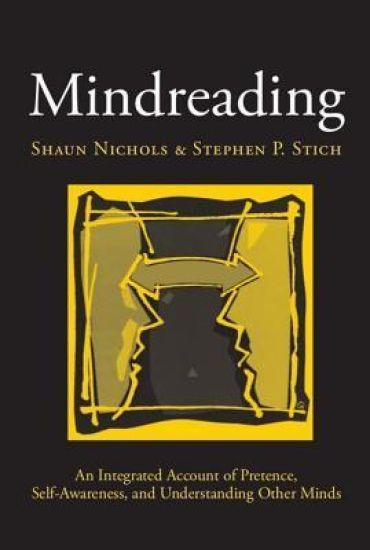
Mindreading

Mindreading

Shaun Nichols; Stephen P. Stich

Clarendon Press
2003
nidottu
The everyday capacity to understand the mind, fancifully dubbed 'mindreading', plays an enormous role in our lives. In the latter half of the 20th century mindreading became the object of sustained scientific and theoretical research, capturing the attention of a wide range of disciplines, including philosophy, developmental psychology, behavioral ecology, anthropology, and cognitive psychopathology. What has been missing is a detailed and integrated account of the mental components that underlie this remarkable capacity. Nichols and Stich develop and defend a new account of the psychological mechanisms underlying mindreading. They maintain that it is, as common sense would suggest, vital to distinguish between reading others' minds and reading one's own. In reading other minds, the imagination plays a central role. As a result, the authors begin with an explicit and systematic account of pretence and imagination which proposes that pretence representations are contained in a separate mental workspace, the 'Possible World Box', which is part of the basic architecture of the human mind. The mechanisms underlying pretence get recruited when people attempt to understand others and predict their behaviour. In some cases, we use our own mental mechanisms to simulate the mental processes of another, as suggested by the 'simulation theory' of mindreading. However, mindreading also implicates very different kinds of mechanisms that rely on rich bodies of information, as suggested by information-based accounts of mindreading. In addition, the authors argue, reading other minds involves important processes that don't fit into either category. None of these mechanisms, though, explain how we read our own minds, which, according to the authors, requires invoking an entirely independent set of mechanisms. What we find, then, is an intricate web of mental components to explain our fascinating and multifarious knack of understanding minds. This account provides a valuable framework for future work on mindreading and has broad implications for philosophical debates that have surrounded the issue for the last quarter century.
Mindreading

Mindreading

Shaun Nichols; Stephen P. Stich

Clarendon Press
2003
sidottu
The everyday capacity to understand the mind, or "mindreading", plays an enormous role in our ordinary lives. Shaun Nichols and Stephen Stich provide a detailed and integrated account of the intricate web of mental components underlying this fascinating and multifarious skill. The imagination, they argue, is essential to understanding others, and there are special cognitive mechanisms for understanding oneself. The account that emerges has broad implications for longstanding philosophical debates over the status of folk psychology.
The Blackwell Guide to Philosophy of Mind

The Blackwell Guide to Philosophy of Mind

Stephen P. Stich; Ted A. Warfield

Blackwell Publishers
2002
sidottu
Comprising a series of specially commissioned chapters by leading scholars, this comprehensive volume presents an up-to-date survey of the central themes in the philosophy of mind. It leads the reader through a broad range of topics, including Artificial Intelligence, Consciousness, Dualism, Emotions, Folk Psychology, Free Will, Individualism, Personal Identity and The Mind-Body Problem. Provides a state of the art overview of philosophy of mind. Contains 16 newly-commissioned articles, all of which are written by internationally distinguished scholars. Each chapter reviews a central issue, examines the current state of the discipline with respect to the topic, and discusses possible futures of the field. Provides a solid foundation for further study.
Deconstructing the Mind

Deconstructing the Mind

Stephen P. Stich

Oxford University Press Inc
1999
nidottu
In this book, Stich unravels - or deconstructs - the doctrine called "eliminativism". Eliminativism claims that beliefs, desires, and many other mental states we use to describe the mind do not exist, but are fictional posits of a badly mistaken theory of "folk psychology". Stich makes a U-turn in his book, opening up new and controversial positions.
Deconstructing the Mind

Deconstructing the Mind

Stephen P. Stich

Oxford University Press Inc
1996
sidottu
Over the last two decades, debates over the viability of commonsense psychology have been centre stage in both cognitive science and the philosophy of mind. Eliminativists have argued that advances in cognitive science and neuroscience will ultimately justify a rejection of our "folk" theory of the mind, and of its ontology. In the first half of this book Stich, who was at one time a leading advocate of eliminativism, maintains that even if the sciences develop in the ways that eliminativists foresee, none of the arguments for ontological elimination are tenable. Rather than being resolved by science, he contends, these ontological disputes will be settled by a pragmatic process in which social and political considerations have a major role to play. In later chapters, Stich argues that the widespread worry about "naturalizing" psychological properties is deeply confused, since there is no plausible account of what naturalizing requires on which the failure of the naturalization project would lead to eliminativism. He also offers a detailed analysis of the many different notions of folk psychology to be found in philosophy and psychology, and argues that simulation theory, which purports to be an alternative to folk psychology, is not supported by recent experimental findings.