Kirjojen hintavertailu. Mukana 12 390 323 kirjaa ja 12 kauppaa.

Kirjailija

Stephen R. Anderson

Kirjat ja teokset yhdessä paikassa: 7 kirjaa, julkaisuja vuosilta 1985-2020, suosituimpien joukossa Phonology in the Twentieth Century. Vertaile teosten hintoja ja tarkista saatavuus suomalaisista kirjakaupoista.

Mukana myös kirjoitusasut: Stephen R Anderson

7 kirjaa

Kirjojen julkaisuhaarukka 1985-2020.

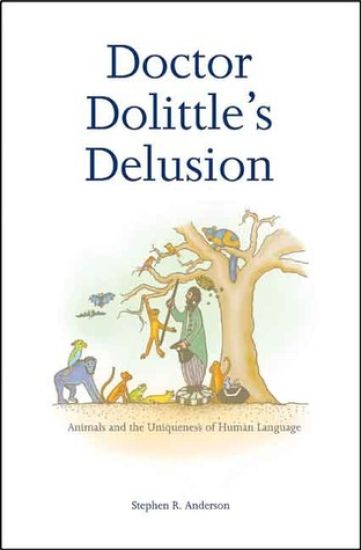
Doctor Dolittle’s Delusion

Doctor Dolittle’s Delusion

Stephen R. Anderson

Yale University Press
2006
pokkari
Dr. Dolittle—and many students of animal communication—are wrong: animals cannot use language. This fascinating book explains why. Can animals be taught a human language and use it to communicate? Or is human language unique to human beings, just as many complex behaviors of other species are uniquely theirs? This engrossing book explores communication and cognition in animals and humans from a linguistic point of view and asserts that animals are not capable of acquiring or using human language. Stephen R. Anderson explains what is meant by communication, the difference between communication and language, and the essential characteristics of language. Next he examines a variety of animal communication systems, including bee dances, frog vocalizations, bird songs, and alarm calls and other vocal, gestural, and olfactory communication among primates. Anderson then compares these to human language, including signed languages used by the deaf. Arguing that attempts to teach human languages or their equivalents to the great apes have not succeeded in demonstrating linguistic abilities in nonhuman species, he concludes that animal communication systems—intriguing and varied though they may be—do not include all the essential properties of human language. Animals can communicate, but they can’t talk.
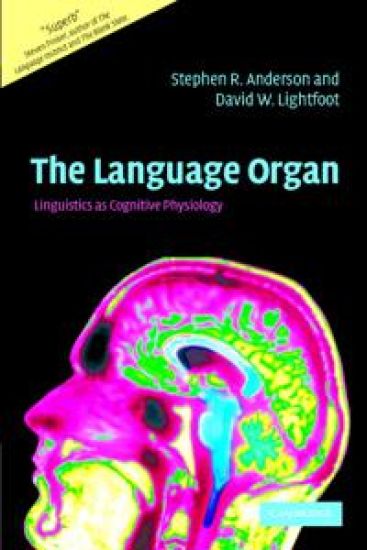
The Language Organ

The Language Organ

Stephen R. Anderson; David W. Lightfoot

Cambridge University Press
2002
pokkari
The Language Organ treats human language as the manifestation of a faculty of the mind, a mental organ whose nature is determined by human biology and whose functional properties should be explored just as physiology explores the functional properties of physical organs. It surveys the nature of the language faculty in its various aspects: the systems of sounds, words, and syntax, the development of language in the child and historically, and what is known about its relation to the brain. It discusses the kinds of work that can be carried out in these areas that will contribute to an understanding of the human language organ. This book will appeal to students and researchers in linguistics, and is written to be accessible to colleagues in other disciplines dealing with language as well as to readers with an interest in general science and the nature of the human mind.
The Language Organ

The Language Organ

Stephen R. Anderson; David W. Lightfoot

Cambridge University Press
2002
sidottu
The Language Organ treats human language as the manifestation of a faculty of the mind, a mental organ whose nature is determined by human biology and whose functional properties should be explored just as physiology explores the functional properties of physical organs. It surveys the nature of the language faculty in its various aspects: the systems of sounds, words, and syntax, the development of language in the child and historically, and what is known about its relation to the brain. It discusses the kinds of work that can be carried out in these areas that will contribute to an understanding of the human language organ. This book will appeal to students and researchers in linguistics, and is written to be accessible to colleagues in other disciplines dealing with language as well as to readers with an interest in general science and the nature of the human mind.
A-Morphous Morphology

A-Morphous Morphology

Stephen R. Anderson

Cambridge University Press
1992
pokkari
In A-Morphous Morphology, Stephen Anderson presents a theory of word structure which relates to a full generative grammar of language. He holds word structure to be the result of interacting principles from a number of grammatical areas, and thus not localized in a single morphological component. Dispensing with classical morphemes, the theory instead treats morphology as a matter of rule-governed relations, minimizing the non-phonological internal structure assigned to words and eliminating morphologically motivated boundary elements. Professor Anderson makes the further claim that the properties of individual lexical items are not visible to, or manipulated by, the rules of the syntax, and assimilates to morphology special clitic phenomena. A-Morphous Morphology maintains significant distinctions between inflection, derivation, and compounding, in terms of their place ina grammar. It also contains discussion of the implications of this new A-Morphous position analysis of word structure.