

Kirjailija
Stephen R. Bown
Kirjat ja teokset yhdessä paikassa: 3 kirjaa, julkaisuja vuosilta 2005-2014, suosituimpien joukossa Scurvy. Vertaile teosten hintoja ja tarkista saatavuus suomalaisista kirjakaupoista.
Mukana myös kirjoitusasut: Stephen R Bown
3 kirjaa
Kirjojen julkaisuhaarukka 2005-2014.
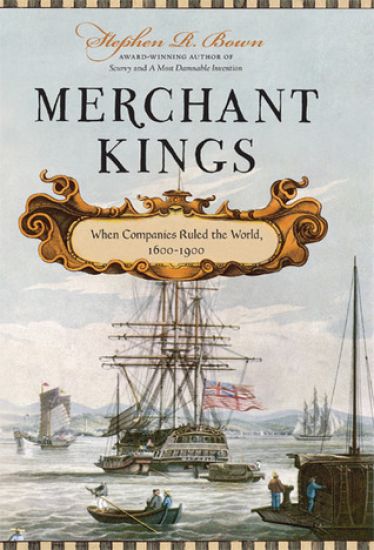
Merchant Kings: When Companies Ruled the World, 1600--1900
Stephen R. Bown
Thomas Dunne Books
2010
sidottu
Commerce meets conquest in this swashbuckling story of the six merchant-adventurers who built the modern world It was an era when monopoly trading companies were the unofficial agents of European expansion, controlling vast numbers of people and huge tracts of land, and taking on governmental and military functions. They managed their territories as business interests, treating their subjects as employees, customers, or competitors. The leaders of these trading enterprises exercised virtually unaccountable, dictatorial political power over millions of people. The merchant kings of the Age of Heroic Commerce were a rogue's gallery of larger-than-life men who, for a couple hundred years, expanded their far-flung commercial enterprises over a sizable portion of the world. They include Jan Pieterszoon Coen, the violent and autocratic pioneer of the Dutch East India Company; Peter Stuyvesant, the one-legged governor of the Dutch West India Company, whose narrow-minded approach lost Manhattan to the British; Robert Clive, who rose from company clerk to become head of the British East India Company and one of the wealthiest men in Britain; Alexandr Baranov of the Russian American Company; Cecil Rhodes, founder of De Beers and Rhodesia; and George Simpson, the "Little Emperor" of the Hudson's Bay Company, who was chauffeured about his vast fur domain in a giant canoe, exhorting his voyageurs to paddle harder so he could set speed records.Merchant Kings looks at the rise and fall of company rule in the centuries before colonialism, when nations belatedly assumed responsibility for their commercial enterprises. A blend of biography, corporate history, and colonial history, this book offers a panoramic, new perspective on the enormous cultural, political, and social legacies, good and bad, of this first period of unfettered globalization.

Scurvy: How a Surgeon, a Mariner, and a Gentlemen Solved the Greatest Medical Mystery of the Age of Sail
Stephen R. Bown
St. Martin's Griffin
2005
nidottu
Scurvy took a terrible toll in the Age of Sail, killing more sailors than were lost in all sea battles combined. The threat of the disease kept ships close to home and doomed those vessels that ventured too far from port. The willful ignorance of the royal medical elite, who endorsed ludicrous medical theories based on speculative research while ignoring the life-saving properties of citrus fruit, cost tens of thousands of lives and altered the course of many battles at sea. The cure for scurvy ranks among the greatest of human accomplishments, yet its impact on history has, until now, been largely ignored. From the earliest recorded appearance of the disease in the sixteenth century, to the eighteenth century, where a man had only half a chance of surviving the scourge, to the early nineteenth century, when the British conquered scurvy and successfully blockaded the French and defeated Napoleon, Scurvy is a medical detective story for the ages, the fascinating true story of how James Lind (the surgeon), James Cook (the mariner), and Gilbert Blane (the gentleman) worked separately to eliminate the dreaded affliction. Scurvy is an evocative journey back to the era of wooden ships and sails, when the disease infiltrated every aspect of seafaring life: press gangs "recruit" mariners on the way home from a late night at the pub; a terrible voyage in search of riches ends with a hobbled fleet and half the crew heaved overboard; Cook majestically travels the South Seas but suffers an unimaginable fate. Brimming with tales of ships, sailors, and baffling bureaucracy, Scurvy is a rare mix of compelling history and classic adventure story.