Kirjojen hintavertailu. Mukana 12 390 323 kirjaa ja 12 kauppaa.

Kirjailija

Stephen W. Raudenbush

Kirjat ja teokset yhdessä paikassa: 3 kirjaa, julkaisuja vuosilta 2002-2017, suosituimpien joukossa The Ambitious Elementary School. Vertaile teosten hintoja ja tarkista saatavuus suomalaisista kirjakaupoista.

3 kirjaa

Kirjojen julkaisuhaarukka 2002-2017.

The Ambitious Elementary School

The Ambitious Elementary School

Elizabeth McGhee Hassrick; Stephen W. Raudenbush; Lisa Rosen

University of Chicago Press
2017
sidottu
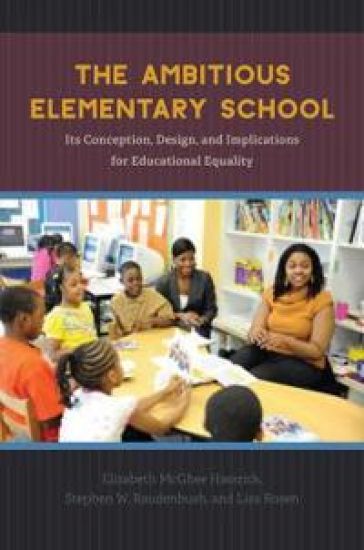
The challenge of overcoming educational inequality in the United States can sometimes appear overwhelming, and great controversy exists as to whether or not elementary schools are up to the task, whether they can ameliorate existing social inequalities and initiate opportunities for economic and civic flourishing for all children. This book shows what can happen when you rethink schools from the ground up with precisely these goals in mind, approaching educational inequality and its entrenched causes head on, student by student. Drawing on an in-depth study of real schools on the South Side of Chicago, Elizabeth McGhee Hassrick, Stephen W. Raudenbush, and Lisa Rosen argue that effectively meeting the challenge of educational inequality requires a complete reorganization of institutional structures as well as wholly new norms, values, and practices that are animated by a relentless commitment to student learning. They examine a model that pulls teachers out of their isolated classrooms and places them into collaborative environments where they can share their curricula, teaching methods, and assessments of student progress with a school-based network of peers, parents, and other professionals. Within this structure, teachers, school leaders, social workers, and parents collaborate to ensure that every child receives instruction tailored to his or her developing skills. Cooperating schools share new tools for assessment and instruction and become sites for the training of new teachers. Parents become respected partners, and expert practitioners work with researchers to evaluate their work and refine their models for educational organization and practice. The authors show not only what such a model looks like but the dramatic results it produces for student learning and achievement. The result is a fresh, deeply informed, and remarkably clear portrait of school reform that directly addresses the real problems of educational inequality.
The Ambitious Elementary School

The Ambitious Elementary School

Elizabeth McGhee Hassrick; Stephen W. Raudenbush; Lisa Rosen

University of Chicago Press
2017
nidottu
The challenge of overcoming educational inequality in the United States can sometimes appear overwhelming, and great controversy exists as to whether or not elementary schools are up to the task, whether they can ameliorate existing social inequalities and initiate opportunities for economic and civic flourishing for all children. This book shows what can happen when you rethink schools from the ground up with precisely these goals in mind, approaching educational inequality and its entrenched causes head on, student by student. Drawing on an in-depth study of real schools on the South Side of Chicago, Elizabeth McGhee Hassrick, Stephen W. Raudenbush, and Lisa Rosen argue that effectively meeting the challenge of educational inequality requires a complete reorganization of institutional structures as well as wholly new norms, values, and practices that are animated by a relentless commitment to student learning. They examine a model that pulls teachers out of their isolated classrooms and places them into collaborative environments where they can share their curricula, teaching methods, and assessments of student progress with a school-based network of peers, parents, and other professionals. Within this structure, teachers, school leaders, social workers, and parents collaborate to ensure that every child receives instruction tailored to his or her developing skills. Cooperating schools share new tools for assessment and instruction and become sites for the training of new teachers. Parents become respected partners, and expert practitioners work with researchers to evaluate their work and refine their models for educational organization and practice. The authors show not only what such a model looks like but the dramatic results it produces for student learning and achievement. The result is a fresh, deeply informed, and remarkably clear portrait of school reform that directly addresses the real problems of educational inequality.
Hierarchical Linear Models

Hierarchical Linear Models

Stephen W. Raudenbush; Anthony S. Bryk

SAGE Publications Inc
2002
sidottu
"This is a first-class book dealing with one of the most important areas of current research in applied statistics…the methods described are widely applicable…the standard of exposition is extremely high." --Short Book Reviews from the International Statistical Institute "The new chapters (10-14) improve an already excellent resource for research and instruction. Their content expands the coverage of the book to include models for discrete level-1 outcomes, non-nested level-2 units, incomplete data, and measurement error---all vital topics in contemporary social statistics. In the tradition of the first edition, they are clearly written and make good use of interesting substantive examples to illustrate the methods. Advanced graduate students and social researchers will find the expanded edition immediately useful and pertinent to their research." --TED GERBER, Sociology, University of Arizona "Chapter 11 was also exciting reading and shows the versatility of the mixed model with the EM algorithm. There was a new revelation on practically every page. I found the exposition to be extremely clear. It was like being led from one treasure room to another, and all of the gems are inherently useful. These are problems that researchers face everyday, and this chapter gives us an excellent alternative to how we have traditionally handled these problems."--PAUL SWANK, Houston School of Nursing, University of Texas, Houston Popular in the First Edition for its rich, illustrative examples and lucid explanations of the theory and use of hierarchical linear models (HLM), the book has been reorganized into four parts with four completely new chapters. The first two parts, Part I on "The Logic of Hierarchical Linear Modeling" and Part II on "Basic Applications" closely parallel the first nine chapters of the previous edition with significant expansions and technical clarifications, such as: * An intuitive introductory summary of the basic procedures for estimation and inference used with HLM models that only requires a minimal level of mathematical sophistication in Chapter 3* New section on multivariate growth models in Chapter 6 * A discussion of research synthesis or meta-analysis applications in Chapter 7* Data analytic advice on centering of level-1 predictors and new material on plausible value intervals and robust standard estimators While the first edition confined its attention to continuously distributed outcomes at level 1, this second edition now includes coverage of an array of outcomes types in Part III: * New Chapter 10 considers applications of hierarchical models in the case of binary outcomes, counted data, ordered categories, and multinomial outcomes using detailed examples to illustrate each case * New Chapter 11 on latent variable models, including estimating regressions from missing data, estimating regressions when predictors are measured with error, and embedding item response models within the framework of the HLM model * New introduction to the logic of Bayesian inference with applications to hierarchical data (Chapter 13) The authors conclude in Part IV with the statistical theory and computations used throughout the book, including univariate models with normal level-1 errors, multivariate linear models, and hierarchical generalized linear models.