Kirjojen hintavertailu. Mukana 12 657 676 kirjaa ja 12 kauppaa.

Kirjailija

Stevan Harrell

Kirjat ja teokset yhdessä paikassa: 25 kirjaa, julkaisuja vuosilta 1996-2025, suosituimpien joukossa Mountain Patterns. Vertaile teosten hintoja ja tarkista saatavuus suomalaisista kirjakaupoista.

25 kirjaa

Kirjojen julkaisuhaarukka 1996-2025.

Ways of Being Ethnic in Southwest China

Ways of Being Ethnic in Southwest China

Stevan Harrell

University of Washington Press
2002
pokkari
Open-access edition: DOI 10.6069/9780295804071Drawing on extensive fieldwork conducted in the 1980s and 1990s in southern Sichuan, this pathbreaking study examines the nature of ethnic consciousness and ethnic relations among local communities, focusing on the Nuosu (classified as Yi by the Chinese government), Prmi, Naze, and Han. It argues that even within the same regional social system, ethnic identity is formulated, perceived, and promoted differently by different communities at different times.Ways of Being Ethnic in Southwest China exemplifies a model in which ethnic consciousness and ethnic relations consist of drawing boundaries between one's own group and others, crossing those boundaries, and promoting internal unity within a group. Leaders and members of ethnic groups use commonalties and differences in history, culture, and kinship to promote internal unity and to strengthen or cross external boundaries. Superimposed on the structure of competing and cooperating local groups is a state system of ethnic classification and administration; members and leaders of local groups incorporate this system into their own ethnic consciousness, co-opting or resisting it situationally.The heart of the book consists of detailed case studies of three Nuosu village communities, along with studies of Prmi and Naze communities, smaller groups such as the Yala and Nasu, and Han Chinese who live in minority areas. These are followed by a synthesis that compares different configurations of ethnic identity in different communities and discusses the implications of these examples for our understanding of ethnicity and for the near future of China. This lively description and analysis of the region's complex ethnic identities and relationships constitutes an original and important contribution to the study of ethnic identity.Ways of Being Ethnic in Southwest China will be of interest to social scientists concerned with issues of ethnicity and state-building.
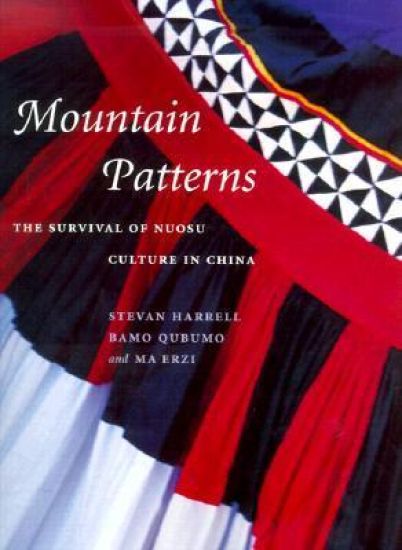
Mountain Patterns

Mountain Patterns

Stevan Harrell; Bamo Qubumo; Ma Erzi

University of Washington Press
2000
pokkari
Nestled against the Tibetan highlands in the remote mountains of Liangshan in southwest China, the land of the Nuosu people was until the 1950s beyond the easy reach of the Chinese government, and the culture of the Nuosu (a branch of the Yi group) developed with little Chinese influence. In the 1960s China's Cultural Revolution suppressed and eroded Nuosu culture, but since the 1980s there has been a resurgence of Nuosu ethnic identity and culture, and a revival of traditional arts.An introductory chapter presents the history and culture of the Nuosu, and essays illustrate each of the traditional visual arts: wooden house architecture, featuring intricate post-and-beam construction and carved decoration; clothing and textiles, including elaborate needlework; red-yellow-black lacquerware, seen in both traditional village-made and modern factory-made versions; silversmithing and jewelry; musical instruments and their use; and two aspects of the ritual culture of the bimo priests -- ceremonies for the souls of deceased ancestors and rituals to expel and exorcise ghosts.Mountain Patterns, includes photographs representing every corner of Nuosu territory and displaying a wide variety of regional styles.
Human Families

Human Families

Stevan Harrell

Westview Press Inc
1999
nidottu
This detailed study maps the variations in family systems throughout the world, focusing on the ways families interact with their societies. Tracing the developmental cycle of families in a wide range of times and places, Stevan Harrell shows how family members in different societies must cooperate to perform various activities and thus organize themselves in particular ways.Within six major divisions, the book describes families in nomadic bands, traditional African societies, Polynesian and Micronesian societies, native societies of the Pacific Northwest coast, preindustrial class societies, and modern industrial societies. Within each group, the author's copious examples demonstrate the variation from one family system to another. His case studies are clearly illustrated with a unique set of diagrams that allow comparison of complex groups and of family processes extending over a generation. Scholars and advanced students alike will find this ambitious book an invaluable resource.
Cultural Encounters on China's Ethnic Frontiers

Cultural Encounters on China's Ethnic Frontiers

Stevan Harrell

University of Washington Press
1996
pokkari
Open-access edition: DOI 10.6069/9780295804088China's exploitation by Western imperialism is well known, but the imperialist treatment within China of ethnic minorities has been little explored. Around the geographic periphery of China, as well as some of the less accessible parts of the interior, and even in its cities, live a variety of peoples of different origins, languages, ecological adaptations, and cultures. These people have interacted for centuries with the Han Chinese majority, with other minority ethnic groups (minzu), and with non-Chinese, but identification of distinct groups and analysis of their history and relationship to others still are problematic.Cultural Encounters on China's Ethnic Frontiers provides rich material for the comparative study of colonialism and imperialism and for the study of Chinese nation-building. It represents some of the first scholarship on ethnic minorities in China based on direct research since before World War II. This, combined with increasing awareness in the West of the importance of ethnic relations, makes it an especially timely book. It will be of interest to anthopologists, historians, and political scientists, as well as to sinologists.