Kirjojen hintavertailu. Mukana 12 152 606 kirjaa ja 12 kauppaa.

Kirjailija

Steve Olson

Kirjat ja teokset yhdessä paikassa: 12 kirjaa, julkaisuja vuosilta 1989-2026, suosituimpien joukossa Anarchy Evolution. Vertaile teosten hintoja ja tarkista saatavuus suomalaisista kirjakaupoista.

12 kirjaa

Kirjojen julkaisuhaarukka 1989-2026.

Anarchy Evolution

Anarchy Evolution

Greg Graffin; Steve Olson

HarperPerennial
2011
nidottu
Most people know Greg Graffin as the lead singer of the punk band Bad Religion, but few know that he also received a Ph.D. from Cornell University and teaches evolution at the University of California at Los Angeles. In "Anarchy Evolution", Graffin argues that art and science have a deep connection. As an adolescent growing up when drugs, sex, and trouble could be had on any given night, Graffin discovered that the study of evolution provided a framework through which he could make sense of the world. In this provocative and personal book, he describes his own coming of age as an artist and the formation of his naturalist worldview on questions involving God, science, and human existence. While the battle between religion and science is often displayed in the starkest of terms, "Anarchy Evolution" provides fresh and nuanced insights into the long-standing debate about atheism and the human condition. It is a book for anyone who has ever wondered if God really exists.

The Apocalypse Factory

The Apocalypse Factory

Steve Olson

WW NORTON CO
2022
nidottu
It began with plutonium, the first element ever manufactured in quantity by humans. Fearing that the Germans would be the first to weaponise the atom, the United States marshalled brilliant minds and seemingly inexhaustible bodies to find a way to create a nuclear chain reaction of inconceivable explosive power. In a matter of months, the Hanford nuclear facility was built to produce the enigmatic and deadly new material that would fuel atomic bombs. In the desert of eastern Washington State, far from prying eyes, scientists Glenn Seaborg, Enrico Fermi and thousands of others—the physicists, engineers, labourers and support staff at the facility—manufactured plutonium for the bomb dropped on Nagasaki, and for the bombs in the current American nuclear arsenal, enabling the construction of weapons with the potential to end human civilisation. With his characteristic blend of scientific clarity and storytelling, Steve Olson asks why Hanford has been largely overlooked in histories of the Manhattan Project and the Cold War. Olson, who grew up just twenty miles from Hanford’s B Reactor, recounts how a small Washington town played host to some of the most influential scientists and engineers in American history as they sought to create the substance at the core of the most destructive weapons ever created. The Apocalypse Factory offers a new generation this dramatic story of human achievement and ultimately, of lethal hubris.
The Apocalypse Factory

The Apocalypse Factory

Steve Olson

WW Norton Co
2020
sidottu
It began with plutonium, the first element ever manufactured in quantity by humans. Fearing that the Germans would be the first to weaponise the atom, the United States marshalled brilliant minds and seemingly inexhaustible bodies to find a way to create a nuclear chain reaction of inconceivable explosive power. In a matter of months, the Hanford nuclear facility was built to produce the enigmatic and deadly new material that would fuel atomic bombs. In the desert of eastern Washington State, far from prying eyes, scientists Glenn Seaborg, Enrico Fermi and thousands of others—the physicists, engineers, labourers and support staff at the facility—manufactured plutonium for the bomb dropped on Nagasaki, and for the bombs in the current American nuclear arsenal, enabling the construction of weapons with the potential to end human civilisation. With his characteristic blend of scientific clarity and storytelling, Steve Olson asks why Hanford has been largely overlooked in histories of the Manhattan Project and the Cold War. Olson, who grew up just twenty miles from Hanford’s B Reactor, recounts how a small Washington town played host to some of the most influential scientists and engineers in American history as they sought to create the substance at the core of the most destructive weapons ever created. The Apocalypse Factory offers a new generation this dramatic story of human achievement and ultimately, of lethal hubris. •2020 marks the 75th anniversary of the United States’ detonation of nuclear weapons over the Japanese cities of Hiroshima and Nagasaki on 6 and 9 August 1945.
Eruption

Eruption

Steve Olson

WW Norton Co
2017
nidottu
For months in early 1980, scientists, journalists and ordinary people listened anxiously to rumblings in the long quiescent volcano Mount St. Helens. Still, when a massive explosion took the top off the mountain, no one was prepared. Fifty-seven people died and the lives of many others were changed forever. Steve Olson interweaves history, science and vivid personal stories to portray the disaster as a multi-faceted turning point. Powerful economic, political and historical forces influenced who died when the volcano erupted. The eruption of Mount St. Helens transformed volcanic science, the study of environmental resilience and our perceptions of how to survive on an increasingly dangerous planet.
Ready, Set, Science!

Ready, Set, Science!

Sarah Michaels; Andrew W. Shouse; Heidi A. Schweingruber; Steve Olson

National Academies Press
2007
nidottu
What types of instructional experiences help K-8 students learn science with understanding? What do science educators, teachers, teacher leaders, science specialists, professional development staff, curriculum designers, and school administrators need to know to create and support such experiences? Ready, Set, Science! guides the way with an account of the groundbreaking and comprehensive synthesis of research into teaching and learning science in kindergarten through eighth grade. Based on the recently released National Research Council report Taking Science to School: Learning and Teaching Science in Grades K-8, this book summarizes a rich body of findings from the learning sciences and builds detailed cases of science educators at work to make the implications of research clear, accessible, and stimulating for a broad range of science educators. Ready, Set, Science! is filled with classroom case studies that bring to life the research findings and help readers to replicate success. Most of these stories are based on real classroom experiences that illustrate the complexities that teachers grapple with every day. They show how teachers work to select and design rigorous and engaging instructional tasks, manage classrooms, orchestrate productive discussions with culturally and linguistically diverse groups of students, and help students make their thinking visible using a variety of representational tools. This book will be an essential resource for science education practitioners and contains information that will be extremely useful to everyone A-A'A1/2including parents A-A'A1/2directly or indirectly involved in the teaching of science.
Evolution in Hawaii

Evolution in Hawaii

Steve Olson

National Academies Press
2004
nidottu
As both individuals and societies, we are making decisions today that will have profound consequences for future generations. From preserving Earth's plants and animals to altering our use of fossil fuels, none of these decisions can be made wisely without a thorough understanding of life's history on our planet through biological evolution. Companion to the best selling title Teaching About Evolution and the Nature of Science, Evolution in Hawaii examines evolution and the nature of science by looking at a specific part of the world. Tracing the evolutionary pathways in Hawaii, we are able to draw powerful conclusions about evolution's occurrence, mechanisms, and courses. This practical book has been specifically designed to give teachers and their students an opportunity to gain a deeper understanding of evolution using exercises with real genetic data to explore and investigate speciation and the probable order in which speciation occurred based on the ages of the Hawaiian Islands. By focusing on one set of islands, this book illuminates the general principles of evolutionary biology and demonstrate how ongoing research will continue to expand our knowledge of the natural world. Table of Contents Front Matter Hawaii Is One of the Best Places in the World to Study Biological Evolution Biological Evolution Explains the Characteristics of Hawaii Science Produces Explanations That Can Be Tested Using Empirical Evidence Scientific Research Has Revealed How the Hawaiian Islands Originated The Evolution of Life on Earth Set the Stage for Evolution in Hawaii An Adaptive Radiation Has Led to a Dramatic Diversification of the Drosophilids in Hawaii Many Other Species Have Undergone Adaptive Radiations in Hawaii Alien Species Pose a Severe Threat to Hawaii Many Critical Problems Cannot Be Addressed Without Understanding Biological Evolution Selected Bibliography Teaching Exercise: Tracing the Evolutionary Origins of Picture-Winged Drosophila Species Index
Mapping Human History

Mapping Human History

Steve Olson

Bloomsbury Publishing PLC
2003
pokkari
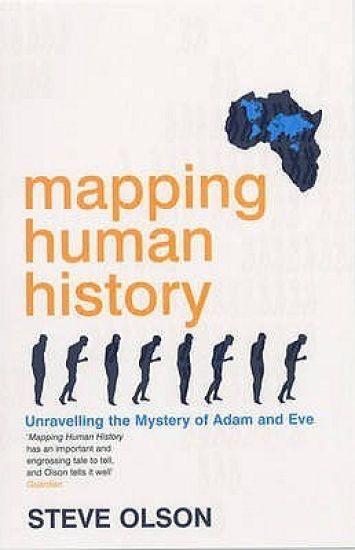
150,000 years of human existence have passed, and yet what do we really know about our history before the advent of writing? Some of the most momentous events - including our origins, our migrations across the globe, and our acquisition of language - were lost in the darkness of 'prehistory'. But at last geneticists and other scientists are piecing together a history - the true story of Adam and Eve. Mapping Human History is nothing less than a 'history of prehistory'. Steve Olson travelled through four continents to discover the development of humans and our expansion throughout the planet. He describes, for example, new thinking about how centres of agriculture sprang up among disparate foraging societies at roughly the same time. He tells why most of us can claim Julius Caesar and Confucius among our forebears. He pinpoints why the ways in which the story of the Jewish people jibes with, and diverges from, biblical accounts. And using very recent genetic findings, he explodes the myth that human races are a biological reality.
Shaping the Future

Shaping the Future

Steve Olson

National Academies Press
1989
sidottu
This book brings the concerned individual up-to-date on the breakthroughs and social questions emerging from biology today. Author Steve Olson draws on the latest research in a number of fields as well as the views of leading biologists, ethicists, and philosophers. He tells the story of the intricate, often frustrating, path scientists must follow to find out why we are the way we are. The volume highlights groundbreaking research being done in four of biology's most exciting fields: genetics, development, neurobiology, and evolution. In each field, the implications of this research extend far beyond basic biology, ranging from human gene therapy to cancer, from neural transplantation to the evolution of the atmosphere. Table of Contents Front Matter Introduction 1 Genetics and the Human Genome Essay: Science and Scientists from the Public's Perspective 2 Biological Development and Cancer Essay: Ethical Considerations in the Use of Human Materials 3 Neuroscience and Neuronal Replacement Essay: The Evolution of Ethics 4 Evolution and the Biosphere Essay: Preserving Biological Diversity Afterword Index