Kirjojen hintavertailu. Mukana 12 595 353 kirjaa ja 12 kauppaa.

Kirjailija

Steven a. Cook

Kirjat ja teokset yhdessä paikassa: 8 kirjaa, julkaisuja vuosilta 2007-2024, suosituimpien joukossa The Case for a New U.S.-Saudi Strategic Compact. Vertaile teosten hintoja ja tarkista saatavuus suomalaisista kirjakaupoista.

Mukana myös kirjoitusasut: Steven a Cook

8 kirjaa

Kirjojen julkaisuhaarukka 2007-2024.

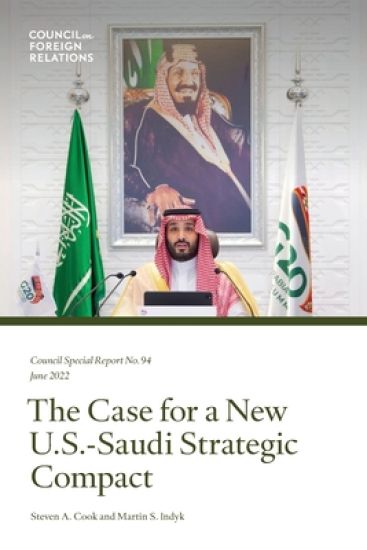
The Case for a New U.S.-Saudi Strategic Compact

The Case for a New U.S.-Saudi Strategic Compact

Steven a. Cook; Martin S. Indyk

Council on Foreign Relations Press
2022
nidottu
The encounter between President Franklin D. Roosevelt and King Abdulaziz Al Saud aboard the USS Quincy in the Suez Canal on February 14, 1945, represents the launching point for relations between the United States and Saudi Arabia. From the start, it was an unlikely partnership. The deal that developed over time was straightforward. The United States needed unimpeded access to the vast reservoirs of oil beneath Al Saud's desert sands, and Saudi Arabia needed protection from avaricious neighbors and great powers.But in recent years, the U.S.-Saudi strategic partnership has frayed. The United States has grown frustrated with Saudi Arabia's human rights record and reluctance to stabilize the oil market, while Riyadh has come to believe that Washington is no longer willing to guarantee the kingdom's security.With their new Council Special Report, The Case for a New U.S.-Saudi Strategic Compact, Eni Enrico Mattei Senior Fellow for Middle East and Africa Studies Steven A. Cook and Distinguished Fellow Martin S. Indyk give a thorough history of the special relationship between the world's foremost democracy and the Middle East's preeminent monarchy, and envision what a renewed partnership would look like.As Cook and Indyk warn, "Seventy-seven years after the original Roosevelt-Abdulaziz pact, the changing circumstances require a reassessment of the relationship's value to each side, for if urgent action is not taken, the process of separation that is already under way is likely to accelerate, damaging the interests of both sides."

The End of Ambition

The End of Ambition

Steven A. Cook

OXFORD UNIVERSITY PRESS INC
2024
sidottu
A clear-headed vision for the United States' role in the Middle East that highlights the changing nature of US national interests and the challenges of grand strategizing at a time of profound change in the international order. Following a long series of catastrophic misadventures in the Middle East over the last two decades, the American foreign policy community has tried to understand what went wrong. After weighing the evidence, they have mostly advised a retreat from the region. The basic view is that when the United States tries to advance change in the Middle East, it only makes matters worse. In The End of Ambition, Steven A. Cook argues that while these analysts are rightly concerned that engagement drains US resources and distorts its domestic politics, the broader impulse to disengage tends to neglect important lessons from the past. Moreover, advocates of pulling back overlook the potential risks of withdrawal. Covering the relationship between the US and the Middle East since the end of WWII, Cook makes the bold claim that despite setbacks and moral costs, the United States has been overwhelmingly successful in protecting its core national interests in the Middle East. Conversely, overly ambitious policies to remake the region and leverage US power not only ended in failure, but rendered the region unstable in new and largely misunderstood ways. While making the case that retrenchment is not the answer to America's problems in the Middle East, The End of Ambition highlights how America's interests in the region have begun to change and critically examines alternative approaches to US-Middle East policy. Cook highlights the challenges that policymakers and analysts confront developing a new strategy for the United States in the Middle East against the backdrop of both political uncertainty in the United States and a changing global order.
False Dawn

False Dawn

Steven A. Cook

Oxford University Press Inc
2019
nidottu
More than half a decade after Arabs across the Middle East across the Middle East poured into the streets to demand change, hopes for democracy have disappeared in a maelstrom of violence and renewed state repression. In False Dawn, noted Middle East expert Steven A. Cook looks at the trajectory of events across the region from the initial uprising in Tunisia to the failed coup attempt in Turkey to explain why the Arab Spring uprisings did not succeed. Despite appearances, there were no true revolutions in the Middle East seven years ago: none of the affected societies underwent social revolutions, and the old structures of power were never eliminated. Even supposed successes like Tunisia still face significant barriers to democracy because of the continued strength of old regime players. Libya, the state that came closest to revolution, has fragmented into chaos, and Turkey's president, Recep Tayyip Erdogan, has undertaken a widespread crackdown on his opponents, reinforcing the Turkish leader's personal power. After taking stock of how and why the uprisings failed to produce lasting change, Cook considers the role of the United States in the region. What Washington cannot do, Cook argues, is shape the politics of the Middle East going forward. While many in the policymaking community believe that the United States must "get the Middle East right," American influence is actually quite limited; the future of the region lies in the hands of the people who live there. Authoritative and powerfully argued, False Dawn is a major work on one of the most important historical events of the past quarter century.
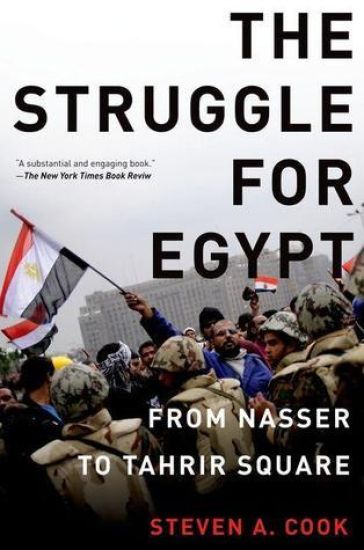
The Struggle for Egypt

The Struggle for Egypt

Steven A. Cook

Oxford University Press Inc
2013
nidottu
The recent revolution in Egypt has shaken the Arab world to its roots. The most populous Arab country and the historical center of Arab intellectual life, Egypt is a linchpin of the US's Middle East strategy, receiving more aid than any nation except Israel. This is not the first time that the world and has turned its gaze to Egypt, however. A half century ago, Egypt under Nasser became the putative leader of the Arab world and a beacon for all developing nations. Yet in the decades prior to the 2011 revolution, it was ruled over by a sclerotic regime plagued by nepotism and corruption. During that time, its economy declined into near shambles, a severely overpopulated Cairo fell into disrepair, and it produced scores of violent Islamic extremists such as Ayman al-Zawahiri and Mohammed Atta. In The Struggle for Egypt, Steven Cook--a Senior Fellow at the Council on Foreign Relations--explains how this parlous state of affairs came to be, why the revolution occurred, and where Egypt might be headed next. A sweeping account of Egypt in the modern era, it incisively chronicles all of the nation's central historical episodes: the decline of British rule, the rise of Nasser and his quest to become a pan-Arab leader, Egypt's decision to make peace with Israel and ally with the United States, the assassination of Sadat, the emergence of the Muslim Brotherhood, and--finally--the demonstrations that convulsed Tahrir Square and overthrew an entrenched regime. Throughout Egypt's history, there has been an intense debate to define what Egypt is, what it stands for, and its relation to the world. Egyptians now have an opportunity to finally answer these questions. Doing so in a way that appeals to the vast majority of Egyptians, Cook notes, will be difficult but ultimately necessary if Egypt is to become an economically dynamic and politically vibrant society.
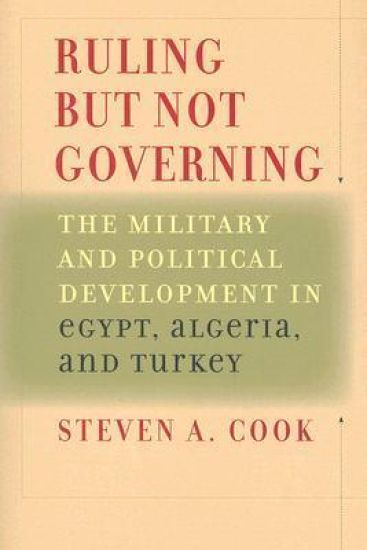
Ruling But Not Governing

Ruling But Not Governing

Steven A. Cook

Johns Hopkins University Press
2007
pokkari
Ruling But Not Governing highlights the critical role that the military plays in the stability of the Egyptian, Algerian, and, until recently, Turkish political systems. This in-depth study demonstrates that while the soldiers and materiel of Middle Eastern militaries form the obvious outer perimeter of regime protection, it is actually the less apparent, multilayered institutional legacies of military domination that play the decisive role in regime maintenance. Steven A. Cook uncovers the complex and nuanced character of the military's interest in maintaining a facade of democracy. He explores how an authoritarian elite hijack seemingly democratic practices such as elections, multiparty politics, and a relatively freer press as part of a strategy to ensure the durability of authoritarian systems. Using Turkey's recent reforms as a point of departure, the study also explores ways external political actors can improve the likelihood of political change in Egypt and Algeria. Ruling But Not Governing provides valuable insight into the political dynamics that perpetuate authoritarian regimes and offers novel ways to promote democratic change.
Ruling But Not Governing

Ruling But Not Governing

Steven A. Cook

Johns Hopkins University Press
2007
sidottu
"Ruling But Not Governing" highlights the critical role that the military plays in the stability of the Egyptian, Algerian, and, until recently, Turkish political systems. This in-depth study demonstrates that while the soldiers and materiel of Middle Eastern militaries form the obvious outer perimeter of regime protection, it is actually the less apparent, multilayered institutional legacies of military domination that play the decisive role in regime maintenance. Steven A. Cook uncovers the complex and nuanced character of the military's interest in maintaining a facade of democracy. He explores how an authoritarian elite hijack seemingly democratic practices such as elections, multiparty politics, and a relatively freer press as part of a strategy to ensure the durability of authoritarian systems. Using Turkey's recent reforms as a point of departure, the study also explores ways external political actors can improve the likelihood of political change in Egypt and Algeria. Ruling But Not Governing provides valuable insight into the political dynamics that perpetuate authoritarian regimes and offers novel ways to promote democratic change.