Kirjojen hintavertailu. Mukana 12 250 895 kirjaa ja 12 kauppaa.
Kirjailija
Steven Carter
Kirjat ja teokset yhdessä paikassa: 35 kirjaa, julkaisuja vuosilta 1987-2025, suosituimpien joukossa Bearing Across. Vertaile teosten hintoja ja tarkista saatavuus suomalaisista kirjakaupoista.
It is the 1980s. A group of elderly friends, connected by their love of their allotments (in Chaddersley Corbett!) are disgusted to discover that their, and other ordinary folks, pleasures and livelihoods are threatened by the rich and greedy. An unlikely 'gang', they plot a Robin Hood style robbery to right the wrong. Will they be caught? Can they overcome the forces arrayed against them? Will love and followship endure? A combined caper and morality tale, The Allotment Gang teaches us that you should not mess with gardeners!
Discover the challenges, excitement, and rewards of law enforcement today with Dempsey/Forst/Carter's AN INTRODUCTION TO POLICING, 10th Edition. Written by law enforcement veterans with extensive first-hand experience in all areas of policing, this book is an essential read for you or anyone you know who is considering a career in law enforcement. You'll get insight into the Black Lives Matter movement, questionable police shootings of civilians and ambush shootings of police officers, strained police-community relations, the President's Task Force on 21st Century Policing, recent terrorism incidents, Specialized Policing Responses to homeless individuals, advances in policing technology and other current issues.
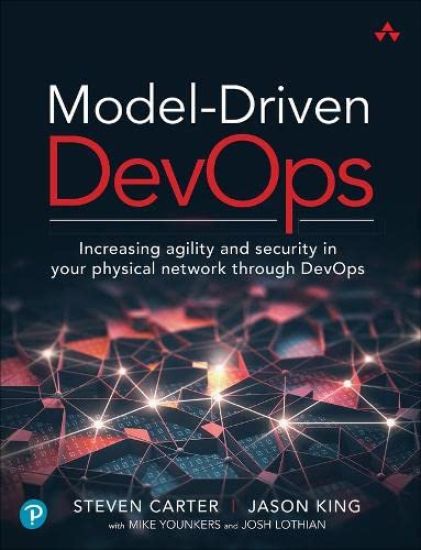
Develop Network Infrastructure More Rapidly, and Operate It More Effectively Using model-driven DevOps and the Infrastructure as Code (IaC) paradigm, teams can develop and operate network infrastructure more quickly, consistently, and securely--growing agility, getting to market sooner, and delivering more value. Now, two leading practitioners walk you step by step through successfully implementing model-driven DevOps for infrastructure. In this practical guide, they share lessons learned, help you avoid common pitfalls, and illuminate key differences between DevOps for infrastructure and conventional application-based DevOps. You'll learn why network infrastructure operations must change, what needs to change, and how to work together to change it. The authors guide you through creating consistent data models to manage massive numbers of network elements, organizing huge quantities of network data, and applying DevOps to infrastructure repeatably and consistently. Your journey includes a complete, hands-on reference implementation, detailed use cases, many examples based on open source tools, and sample code downloadable at GitHub.* Normalize and organize network infrastructure data consistently, to gain the same benefits from DevOps as cloud operators do * Replace legacy command lines with APIs, then leverage and scale them * Use configuration management, templates, and other tools to program infrastructure without coding * Safely implement Continuous Integration/Continuous Deployment for infrastructure Succeed with key human factors: break down silos, change culture, and address skills gaps Whether you're a network or cybersecurity engineer, architect, manager, or leader, this guide will help you suffuse all your network operations with greater efficiency, security, responsiveness, and resilience.
Shotetsu monogatari was written by a disciple of Shotetsu (1381–1459), whom many scholars regard as the last great poet of the courtly tradition. The work provides information about the practice of poetry during the 14th and 15th centuries, including anecdotes about famous poets, advice on how to treat certain standard topics, and lessons in etiquette when attending or participating in poetry contests and gatherings. But unlike the many other works of that time that stop at that level, Shotetsu’s contributions to medieval aesthetics gained prominence, showing him as a worthy heir—both as poet and thinker—to the legacy of the great poet-critic Fujiwara no Teika (1162–1241). The last project of the late Robert H. Brower, Conversations with Shôtetsu provides a translation of the complete Nihon koten bungaku taikei text, as edited by Hisamatsu Sen'ichi. Steven D. Carter has annotated the translation and provided an introduction that details Shôtetsu’s life, his place in the poetic circles of his day, and the relationship of his work to the larger poetic tradition of medieval Japan. Conversations with Shotetsu is important reading for anyone interested in medieval Japanese literature and culture, in poetry, and in aesthetics. It provides a unique look at the literary world of late medieval Japan.
Discover the challenges, excitement and rewards of law enforcement today with Dempsey, Forst, and Carter's AN INTRODUCTION TO POLICING, 9th Edition. Written by law enforcement veterans with extensive first-hand experience in all areas of policing, this book is an essential read for you or anyone you know who is considering a career in law enforcement. You'll get insight into the Black Lives Matter movement, questionable police shootings of civilians and ambush shootings of police officers, strained police-community relations, the President's Task Force on 21st Century Policing, recent terrorism incidents, Specialized Policing Responses to homeless individuals, advances in policing technology and other current issues. You'll also find the latest research as well as up-to-date applications, statistics, court cases and information on law enforcement careers.
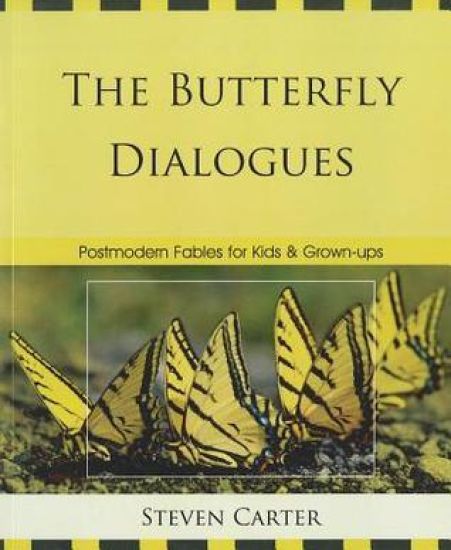
This is the third volume in a trilogy of fables (and parables) by Steven Carter. Carter's butterflies are naive, worldly, sarcastic, philosophical, and very funny—in short, perfectly human!
Look around you. The world is more homogenous than you think. Far too often, distinctions among people, places, and things are matters of degree rather than kind. Many are illusory. As satire, Little House of Imaginary Distinctions is meant to complement Steven Carter's previous book, Little House of Oxymorons, published by Hamilton Books in 2010.
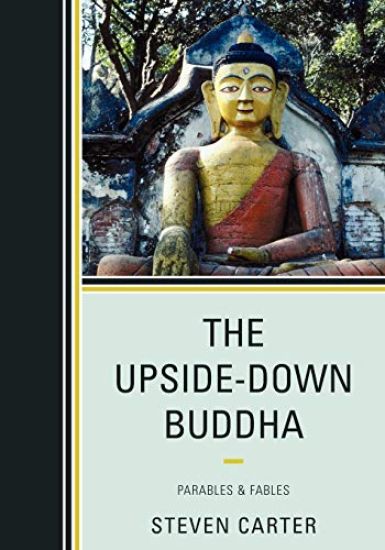
In The Upside-Down Buddha: Parables & Fables, Steven Carter continues to breathe new life into two of the world's oldest art forms. By turns hilarious, poignant, and profound, the entries in The Upside-Down Buddha are certain to instruct and entertain a diverse modern audience.
In After Aesop: Improvisations on Aesop's Fables, Steven Carter adds parody to his wide-ranging repertoire of literary genres. Aesop, perhaps the world's best-known author, produced hundreds of fables that have been re-told countless times, but rarely parodied on a one-to-one basis. By turns hilarious, poignant, and profound, the more than 200 entries in After Aesop are certain to instruct and entertain a diverse modern audience.
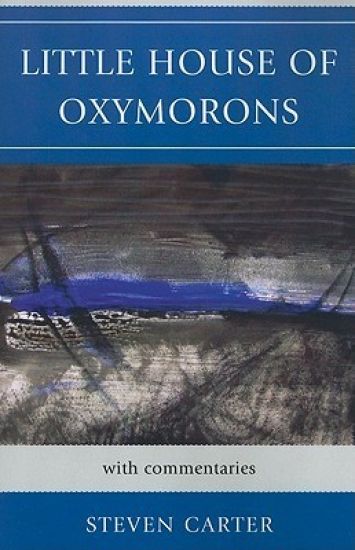
Eschewing old clunkers like "military intelligence" and "student-athlete," this volume features well over 200 fresh and original oxymorons with commentaries-all with a satirical twist. As a satire, Little House of Oxymorons complements Steven Carter's The New Devil's Dictionary, a two-volume "sequel" to Ambrose Bierce's notorious The Devil's Dictionary of a century ago. Cover image: Allison O'Donnell, Resist, 2008. Acrylic and graphite painting on rag board.
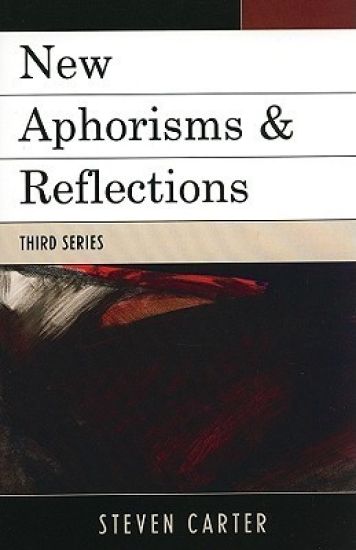
New Aphorisms & Reflections: Third Series, the sixth volume in a sequence which began with 222: Aphorisms & Reflections, features more than 450 entries, some of which are autobiographical. Like its predecessors, New Aphorisms & Reflections includes a sampling of "meetings of the minds"-dialogues between the author and aphorists and thinkers of the past. Cover image: Allison O'Donnell, Mostly Underground, 2008. Acrylic and graphite on board.
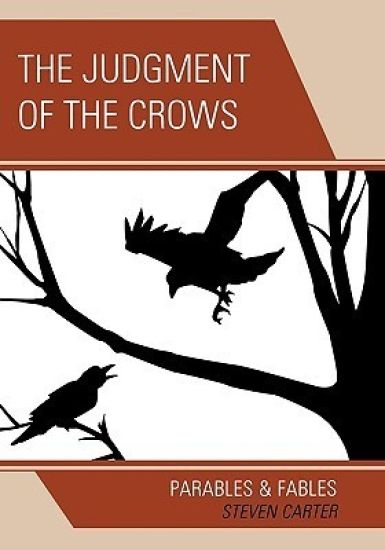
In The Judgment of the Crows: Parables & Fables, Steven Carter breathes new life into two of the world's oldest art forms. At times hilarious, poignant, and profound, the entries in The Judgment of the Crows are certain to instruct and entertain a diverse modern audience. The volume concludes with a handful of "improvisations" on Aesop's fables.
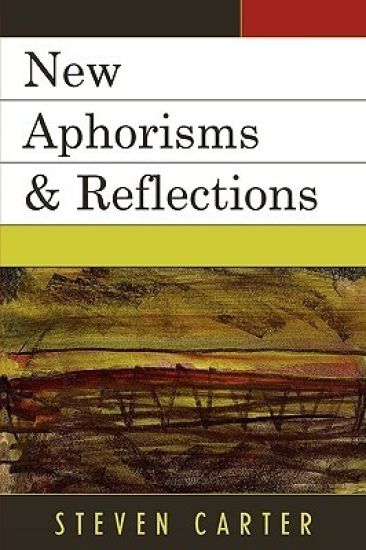
New Aphorisms & Reflections, the fourth volume of a major work in progress, features nearly 500 entries, some of which are autobiographical. Like its predecessors, New Aphorisms & Reflections includes a sampling of "meetings of the minds"—dialogues between the author and aphorists and thinkers of the past.
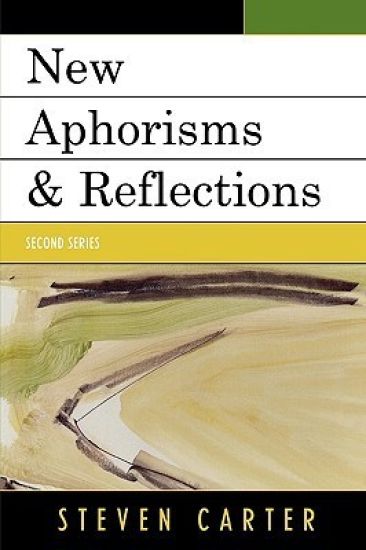
New Aphorisms & Reflections: Second Series, the fifth volume of a major work in progress, features more than 400 entries, some of which are autobiographical. Like its predecessors, New Aphorisms & Reflections includes a sampling of "meetings of the minds"—dialogues between the author and aphorists and thinkers of the past.
The second installment of Steven Carter's multi-volume series 222: Aphorisms & Reflections features 222 additional entries, including a generous sampling of "meetings of the minds"—dialogues between the author and aphorists and thinkers of the past.
The third installment of Steven Carter's multi-volume series 222: Aphorisms & Reflections features 222 additional entries, including a generous sampling of "meetings of the minds"—dialogues between the author and aphorists and thinkers of the past.
222: Aphorisms & Reflections is an attempt to breathe new life into the art of the aphorism and the brief reflection (or meditation), brought to near-perfection in Western culture over the last five centuries by Pascal, La Rochefoucauld, Lichtenberg, Nietzsche, Kafka, E.M. Cioran, Karl Kraus, Fernando Pessoa, and many others. About four in ten of the entries in 222 consist of "conversations" between Steven Carter and aphorists of the past, including many of the above. In publishing this initial volume of a projected multi-volume work, Carter hopes to join the ranks of current aphorists and anthologists—James Richardson and James Geary, to name two—whose recent works help to further the grand tradition of the aphorism, which began in ancient Greece with Hippocrates, the West's first known aphorist. While 222 is primarily intended for a general college-educated audience, everyone can enjoy a good aphorism-as the Americans Josh Billings, Will Rogers, and especially Mark Twain have shown.
How is terrorism transformed into media entertainment? What is the connection between affirmative action and narcissism? Why has pathos become an endangered-perhaps an extinct-species in the contemporary American psyche? In American Affect in the Postmodern Era: A Primer, Steven Carter addresses these and other questions that have helped to define American popular culture since the nineteen-sixties. Cover painting: Kyle Margiotta, Baja, 1999. Oil on canvas.
The authors expose the dangers of narcissistic behavior in a relationship, showing readers how to identify narcissism, recognize the various feelings it evokes, and learn to avoid such relationships in the future.