Kirjojen hintavertailu. Mukana 12 595 353 kirjaa ja 12 kauppaa.

Kirjailija

Steven G. Krantz

Kirjat ja teokset yhdessä paikassa: 77 kirjaa, julkaisuja vuosilta 1992-2026, suosituimpien joukossa Convex Analysis. Vertaile teosten hintoja ja tarkista saatavuus suomalaisista kirjakaupoista.

77 kirjaa

Kirjojen julkaisuhaarukka 1992-2026.

A Second Course in Complex Analysis

A Second Course in Complex Analysis

Peter V. Dovbush; Steven G. Krantz

TAYLOR FRANCIS LTD
2026
sidottu
Few other books purport to be a second course in complex analysis. This book differs in that it covers more modern topics and is more geometric in focus. Most texts on complex variable theory contain the same material. However, complex analysis is a vast and diverse subject with a long history and many aspects. A second course will benefit students and introduce these new topics that they might not otherwise experience. Lars Ahlfors alone invented many new parts of the subject; Lipman Bers made decisive contributions, and there are many others. It is easy to justify a “second course” in complex analysis. That is what this book purports to be. Some of the topics presented here are: • harmonic measure • extremal length • Riemann surfaces • uniformization • automorphism groups • the Schwarz lemma and its generalizations • analytic capacity • the Bergman theory • invariant metrics • Picard’s theorem • the boundary Schwarz lemma The goal is to expose the reader to unfamiliar parts of the subject of complex variables and perhaps to pique interest in further reading. As with the authors’ other books, not only theorems and proofs are included, but also many examples and some exercises. Numerous graphics illustrate the key ideas.

Convex Analysis

Convex Analysis

Steven G. Krantz

TAYLOR FRANCIS LTD
2026
sidottu
Convexity is an ancient idea going back to Archimedes. Used sporadically in mathematical literature over the centuries, today it is a flourishing area of research. Convexity is used in optimization theory, functional analysis, complex analysis, and other parts of mathematics. This text, popular in its first edition, introduces analytic tools for studying convexity and provides analytical applications of the concept. It includes a general background on classical geometric theory, revealing a glimpse of how modern mathematics is developed and how geometric ideas may be studied analytically. The book contains copious examples, many applications, and plenty of figures. It also includes an appendix which offers the technical tools needed to understand certain arguments in the book, a table of notation, and a thorough glossary to help readers with unfamiliar terms. The book presents an analytic way to think about convexity theory. Although this means of doing things is well known to the experts, it is not well documented in the literature. The reader with only a basic background in real analysis (and perhaps a little linear algebra) can get a lot out of this book. This book is a definitive introductory text to the concept of convexity in the context of mathematical analysis and a suitable resource for students and faculty alike.
Convex Analysis

Convex Analysis

Steven G. Krantz

TAYLOR FRANCIS LTD
2026
nidottu
Convexity is an ancient idea going back to Archimedes. Used sporadically in mathematical literature over the centuries, today it is a flourishing area of research. Convexity is used in optimization theory, functional analysis, complex analysis, and other parts of mathematics. This text, popular in its first edition, introduces analytic tools for studying convexity and provides analytical applications of the concept. It includes a general background on classical geometric theory, revealing a glimpse of how modern mathematics is developed and how geometric ideas may be studied analytically. The book contains copious examples, many applications, and plenty of figures. It also includes an appendix which offers the technical tools needed to understand certain arguments in the book, a table of notation, and a thorough glossary to help readers with unfamiliar terms. The book presents an analytic way to think about convexity theory. Although this means of doing things is well known to the experts, it is not well documented in the literature. The reader with only a basic background in real analysis (and perhaps a little linear algebra) can get a lot out of this book. This book is a definitive introductory text to the concept of convexity in the context of mathematical analysis and a suitable resource for students and faculty alike.
Elements of Topology

Elements of Topology

Steven G. Krantz

TAYLOR FRANCIS LTD
2026
sidottu
This book is an ambitious but optimistic treatment of the subject of topology. Not only does it treat the standard basic material about point-set topology, it also gives an introduction to algebraic topology, a treatment of manifolds, a discussion of function spaces, some ideas of knot theory, a presentation of graph theory, and some ideas from dynamical systems. Even the exciting new topic of the Jones polynomial is covered. After discussing the key ideas of topology, the author examines the more advanced topics of algebraic topology and manifold theory. He also explores meaningful applications in several areas, including the traveling salesman problem, digital imaging, mathematical economics, and dynamical systems. The appendices offer background material on logic, set theory, the properties of real numbers, the axiom of choice, and basic algebraic structures. Topic coverage has been reduced in this edition, and exercise sets have been added at the end of each section. The book as a whole—and the first two chapters in particular— offer many examples. Solutions to odd-numbered exercises are included at the end. Today’s students need a text that speaks to them in their own language, and at a pace with which they are comfortable. That is the goal of this edition. Taking a fresh and accessible approach to a venerable subject, this text provides excellent representations of topological ideas. It forms the foundation for further mathematical study in real analysis, abstract algebra, and beyond.
One Complex Variable from the Several Variable Point of View

One Complex Variable from the Several Variable Point of View

Peter V. Dovbush; Steven G. Krantz

TAYLOR FRANCIS LTD
2025
sidottu
Traditionally speaking, those who study the function theory of one complex variable spend little or no time thinking about several complex variables. Conversely, experts in the function theory of several complex variables do not consider one complex variable. One complex variable is the inspiration and testing ground for several complex variables, and several complex variables are the natural generalization of one complex variable.The authors’ thesis here is that these two subject areas have much in common. These subject areas can gain a lot by learning to communicate with each other. These two fields are logically connected, and each can be used to explain and put the other into context. This is the purpose of this book.The point of view and the methodology of the two subject areas are quite different. One complex variable is an aspect of traditional hard analysis. Several complex variables are more like algebraic geometry and differential equations, with some differential geometry thrown in. The authors intend to create a marriage of the function theory of one complex variable and the function theory of several complex variables, leading to a new and productive dialogue between the two disciplines.The hope is for this book to foster and develop this miscegenation in a manner that leads to new collaborations and developments. There is much fertile ground here, and this book aims to breathe new life into it.
Elements of Algebraic Topology

Elements of Algebraic Topology

James R. Munkres; Steven G. Krantz; Harold R. Parks

TAYLOR FRANCIS LTD
2025
sidottu
This classic text appears here in a new edition for the first time in four decades. The new edition, with the aid of two new authors, brings it up to date for a new generation of mathematicians and mathematics students.Elements of Algebraic Topology provides the most concrete approach to the subject. With coverage of homology and cohomology theory, universal coefficient theorems, Kunneth theorem, duality in manifolds, and applications to classical theorems of point-set topology, this book is perfect for communicating complex topics and the fun nature of algebraic topology for beginners.This second edition retains the essential features of the original book. Most of the notation and terminology are the same. There are some useful additions. There is a new introduction to homotopy theory. A new Index of Notation is included. Many new exercises are added.Algebraic topology is a cornerstone of modern mathematics. Every working mathematician should have at least an acquaintance with the subject. This book, which is based largely on the theory of triangulations, provides such an introduction. It should be accessible to a broad cross-section of the profession—both students and senior mathematicians. Students should have some familiarity with general topology.
The Geometric Theory of Complex Variables

The Geometric Theory of Complex Variables

Peter V. Dovbush; Steven G. Krantz

Springer International Publishing AG
2025
sidottu
This book provides the reader with a broad introduction to the geometric methodology in complex analysis. It covers both single and several complex variables, creating a dialogue between the two viewpoints. Regarded as one of the 'grand old ladies' of modern mathematics, complex analysis traces its roots back 500 years. The subject began to flourish with Carl Friedrich Gauss's thesis around 1800. The geometric aspects of the theory can be traced back to the Riemann mapping theorem around 1850, with a significant milestone achieved in 1938 with Lars Ahlfors's geometrization of complex analysis. These ideas inspired many other mathematicians to adopt this perspective, leading to the proliferation of geometric theory of complex variables in various directions, including Riemann surfaces, Teichmüller theory, complex manifolds, extremal problems, and many others. This book explores all these areas, with classical geometric function theory as its main focus. Its accessible and gentle approach makes it suitable for advanced undergraduate and graduate students seeking to understand the connections among topics usually scattered across numerous textbooks, as well as experienced mathematicians with an interest in this rich field.
Differential Equations

Differential Equations

Steven G. Krantz

TAYLOR FRANCIS LTD
2024
nidottu
Differential Equations: Theory, Technique, and Practice with Boundary Value Problems presents classical ideas and cutting-edge techniques for a contemporary, undergraduate-level, one- or two-semester course on ordinary differential equations. Authored by a widely respected researcher and teacher, the text covers standard topics such as partial differential equations (PDEs), boundary value problems, numerical methods, and dynamical systems. Lively historical notes and mathematical nuggets of information enrich the reading experience by offering perspective on the lives of significant contributors to the discipline. "Anatomy of an Application" sections highlight applications from engineering, physics, and applied science. Problems for review and discovery provide students with open-ended material for further exploration and learning. Streamlined for the interests of engineers, this version:Includes new coverage of Sturm-Liouville theory and problemsDiscusses PDEs, boundary value problems, and dynamical systemsFeatures an appendix that provides a linear algebra reviewAugments the substantial and valuable exercise setsEnhances numerous examples to ensure clarityA solutions manual is available with qualifying course adoption.Differential Equations: Theory, Technique, and Practice with Boundary Value Problems delivers a stimulating exposition of modeling and computing, preparing students for higher-level mathematical and analytical thinking.
Real Analysis and Foundations

Real Analysis and Foundations

Steven G. Krantz

TAYLOR FRANCIS LTD
2024
nidottu
Through four editions this popular textbook attracted a loyal readership and widespread use. Students find the book to be concise, accessible, and complete. Instructors find the book to be clear, authoritative, and dependable. The primary goal of this new edition remains the same as in previous editions. It is to make real analysis relevant and accessible to a broad audience of students with diverse backgrounds while also maintaining the integrity of the course. This text aims to be the generational touchstone for the subject and the go-to text for developing young scientists. This new edition continues the effort to make the book accessible to a broader audience. Many students who take a real analysis course do not have the ideal background. The new edition offers chapters on background material like set theory, logic, and methods of proof. The more advanced material in the book is made more apparent.This new edition offers a new chapter on metric spaces and their applications. Metric spaces are important in many parts of the mathematical sciences, including data mining, web searching, and classification of images. The author also revised the material on sequences and series adding examples and exercises that compare convergence tests and give additional tests.The text includes rare topics such as wavelets and applications to differential equations. The level of difficulty moves slowly, becoming more sophisticated in later chapters. Students have commented on the progression as a favorite aspect of the textbook.The author is perhaps the most prolific expositor of upper division mathematics. With over seventy books in print, thousands of students have been taught and learned from his books.
The Elements of Advanced Mathematics

The Elements of Advanced Mathematics

Steven G. Krantz

TAYLOR FRANCIS LTD
2024
nidottu
This book has enjoyed considerable use and appreciation during its first four editions. With hundreds of students having learned out of early editions, the author continues to find ways to modernize and maintain a unique presentation.What sets the book apart is the excellent writing style, exposition, and unique and thorough sets of exercises. This edition offers a more instructive preface to assist instructors on developing the course they prefer. The prerequisites are more explicit and provide a roadmap for the course. Sample syllabi are included.As would be expected in a fifth edition, the overall content and structure of the book are sound.This new edition offers a more organized treatment of axiomatics. Throughout the book, there is a more careful and detailed treatment of the axioms of set theory. The rules of inference are more carefully elucidated.Additional new features include: An emphasis on the art of proof. Enhanced number theory chapter presents some easily accessible but still-unsolved problems. These include the Goldbach conjecture, the twin prime conjecture, and so forth. The discussion of equivalence relations is revised to present reflexivity, symmetry, and transitivity before we define equivalence relations. The discussion of the RSA cryptosystem in Chapter 8 is expanded. The author introduces groups much earlier. Coverage of group theory, formerly in Chapter 11, has been moved up; this is an incisive example of an axiomatic theory.Recognizing new ideas, the author has enhanced the overall presentation to create a fifth edition of this classic and widely-used textbook.
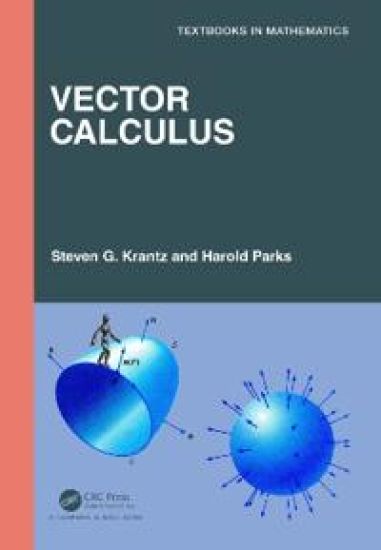
Vector Calculus

Vector Calculus

Steven G. Krantz; Harold Parks

TAYLOR FRANCIS LTD
2024
sidottu
Using meaningful examples, credible applications, and incisive technology, Vector Calculus strives to empower students, enhance their critical thinking skills, and equip them with the knowledge and skills to succeed in the major or discipline they ultimately choose to study. This text is intended to be a cornerstone of that process. An engaging style and clear writing make the language of mathematics accessible, understandable, and enjoyable, with a high standard for mathematical rigor.A calculus book must tell the truth. This book is carefully written in the accepted language of mathematics in a readable exposition. It includes useful and fascinating applications, acquaints students with the history of the subject, and offers a sense of what mathematics is all about.Technique is presented, yet so are ideas. The authors help students to master basic methods and discover and build their own concepts in a scientific subject. There is an emphasis on using modeling and numerical calculation. Additional features include:A Quick Quiz and Problems for Practice, Further Theory and Practice, and Calculator/Computer Exercises appear at the end of each sectionAll exercise sets are step laddered A Look Back and A Look Forward help students put the ideas in contextEvery chapter ends with a Genesis and Development section, giving history and perspective on key topics in the evolution of calculusBoxed Insights clear up points or answer commonly asked questionsThe text has an extra-large offering of examplesExamples are illustrated with meaningful and useful graphicsThe pedagogical features make the subject more interesting and accessible to students than other texts, while maintaining an appropriate rigor. —Daniel Cunningham, CSU-FresnoThis text is truly well written and organized. I do like the fact the book is quite rigorous, yet full of illustrative examples. —Bob Devaney, Boston University
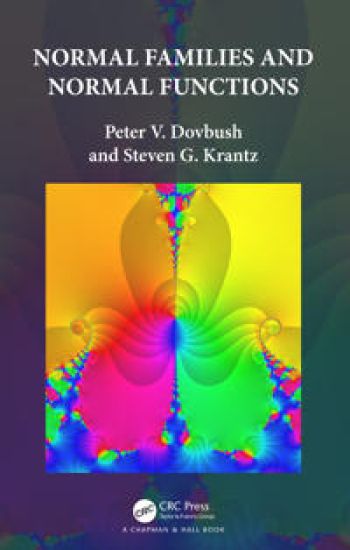
Normal Families and Normal Functions

Normal Families and Normal Functions

Peter V. Dovbush; Steven G. Krantz

TAYLOR FRANCIS LTD
2024
sidottu
This book centers on normal families of holomorphic and meromorphic functions and also normal functions. The authors treat one complex variable, several complex variables, and infinitely many complex variables (i.e., Hilbert space).The theory of normal families is more than 100 years old. It has played a seminal role in the function theory of complex variables. It was used in the first rigorous proof of the Riemann mapping theorem. It is used to study automorphism groups of domains, geometric analysis, and partial differential equations.The theory of normal families led to the idea, in 1957, of normal functions as developed by Lehto and Virtanen. This is the natural class of functions for treating the Lindelof principle. The latter is a key idea in the boundary behavior of holomorphic functions.This book treats normal families, normal functions, the Lindelof principle, and other related ideas. Both the analytic and the geometric approaches to the subject area are offered. The authors include many incisive examples.The book could be used as the text for a graduate research seminar. It would also be useful reading for established researchers and for budding complex analysts.
The E. M. Stein Lectures on Hardy Spaces

The E. M. Stein Lectures on Hardy Spaces

Steven G. Krantz

Springer International Publishing AG
2023
nidottu
?The book The E. M. Stein Lectures on Hardy Spaces is based on a graduate course on real variable Hardy spaces which was given by E.M. Stein at Princeton University in the academic year 1973-1974. Stein, along with C. Fefferman and G. Weiss, pioneered this subject area, removing the theory of Hardy spaces from its traditional dependence on complex variables, and to reveal its real-variable underpinnings.This book is based on Steven G. Krantz’s notes from the course given by Stein. The text builds on Fefferman's theorem that BMO is the dual of the Hardy space. Using maximal functions, singular integrals, and related ideas, Stein offers many new characterizations of the Hardy spaces. The result is a rich tapestry of ideas that develops the theory of singular integrals to a new level. The final chapter describes the major developments since 1974.This monograph is of broad interest to graduate students and researchers in mathematical analysis. Prerequisites for the book include a solid understanding of real variable theory and complex variable theory. A basic knowledge of functional analysis would also be useful.
Complex Variables

Complex Variables

Steven G. Krantz

TAYLOR FRANCIS LTD
2023
nidottu
The idea of complex numbers dates back at least 300 years—to Gauss and Euler, among others. Today complex analysis is a central part of modern analytical thinking. It is used in engineering, physics, mathematics, astrophysics, and many other fields. It provides powerful tools for doing mathematical analysis, and often yields pleasing and unanticipated answers.This book makes the subject of complex analysis accessible to a broad audience. The complex numbers are a somewhat mysterious number system that seems to come out of the blue. It is important for students to see that this is really a very concrete set of objects that has very concrete and meaningful applications. Features:This new edition is a substantial rewrite, focusing on the accessibility, applied, and visual aspect of complex analysis This book has an exceptionally large number of examples and a large number of figures. The topic is presented as a natural outgrowth of the calculus. It is not a new language, or a new way of thinking. Incisive applications appear throughout the book. Partial differential equations are used as a unifying theme.
The Elements of Advanced Mathematics

The Elements of Advanced Mathematics

Steven G. Krantz

TAYLOR FRANCIS LTD
2022
sidottu
This book has enjoyed considerable use and appreciation during its first four editions. With hundreds of students having learned out of early editions, the author continues to find ways to modernize and maintain a unique presentation.What sets the book apart is the excellent writing style, exposition, and unique and thorough sets of exercises. This edition offers a more instructive preface to assist instructors on developing the course they prefer. The prerequisites are more explicit and provide a roadmap for the course. Sample syllabi are included.As would be expected in a fifth edition, the overall content and structure of the book are sound.This new edition offers a more organized treatment of axiomatics. Throughout the book, there is a more careful and detailed treatment of the axioms of set theory. The rules of inference are more carefully elucidated.Additional new features include: An emphasis on the art of proof. Enhanced number theory chapter presents some easily accessible but still-unsolved problems. These include the Goldbach conjecture, the twin prime conjecture, and so forth. The discussion of equivalence relations is revised to present reflexivity, symmetry, and transitivity before we define equivalence relations. The discussion of the RSA cryptosystem in Chapter 8 is expanded. The author introduces groups much earlier. Coverage of group theory, formerly in Chapter 11, has been moved up; this is an incisive example of an axiomatic theory.Recognizing new ideas, the author has enhanced the overall presentation to create a fifth edition of this classic and widely-used textbook.
Differential Equations

Differential Equations

Steven G. Krantz

TAYLOR FRANCIS LTD
2022
sidottu
Differential equations is one of the oldest subjects in modern mathematics. It was not long after Newton and Leibniz invented the calculus that Bernoulli and Euler and others began to consider the heat equation and the wave equation of mathematical physics. Newton himself solved differential equations both in the study of planetary motion and also in his consideration of optics.Today differential equations is the centerpiece of much of engineering, of physics, of significant parts of the life sciences, and in many areas of mathematical modeling. This text describes classical ideas and provides an entree to the newer ones. The author pays careful attention to advanced topics like the Laplace transform, Sturm–Liouville theory, and boundary value problems (on the traditional side) but also pays due homage to nonlinear theory, to modeling, and to computing (on the modern side). This book began as a modernization of George Simmons’ classic, Differential Equations with Applications and Historical Notes. Prof. Simmons invited the author to update his book. Now in the third edition, this text has become the author’s own and a unique blend of the traditional and the modern. The text describes classical ideas and provides an entree to newer ones. Modeling brings the subject to life and makes the ideas real. Differential equations can model real life questions, and computer calculations and graphics can then provide real life answers. The symbiosis of the synthetic and the calculational provides a rich experience for students, and prepares them for more concrete, applied work in future courses.Additional Features Anatomy of an Application sections. Historical notes continue to be a unique feature of this text. Math Nuggets are brief perspectives on mathematical lives or other features of the discipline that will enhance the reading experience. Problems for Review and Discovery give students some open-ended material for exploration and further learning. They are an important means of extending the reach of the text, and for anticipating future work.This new edition is re-organized to make it more useful and more accessible. The most frequently taught topics are now up front. And the major applications are isolated in their own chapters. This makes this edition the most useable and flexible of any previous editions.
Real Analysis and Foundations

Real Analysis and Foundations

Steven G. Krantz

TAYLOR FRANCIS LTD
2022
sidottu
Through four editions this popular textbook attracted a loyal readership and widespread use. Students find the book to be concise, accessible, and complete. Instructors find the book to be clear, authoritative, and dependable. The primary goal of this new edition remains the same as in previous editions. It is to make real analysis relevant and accessible to a broad audience of students with diverse backgrounds while also maintaining the integrity of the course. This text aims to be the generational touchstone for the subject and the go-to text for developing young scientists. This new edition continues the effort to make the book accessible to a broader audience. Many students who take a real analysis course do not have the ideal background. The new edition offers chapters on background material like set theory, logic, and methods of proof. The more advanced material in the book is made more apparent.This new edition offers a new chapter on metric spaces and their applications. Metric spaces are important in many parts of the mathematical sciences, including data mining, web searching, and classification of images. The author also revised the material on sequences and series adding examples and exercises that compare convergence tests and give additional tests.The text includes rare topics such as wavelets and applications to differential equations. The level of difficulty moves slowly, becoming more sophisticated in later chapters. Students have commented on the progression as a favorite aspect of the textbook.The author is perhaps the most prolific expositor of upper division mathematics. With over seventy books in print, thousands of students have been taught and learned from his books.
Partial Differential Equations and Complex Analysis
Ever since the groundbreaking work of J.J. Kohn in the early 1960s, there has been a significant interaction between the theory of partial differential equations and the function theory of several complex variables. Partial Differential Equations and Complex Analysis explores the background and plumbs the depths of this symbiosis. The book is an excellent introduction to a variety of topics and presents many of the basic elements of linear partial differential equations in the context of how they are applied to the study of complex analysis. The author treats the Dirichlet and Neumann problems for elliptic equations and the related Schauder regularity theory, and examines how those results apply to the boundary regularity of biholomorphic mappings. He studies the ?-Neumann problem, then considers applications to the complex function theory of several variables and to the Bergman projection.
Foundations of Analysis

Foundations of Analysis

Steven G. Krantz

CRC Press
2019
nidottu
Foundations of Analysis covers the basics of real analysis for a one- or two-semester course. In a straightforward and concise way, it helps students understand the key ideas and apply the theorems. The book’s accessible approach will appeal to a wide range of students and instructors.Each section begins with a boxed introduction that familiarizes students with the upcoming topics and sets the stage for the work to be done. Each section ends with several questions that ask students to review what they have just learned. The text is also scattered with notes pointing out places where different pieces of terminology seem to conflict with each other or where different ideas appear not to fit together properly. In addition, many remarks throughout help put the material in perspective.As with any real analysis text, exercises are powerful and effective learning tools. This book is no exception. Each chapter generally contains at least 50 exercises that build in difficulty, with an exercise set at the end of every section. This allows students to more easily link the exercises to the material in the section.
Complex Variables

Complex Variables

Steven G. Krantz

CRC Press
2019
sidottu
The idea of complex numbers dates back at least 300 years—to Gauss and Euler, among others. Today complex analysis is a central part of modern analytical thinking. It is used in engineering, physics, mathematics, astrophysics, and many other fields. It provides powerful tools for doing mathematical analysis, and often yields pleasing and unanticipated answers.This book makes the subject of complex analysis accessible to a broad audience. The complex numbers are a somewhat mysterious number system that seems to come out of the blue. It is important for students to see that this is really a very concrete set of objects that has very concrete and meaningful applications. Features:This new edition is a substantial rewrite, focusing on the accessibility, applied, and visual aspect of complex analysis This book has an exceptionally large number of examples and a large number of figures. The topic is presented as a natural outgrowth of the calculus. It is not a new language, or a new way of thinking. Incisive applications appear throughout the book. Partial differential equations are used as a unifying theme.