Kirjojen hintavertailu. Mukana 12 290 378 kirjaa ja 12 kauppaa.

Kirjailija

Steven H. Weintraub

Kirjat ja teokset yhdessä paikassa: 13 kirjaa, julkaisuja vuosilta 1992-2019, suosituimpien joukossa Galois Theory. Vertaile teosten hintoja ja tarkista saatavuus suomalaisista kirjakaupoista.

13 kirjaa

Kirjojen julkaisuhaarukka 1992-2019.

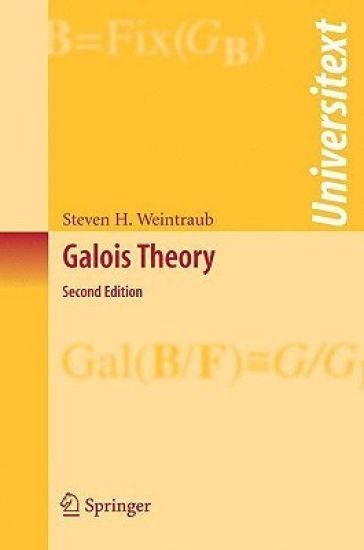
Galois Theory

Galois Theory

Steven H. Weintraub

Springer-Verlag New York Inc.
2008
nidottu
This is a textbook on Galois theory. Galois theory has a well-deserved re- tation as one of the most beautiful subjects in mathematics. I was seduced by its beauty into writing this book. I hope you will be seduced by its beauty in reading it. This book begins at the beginning. Indeed (and perhaps a little unusually for a mathematics text), it begins with an informal introductory chapter, Ch- ter 1. In this chapter we give a number of examples in Galois theory, even before our terms have been properly de?ned. (Needless to say, even though we proceed informally here, everything we say is absolutely correct.) These examples are sort of an airport beacon, shining a clear light at our destination as we navigate a course through the mathematical skies to get there. Then we start with our proper development of the subject, in Chapter 2. We assume no prior knowledge of ?eld theory on the part of the reader. We develop ?eld theory, with our goal being the Fundamental Theorem of Galois Theory (the FTGT). On the way, we consider extension ?elds, and deal with the notions of normal, separable, and Galois extensions. Then, in the penul- mate section of this chapter, we reach our main goal, the FTGT.
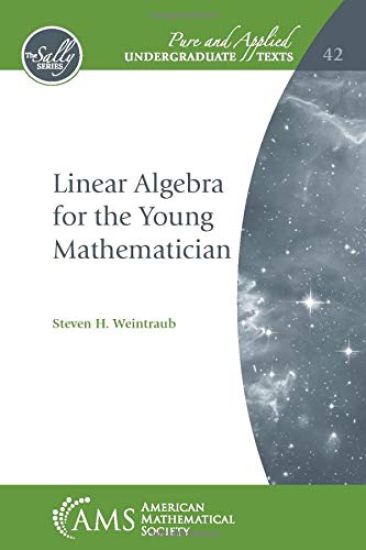
Linear Algebra for the Young Mathematician

Linear Algebra for the Young Mathematician

Steven H. Weintraub

AMERICAN MATHEMATICAL SOCIETY
2019
sidottu
Provides a careful, thorough, and rigorous introduction to linear algebra. The book adopts a conceptual point of view, focusing on the notions of vector spaces and linear transformations, and it takes pains to provide proofs that bring out the essential ideas of the subject.
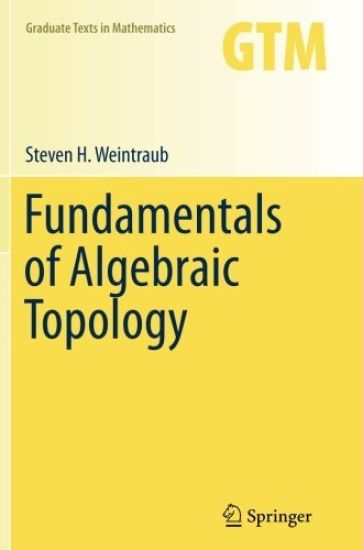
Fundamentals of Algebraic Topology

Fundamentals of Algebraic Topology

Steven H. Weintraub

Springer-Verlag New York Inc.
2016
nidottu
This rapid and concise presentation of the essential ideas and results of algebraic topology follows the axiomatic foundations pioneered by Eilenberg and Steenrod. The approach of the book is pragmatic: while most proofs are given, those that are particularly long or technical are omitted, and results are stated in a form that emphasizes practical use over maximal generality. Moreover, to better reveal the logical structure of the subject, the separate roles of algebra and topology are illuminated.Assuming a background in point-set topology, Fundamentals of Algebraic Topology covers the canon of a first-year graduate course in algebraic topology: the fundamental group and covering spaces, homology and cohomology, CW complexes and manifolds, and a short introduction to homotopy theory. Readers wishing to deepen their knowledge of algebraic topology beyond the fundamentals are guided by a short but carefully annotated bibliography.
Fundamentals of Algebraic Topology

Fundamentals of Algebraic Topology

Steven H. Weintraub

Springer-Verlag New York Inc.
2014
sidottu
This rapid and concise presentation of the essential ideas and results of algebraic topology follows the axiomatic foundations pioneered by Eilenberg and Steenrod. The approach of the book is pragmatic: while most proofs are given, those that are particularly long or technical are omitted, and results are stated in a form that emphasizes practical use over maximal generality. Moreover, to better reveal the logical structure of the subject, the separate roles of algebra and topology are illuminated.Assuming a background in point-set topology, Fundamentals of Algebraic Topology covers the canon of a first-year graduate course in algebraic topology: the fundamental group and covering spaces, homology and cohomology, CW complexes and manifolds, and a short introduction to homotopy theory. Readers wishing to deepen their knowledge of algebraic topology beyond the fundamentals are guided by a short but carefully annotated bibliography.
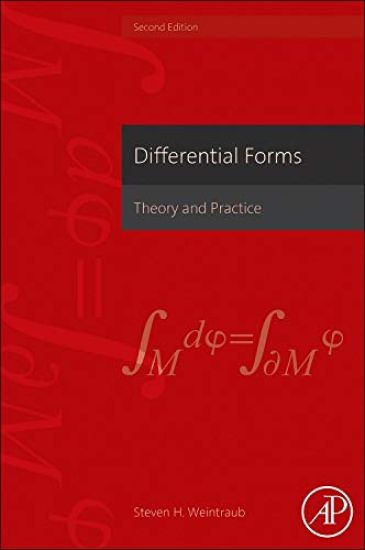
Differential Forms

Differential Forms

Steven H. Weintraub

Academic Press Inc
2014
sidottu
Differential forms are a powerful mathematical technique to help students, researchers, and engineers solve problems in geometry and analysis, and their applications. They both unify and simplify results in concrete settings, and allow them to be clearly and effectively generalized to more abstract settings. Differential Forms has gained high recognition in the mathematical and scientific community as a powerful computational tool in solving research problems and simplifying very abstract problems. Differential Forms, Second Edition, is a solid resource for students and professionals needing a general understanding of the mathematical theory and to be able to apply that theory into practice.
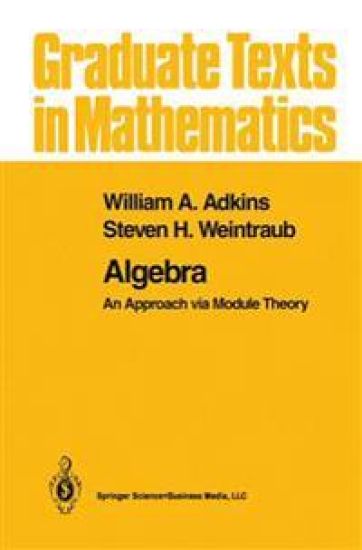
Algebra

Algebra

William A. Adkins; Steven H. Weintraub

Springer-Verlag New York Inc.
2012
nidottu
This book is designed as a text for a first-year graduate algebra course. As necessary background we would consider a good undergraduate linear algebra course. An undergraduate abstract algebra course, while helpful, is not necessary (and so an adventurous undergraduate might learn some algebra from this book). Perhaps the principal distinguishing feature of this book is its point of view. Many textbooks tend to be encyclopedic. We have tried to write one that is thematic, with a consistent point of view. The theme, as indicated by our title, is that of modules (though our intention has not been to write a textbook purely on module theory). We begin with some group and ring theory, to set the stage, and then, in the heart of the book, develop module theory. Having developed it, we present some of its applications: canonical forms for linear transformations, bilinear forms, and group representations. Why modules? The answer is that they are a basic unifying concept in mathematics. The reader is probably already familiar with the basic role that vector spaces play in mathematics, and modules are a generaliza­ tion of vector spaces. (To be precise, modules are to rings as vector spaces are to fields.
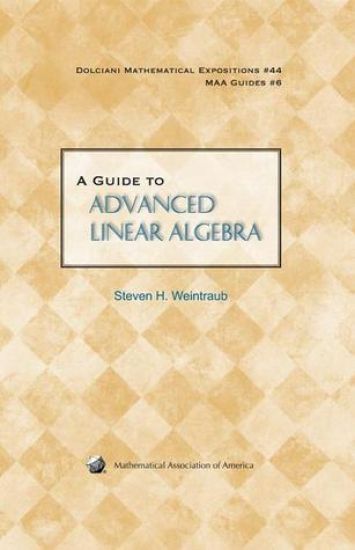
A Guide to Advanced Linear Algebra

A Guide to Advanced Linear Algebra

Steven H. Weintraub

Mathematical Association of America
2011
sidottu
Linear algebra occupies a central place in modern mathematics. This book provides a rigorous and thorough development of linear algebra at an advanced level. It approaches linear algebra from an algebraic point of view, but its selection of topics is governed not only for their importance in linear algebra itself, but also for their applications throughout mathematics. Topics treated in this book include: vector spaces and linear transformations; dimension counting and applications; representation of linear transformations by matrices; duality; determinants and their uses; rational and especially Jordan canonical form; bilinear forms; inner product spaces; normal linear transformations and the spectral theorem; and an introduction to matrix groups as Lie groups. Students in algebra, analysis and topology will all find much of interest and use to them and the careful treatment and breadth of subject matter will make this book a valuable reference for mathematicians throughout their professional lives.
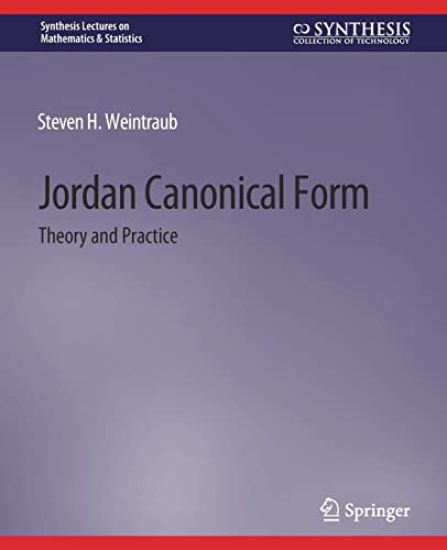
Jordan Canonical Form

Jordan Canonical Form

Steven H. Weintraub

Springer International Publishing AG
2009
nidottu
Jordan Canonical Form (JCF) is one of the most important, and useful, concepts in linear algebra. The JCF of a linear transformation, or of a matrix, encodes all of the structural information about that linear transformation, or matrix. This book is a careful development of JCF. After beginning with background material, we introduce Jordan Canonical Form and related notions: eigenvalues, (generalized) eigenvectors, and the characteristic and minimum polynomials. We decide the question of diagonalizability, and prove the Cayley-Hamilton theorem. Then we present a careful and complete proof of the fundamental theorem: Let V be a finite-dimensional vector space over the field of complex numbers C, and let T : V ? V be a linear transformation. Then T has a Jordan Canonical Form. This theorem has an equivalent statement in terms of matrices: Let A be a square matrix with complex entries. Then A is similar to a matrix J in Jordan Canonical Form, i.e., there is an invertible matrix P and a matrix J in Jordan Canonical Form with A = PJP-1. We further present an algorithm to find P and J, assuming that one can factor the characteristic polynomial of A. In developing this algorithm we introduce the eigenstructure picture (ESP) of a matrix, a pictorial representation that makes JCF clear. The ESP of A determines J, and a refinement, the labeled eigenstructure picture (lESP) of A, determines P as well. We illustrate this algorithm with copious examples, and provide numerous exercises for the reader. Table of Contents: Fundamentals on Vector Spaces and Linear Transformations / The Structure of a Linear Transformation / An Algorithm for Jordan Canonical Form and Jordan Basis
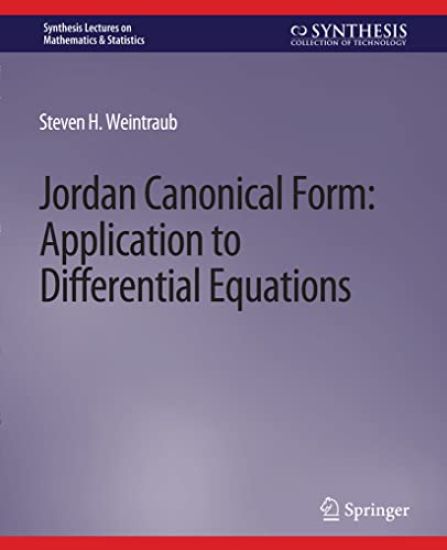
Jordan Canonical Form

Jordan Canonical Form

Steven H. Weintraub

Springer International Publishing AG
2008
nidottu
Jordan Canonical Form (JCF) is one of the most important, and useful, concepts in linear algebra. In this book we develop JCF and show how to apply it to solving systems of differential equations. We first develop JCF, including the concepts involved in it?eigenvalues, eigenvectors, and chains of generalized eigenvectors. We begin with the diagonalizable case and then proceed to the general case, but we do not present a complete proof. Indeed, our interest here is not in JCF per se, but in one of its important applications. We devote the bulk of our attention in this book to showing how to apply JCF to solve systems of constant-coefficient first order differential equations, where it is a very effective tool. We cover all situations?homogeneous and inhomogeneous systems; real and complex eigenvalues. We also treat the closely related topic of the matrix exponential. Our discussion is mostly confined to the 2-by-2 and 3-by-3 cases, and we present a wealth of examples that illustrate allthe possibilities in these cases (and of course, exercises for the reader). Table of Contents: Jordan Canonical Form / Solving Systems of Linear Differential Equations / Background Results: Bases, Coordinates, and Matrices / Properties of the Complex Exponential
Factorization

Factorization

Steven H. Weintraub

A K Peters
2008
sidottu
The concept of factorization, familiar in the ordinary system of whole numbers that can be written as a unique product of prime numbers, plays a central role in modern mathematics and its applications. This exposition of the classic theory leads the reader to an understanding of the current knowledge of the subject and its connections to other mathematical concepts, for example in algebraic number theory. The book can be used as a text for a first course in number theory or for self-study by motivated high school students or readers interested in modern mathematics.
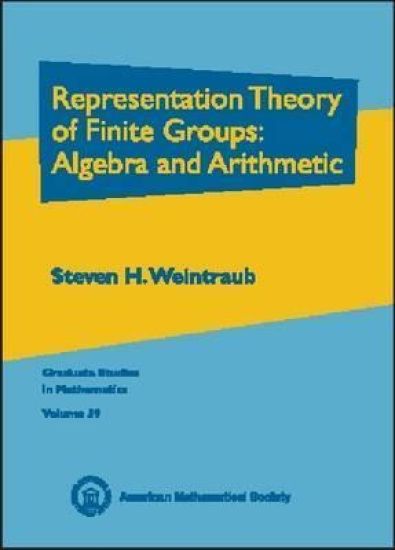
Representation Theory of Finite Groups

Representation Theory of Finite Groups

Steven H. Weintraub

Amer Mathematical Society
2003
sidottu
'We explore widely in the valley of ordinary representations, and we take the reader over the mountain pass leading to the valley of modular representations, to a point from which (s)he can survey this valley, but we do not attempt to widely explore it. We hope the reader will be sufficiently fascinated by the scenery to further explore both valleys on his/her own' - from the Preface. Representation theory plays important roles in geometry, algebra, analysis, and mathematical physics. In particular, it has been one of the great tools in the study and classification of finite groups. The theory contains some particularly beautiful results: Frobenius' theorem, Burnside's theorem, Artin's theorem, Brauer's theorem - all of which are covered in this textbook. Some seem uninspiring at first but prove to be quite useful. Others are clearly deep from the outset.And when a group (finite or otherwise) acts on something else (as a set of symmetries, for example), one ends up with a natural representation of the group. This book is an introduction to the representation theory of finite groups from an algebraic point of view, regarding representations as modules over the group algebra.The approach is to develop the requisite algebra in reasonable generality and then to specialize it to the case of group representations. Methods and results particular to group representations, such as characters and induced representations, are developed in depth. Arithmetic comes into play when considering the field of definition of a representation, especially for subfields of the complex numbers.The book has an extensive development of the semisimple case, where the characteristic of the field is zero or is prime to the order of the group, and builds the foundations of the modular case, where the characteristic of the field divides the order of the group. The book assumes only the material of a standard graduate course in algebra. It is suitable as a text for a year-long graduate course. The subject is of interest to students of algebra, number theory and algebraic geometry. The systematic treatment presented here makes the book also valuable as a reference.
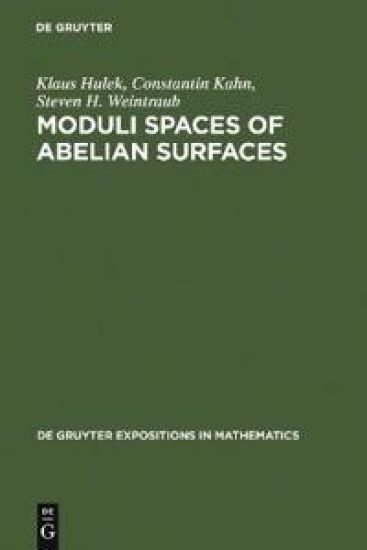
Moduli Spaces of Abelian Surfaces

Moduli Spaces of Abelian Surfaces

Klaus Hulek; Constantin Kahn; Steven H. Weintraub

De Gruyter
1993
sidottu
The aim of the Expositions is to present new and important developments in pure and applied mathematics. Well established in the community over more than two decades, the series offers a large library of mathematical works, including several important classics. The volumes supply thorough and detailed expositions of the methods and ideas essential to the topics in question. In addition, they convey their relationships to other parts of mathematics. The series is addressed to advanced readers interested in a thorough study of the subject. Editorial Board Lev Birbrair, Universidade Federal do Ceará, Fortaleza, BrasilWalter D. Neumann, Columbia University, New York, USAMarkus J. Pflaum, University of Colorado, Boulder, USADierk Schleicher, Aix-Marseille Université, FranceKatrin Wendland, Trinity College Dublin, Dublin, Ireland Honorary Editor Victor P. Maslov, Russian Academy of Sciences, Moscow, Russia Titles in planning include Yuri A. Bahturin, Identical Relations in Lie Algebras (2019)Yakov G. Berkovich, Lev G. Kazarin, and Emmanuel M. Zhmud', Characters of Finite Groups, Volume 2 (2019)Jorge Herbert Soares de Lira, Variational Problems for Hypersurfaces in Riemannian Manifolds (2019)Volker Mayer, Mariusz Urbanski, and Anna Zdunik, Random and Conformal Dynamical Systems (2021)Ioannis Diamantis, Boštjan Gabrovšek, Sofia Lambropoulou, and Maciej Mroczkowski, Knot Theory of Lens Spaces (2021)
Algebra

Algebra

William A. Adkins; Steven H. Weintraub

Springer-Verlag New York Inc.
1992
sidottu
This book is designed as a text for a first-year graduate algebra course. As necessary background we would consider a good undergraduate linear algebra course. An undergraduate abstract algebra course, while helpful, is not necessary (and so an adventurous undergraduate might learn some algebra from this book). Perhaps the principal distinguishing feature of this book is its point of view. Many textbooks tend to be encyclopedic. We have tried to write one that is thematic, with a consistent point of view. The theme, as indicated by our title, is that of modules (though our intention has not been to write a textbook purely on module theory). We begin with some group and ring theory, to set the stage, and then, in the heart of the book, develop module theory. Having developed it, we present some of its applications: canonical forms for linear transformations, bilinear forms, and group representations. Why modules? The answer is that they are a basic unifying concept in mathematics. The reader is probably already familiar with the basic role that vector spaces play in mathematics, and modules are a generaliza­ tion of vector spaces. (To be precise, modules are to rings as vector spaces are to fields.