Kirjojen hintavertailu. Mukana 12 386 522 kirjaa ja 12 kauppaa.

Kirjailija

Steven Heine

Kirjat ja teokset yhdessä paikassa: 28 kirjaa, julkaisuja vuosilta 1985-2024, suosituimpien joukossa Chan Rhetoric of Uncertainty in the Blue Cliff Record. Vertaile teosten hintoja ja tarkista saatavuus suomalaisista kirjakaupoista.

28 kirjaa

Kirjojen julkaisuhaarukka 1985-2024.

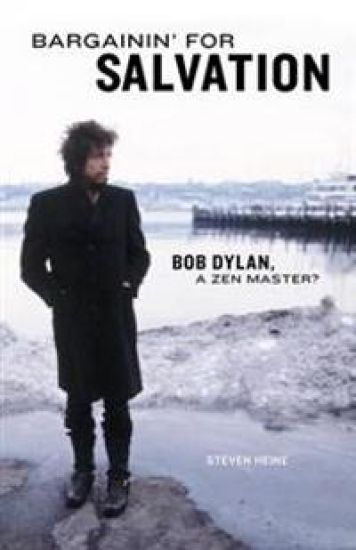
Bargainin' for Salvation

Bargainin' for Salvation

Steven Heine

Continuum International Publishing Group Ltd.
2009
nidottu
This book argues that Dylan actually embraces two radically distinct world views at alternating periods. Throughout his various stages, Dylan's work reveals an affinity with the Zen world view, where enlightenment can be attained through meditation, self-contemplation and intuition rather than through faith and devotion. Forgoing Christianity and Western Views for Zen and Buddhism, "Bargainin' for Salvation" will capture your attention and direct it toward the East. One of the mysteries of Bob Dylan's incredible corpus is why he seems to veer and zigzag so drastically and dramatically from one extreme standpoint to another. Throughout his career, rapid, radical transitions in musical style and public persona have either inspired or shocked different sectors of his fans. Is Dylan's work complex and contradictory, or is there an underlying consistency and continuity? Steven Heine, Director of the Institute for Asian Studies at Florida International University, argues that Dylan actually embraces two radically distinct world views at alternating periods. One is prevalent in his Protest (early '60s), Country (late '60s), and Gospel (late '70s) phases; it finds Dylan expressing moral outrage in endorsing a single higher truth based on a right-versus-wrong philosophy. The second view appears during periods of Dylan's disillusionment in the mid '60s ("Desolation Row"), mid '70s ("Tangled Up in Blue"), and mid '80s ("Jokerman"), finding him disenchanted with one-sided proclamations of truth and wandering, seemingly aimless amid a relativistic world of masks and disguises where nothing is ever what it claims to be. Throughout his various stages, Dylan's work reveals an affinity with the Zen world view, where enlightenment can be attained through meditation, self-contemplation and intuition rather than through faith and devotion. Whatever his current beliefs are, though, one can go into reading this book knowing that there are no others like it. Forgoing Christianity and Western views for Zen and Buddhism, "Bargainin' for Salvation" will capture your attention and direct it toward the East.
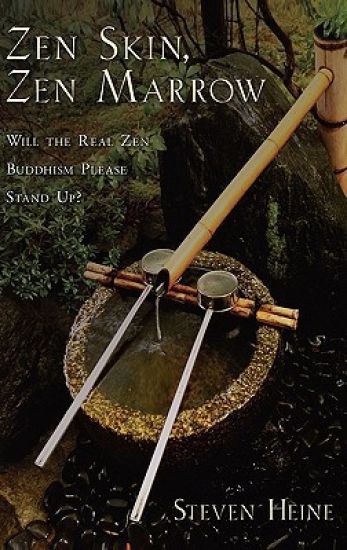
Zen Skin, Zen Marrow

Zen Skin, Zen Marrow

Steven Heine

Oxford University Press Inc
2008
sidottu
Since Zen Buddhism first captivated the attention of Western seekers the dominant discourse about this sect has been romantic, idealistic, and utopian. The essence of Zen has been described as ineffable, wholistic, and promoting social harmony. In recent years, however, some scholars have begun to examine Zen through the lenses of historical and cultural criticism, producing a sharp challenge to the traditional view. These clashing viewpoints are now entrenched in two warring camps, and their exponents talk past each other with virtually no constructive interaction. In this book, Steven Heine argues that a constructive compromise is possible. He focuses on three principal areas of disagreement: (1) the role of language and discourse in a tradition that claims to be 'outside words and letters,' yet has produced a voluminous body of texts, (2) the function of rituals and objects of worship to gain world benefit in a tradition supposedly founded on unmediated experience attained in an iconoclastic and ascetic environment, (3) the impact of a tradition that espouses peace and harmony on social issues such as class and gender discrimination and on nationalism and imperialism in Japan. Avoiding the stagnant polarization that characterizes most encounters between Zen traditionalists and their critics, he suggests ways in which these two perspectives can complement each other in a more balanced and nuanced alternative position.
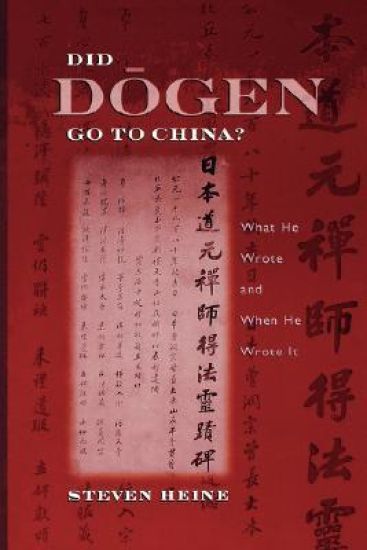
Did Dogen Go to China?

Did Dogen Go to China?

Steven Heine

Oxford University Press Inc
2006
nidottu
Dogen (1200-1253), the founder of the Soto Zen sect in Japan, is especially known for introducing to Japanese Buddhism many of the texts and practices that he discovered in China. Heine reconstructs the context of Dogen's travels to and reflections on China by means of a critical look at traditional sources both by and about Dogen in light of recent Japanese scholarship. While many studies emphasize the unique features of Dogen's Japanese influences, this book calls attention to the way Chinese and Japanese elements were fused in Dogen's religious vision. It reveals many new materials and insights into Dogen's main writings, including the multiple editions of the Shobogenzo, and how and when this seminal text was created by Dogen and was edited and interpreted by his disciples. This book is the culmination of the author's thirty years of research on Dogen and provides the reader with a comprehensive approach to the master's life works and an understanding of the overall career trajectory of one of the most important figures in the history of Buddhism and Asian religious thought.
Did Dogen Go to China?

Did Dogen Go to China?

Steven Heine

Oxford University Press Inc
2006
sidottu
Dogen (1200-1253) was the founder of Soto Zen Buddhism in Japan, and as such one of the most notable figures in Japanese religious history. In this book, Steven Heine attempts to clarify how and when Dogen's various works were composed and compiled in relation to the unfolding of Dogen's career. In addition to presenting Heine's own innovative interpretation of Dogen's life and work, this book performs a valuable service by bringing cutting edge Japanese scholarship on Dogen to the attention of of Western scholars of Buddhism.
White Collar Zen

White Collar Zen

Steven Heine

Oxford University Press Inc
2005
sidottu
It is said that in traditional Japan the samurai embraced Zen because it helped them to be fearless in adversity, to act quickly and decisively, and to keep focused on their ultimate goal. In White Collar Zen, Steven Heine shows how, by applying Zen principles in our working lives, we can achieve the same results for ourselves. Heine describes the way Zen embraces two different yet harmonious paths. The Way of the Hermit teaches detachment--the mental clarity you need to view your situation dispassionately and impartially, to perceive who is an ally and who is a competitor, to understand what is possible and what is not. The Way of the Warrior teaches the ability to act without hesitation at the proper moment. Together, they can prepare you to meet the challenges of the modern professional world. Heine offers a step-by-step approach to attaining these skills and applying them in daily life. Using real-world examples interwoven with sayings and stories from the Zen tradition, he shows how Zen can help in situations ranging from gaining a deserved promotion to overcoming obstacles that arise from a breakdown in teamwork. He makes it clear that in Zen the path to personal success must be one that values integrity, respects every individual, emphasizes cooperation, and serves the goals of the larger group. Replete with practical advice, White Collar Zen will appeal to many of the same readers who have made The Art of War and The Book of Five Rings so successful. It will certainly fascinate anyone interested in applying Zen principles to achieving professional excellence.
Opening a Mountain

Opening a Mountain

Steven Heine

Oxford University Press Inc
2004
nidottu
With the growing popularity of Zen Buddhism in the West, virtually everyone knows, or thinks they know, what a koan is: a brief and baffling question or statement that cannot be solved by the logical mind and which, after sustained concentration, can lead to sudden enlightenment. But the truth about koans is both simpler--and more complicated--than this. In Opening a Mountain, Steven Heine shows that koans, and the questions we associate with them--such as "What is the sound of one hand clapping?"--are embedded in larger narratives and belong to an ancient Buddhist tradition of "encounter dialogues." These dialogues feature dramatic and often inscrutable contests between masters and disciples, or between masters and an array of natural and supernatural forces: rouge priests, "wild foxes," hermits, wizards, shapeshifters, magical animals, and dangerous women. To establish a new monastery, "to open a mountain," the Zen master had to tame these wild forces in regions most remote from civilization. In these extraordinary encounters, fingers and arms are cut off, pitchers are kicked over, masters appear in and interpret each other's dreams, and seemingly absurd statements are shown to reveal the deepest insights. Heine restores these koans to their original traditions, allowing readers to see both the complex elements of Chinese culture and religion that they reflect and the role they played in Zen's transformation of local superstitions into its own teachings. Offering a fresh approach to one of the most crucial elements of Zen Buddhism, Opening a Mountain is essential reading for anyone seeking to understand the full story behind koans and the mysterious worlds they come from.
A Dream Within a Dream

A Dream Within a Dream

Steven Heine

Peter Lang Publishing Inc
1991
sidottu
This book is a collection of articles by one of the leading scholars in Japanese thought dealing with three areas of Japanese philosophy and religion: Dogen's Zen view of liberation, including the key doctrines of casting off body-mind, being-time, and spontaneous manifestation of the koan; the relation between Buddhism, literary aesthetics, and folk religion; and a comparison of Japanese and Western thought, particularly Heidegger, on science, language, and death. The central theme throughout these essays is the meaning of time and impermanence in Japanese religion and culture based on Buddhist contemplation. The book's title refers to a phrase used by Dogen, the dramatist Chikamatsu, and others that plays on the twofold image of -dream- representing either the fleeting world of illusion or the nonsubstantial realm of ultimate reality. One of the articles is a new annotated translation of Dogen's "Shobogenzo" -Muchu setsumu- (-Disclosing a Dream Within a Dream-) fascicle. Other essays offer novel interpretations of Chikamatsu and Kyoto-school thinkers Kuki Shuzo and Nishitani Keiji in addition to Japanese folk religion."
Existential and Ontological Dimensions of Time in Heidegger and Dogen

Existential and Ontological Dimensions of Time in Heidegger and Dogen

Steven Heine

State University of New York Press
1985
pokkari
In a landmark work, Steven Heine establishes the basis and framework for philosophical dialogue between Heidegger's approach to "Being and Time" and Dogen's doctrine of "being-time." Close examination of their analysis of the true nature, structure, and meaning of time reveals critical points of convergence in the existential and ontological dimensions of their thought.Heine asserts that Heidegger and Dogen are uniquely suited for critical comparative and cross-cultural study because both attempt to overcome their respective philosophical traditions that express unacknowledged and deficient presuppositions concerning time. And both reorient our understanding of all phases of existence and experience in terms of time and temporality, death and dying, and finitude and impermanence.Heine provides new insight into Dogen's philosophy as seen in the "Uji" chapter of Dogen's Shorogenzo.The book features a new annotated translation of the "Uji" and a glossary of Japanese terms.