Kirjojen hintavertailu. Mukana 12 390 323 kirjaa ja 12 kauppaa.

Kirjailija

Steven K. Vogel

Kirjat ja teokset yhdessä paikassa: 4 kirjaa, julkaisuja vuosilta 1998-2020, suosituimpien joukossa Freer Markets, More Rules. Vertaile teosten hintoja ja tarkista saatavuus suomalaisista kirjakaupoista.

4 kirjaa

Kirjojen julkaisuhaarukka 1998-2020.

Marketcraft

Marketcraft

Steven K. Vogel

Oxford University Press Inc
2020
nidottu
Modern-day markets do not arise spontaneously or evolve naturally. Rather they are crafted by individuals, firms, and most of all, by governments. Like statecraft, "marketcraft" represents a core function of government, and it requires considerable artistry to govern markets effectively. In Marketcraft, Steven K. Vogel builds his argument upon the recognition that all markets are crafted and then systematically explores the implications for analysis and policy. Vogel marshals a wide range of policy examples to support this concept, focusing in particular on the U.S. and Japan. He examines how the U.S., the "freest" market economy, is actually among the most heavily regulated advanced economies, while Japan's effort to liberalize its economy in the 1990s counterintuitively expanded the government's role in practice. In our era--and despite what anti-government ideologues contend--government officials, regardless of party affiliation, should be trained in marketcraft just as much as in statecraft.
Marketcraft

Marketcraft

Steven K. Vogel

Oxford University Press Inc
2018
sidottu
Modern-day markets do not arise spontaneously or evolve naturally. Rather they are crafted by individuals, firms, and most of all, by governments. Thus "marketcraft" represents a core function of government comparable to statecraft and requires considerable artistry to govern markets effectively. Just as real-world statecraft can be masterful or muddled, so it is with marketcraft. In Marketcraft, Steven Vogel builds his argument upon the recognition that all markets are crafted then systematically explores the implications for analysis and policy. In modern societies, there is no such thing as a free market. Markets are institutions, and contemporary markets are all heavily regulated. The "free market revolution" that began in the 1980s did not see a deregulation of markets, but rather a re-regulation. Vogel looks at a wide range of policy issues to support this concept, focusing in particular on the US and Japan. He examines how the US, the "freest" market economy, is actually among the most heavily regulated advanced economies, while Japan's effort to liberalize its economy counterintuitively expanded the government's role in practice. Marketcraft demonstrates that market institutions need government to function, and in increasingly complex economies, governance itself must feature equally complex policy tools if it is to meet the task. In our era-and despite what anti-government ideologues contend-governmental officials, regardless of party affiliation, should be trained in marketcraft just as much as in statecraft.
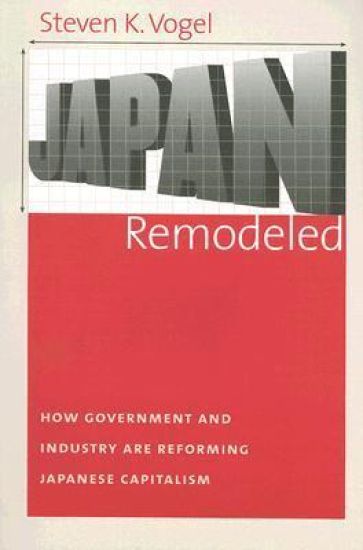
Japan Remodeled

Japan Remodeled

Steven K. Vogel

Cornell University Press
2006
pokkari
As the Japanese economy languished in the 1990s Japanese government officials, business executives, and opinion leaders concluded that their economic model had gone terribly wrong. They questioned the very institutions that had been credited with Japan's past success: a powerful bureaucracy guiding the economy, close government-industry ties, "lifetime" employment, the main bank system, and dense interfirm networks. Many of these leaders turned to the U.S. model for lessons, urging the government to liberate the economy and companies to sever long-term ties with workers, banks, suppliers, and other firms. Despite popular perceptions to the contrary, Japanese government and industry have in fact enacted substantial reforms. Yet Japan never emulated the American model. As government officials and industry leaders scrutinized their options, they selected reforms to modify or reinforce preexisting institutions rather than to abandon them. In Japan Remodeled, Steven Vogel explains the nature and extent of these reforms and why they were enacted. Vogel demonstrates how government and industry have devised innovative solutions. The cumulative result of many small adjustments is, he argues, an emerging Japan that has a substantially redesigned economic model characterized by more selectivity in business partnerships, more differentiation across sectors and companies, and more openness to foreign players.
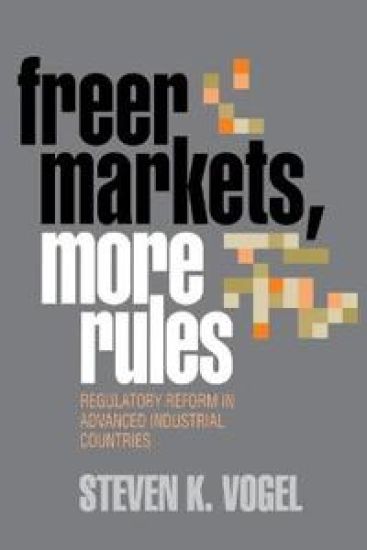
Freer Markets, More Rules

Freer Markets, More Rules

Steven K. Vogel

Cornell University Press
1998
pokkari
Over the past fifteen years, the United States, Western Europe, and Japan have transformed the relationship between governments and corporations. The changes are complex and the terms used to describe them often obscure the reality. In Freer Markets, More Rules, Steven K. Vogel dispenses with euphemisms and makes sense of this recent transformation. In defiance of conventional wisdom, Vogel contends that the deregulation revolution of the 1980s and 1990s never happened. The advanced industrial countries moved toward liberalization or freer markets at the same time that they imposed reregulation or more rules. Moreover, the countries involved did not converge in regulatory practice but combined liberalization and reregulation in markedly different ways. The state itself, far more than private interest groups, drove the process of regulatory reform. Thus, the story of deregulation is one rich in paradox: a movement aimed at reducing regulation increased it; a movement propelled by global forces reinforced national differences; and a movement that purported to reduce state power was led by the state itself. Vogel's astute and far-reaching analysis compares deregulation in Britain and Japan, with special attention to the telecommunication and financial services industries. He also considers such important sectors as broadcasting, transportation, and utilities in the United States, France, and Germany.