Kirjojen hintavertailu. Mukana 12 595 353 kirjaa ja 12 kauppaa.

Kirjailija

Steven L. Brunton

Kirjat ja teokset yhdessä paikassa: 6 kirjaa, julkaisuja vuosilta 2016-2026, suosituimpien joukossa Optimization. Vertaile teosten hintoja ja tarkista saatavuus suomalaisista kirjakaupoista.

6 kirjaa

Kirjojen julkaisuhaarukka 2016-2026.

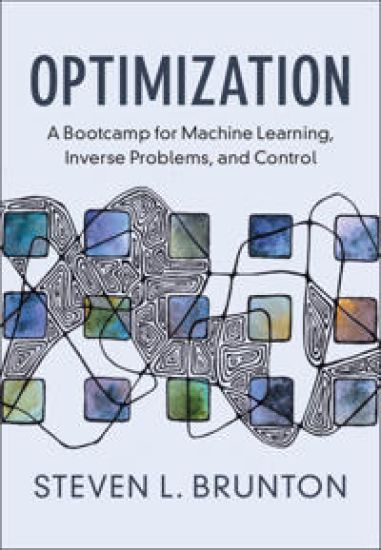
Optimization

Optimization

Steven L. Brunton

Cambridge University Press
2026
sidottu
Optimization is a foundational topic in mathematics, underpinning nearly all of our modern industrial and technological world. Assuming only basic knowledge of linear algebra and calculus, this book provides a rapid, yet thorough, overview of applied mathematical optimization for advanced undergraduates, beginning graduate students, or practitioners in engineering and science. The text opens with an 'Optimization Bootcamp', introducing methods at a beginning level, before progressing to deep-dives into advanced topics and research-ready methods. The focus throughout is on modern applications of machine learning, inverse problems, and control. Rich pedagogy includes Python code with simple working examples and advanced case studies. Every section is accompanied by YouTube lectures to encourage interaction with the material. Using intuitive explanations, this book makes the material as simple and interesting as possible, while still having the depth, breadth and precision required to empower use in research and real-world applications.
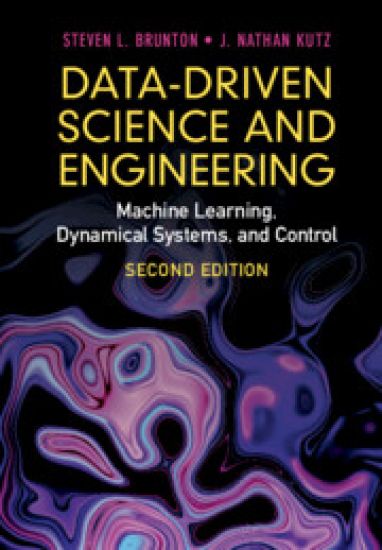
Data-Driven Science and Engineering

Data-Driven Science and Engineering

Steven L. Brunton; J. Nathan Kutz

Cambridge University Press
2022
sidottu
Data-driven discovery is revolutionizing how we model, predict, and control complex systems. Now with Python and MATLAB®, this textbook trains mathematical scientists and engineers for the next generation of scientific discovery by offering a broad overview of the growing intersection of data-driven methods, machine learning, applied optimization, and classical fields of engineering mathematics and mathematical physics. With a focus on integrating dynamical systems modeling and control with modern methods in applied machine learning, this text includes methods that were chosen for their relevance, simplicity, and generality. Topics range from introductory to research-level material, making it accessible to advanced undergraduate and beginning graduate students from the engineering and physical sciences. The second edition features new chapters on reinforcement learning and physics-informed machine learning, significant new sections throughout, and chapter exercises. Online supplementary material – including lecture videos per section, homeworks, data, and code in MATLAB®, Python, Julia, and R – available on databookuw.com.
Data-Driven Science and Engineering

Data-Driven Science and Engineering

Steven L. Brunton; J. Nathan Kutz

Cambridge University Press
2019
sidottu
Data-driven discovery is revolutionizing the modeling, prediction, and control of complex systems. This textbook brings together machine learning, engineering mathematics, and mathematical physics to integrate modeling and control of dynamical systems with modern methods in data science. It highlights many of the recent advances in scientific computing that enable data-driven methods to be applied to a diverse range of complex systems, such as turbulence, the brain, climate, epidemiology, finance, robotics, and autonomy. Aimed at advanced undergraduate and beginning graduate students in the engineering and physical sciences, the text presents a range of topics and methods from introductory to state of the art.
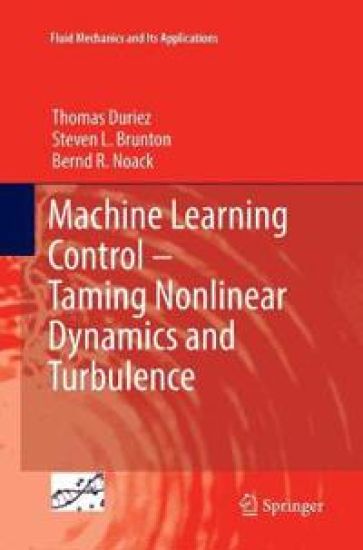
Machine Learning Control – Taming Nonlinear Dynamics and Turbulence

Machine Learning Control – Taming Nonlinear Dynamics and Turbulence

Thomas Duriez; Steven L. Brunton; Bernd R. Noack

Springer International Publishing AG
2018
nidottu
This is the first textbook on a generally applicable control strategy for turbulence and other complex nonlinear systems. The approach of the book employs powerful methods of machine learning for optimal nonlinear control laws. This machine learning control (MLC) is motivated and detailed in Chapters 1 and 2. In Chapter 3, methods of linear control theory are reviewed. In Chapter 4, MLC is shown to reproduce known optimal control laws for linear dynamics (LQR, LQG). In Chapter 5, MLC detects and exploits a strongly nonlinear actuation mechanism of a low-dimensional dynamical system when linear control methods are shown to fail. Experimental control demonstrations from a laminar shear-layer to turbulent boundary-layers are reviewed in Chapter 6, followed by general good practices for experiments in Chapter 7. The book concludes with an outlook on the vast future applications of MLC in Chapter 8. Matlab codes are provided for easy reproducibility of the presented results. The book includes interviews with leading researchers in turbulence control (S. Bagheri, B. Batten, M. Glauser, D. Williams) and machine learning (M. Schoenauer) for a broader perspective. All chapters have exercises and supplemental videos will be available through YouTube.
Machine Learning Control – Taming Nonlinear Dynamics and Turbulence

Machine Learning Control – Taming Nonlinear Dynamics and Turbulence

Thomas Duriez; Steven L. Brunton; Bernd R. Noack

Springer International Publishing AG
2016
sidottu
This is the first textbook on a generally applicable control strategy for turbulence and other complex nonlinear systems. The approach of the book employs powerful methods of machine learning for optimal nonlinear control laws. This machine learning control (MLC) is motivated and detailed in Chapters 1 and 2. In Chapter 3, methods of linear control theory are reviewed. In Chapter 4, MLC is shown to reproduce known optimal control laws for linear dynamics (LQR, LQG). In Chapter 5, MLC detects and exploits a strongly nonlinear actuation mechanism of a low-dimensional dynamical system when linear control methods are shown to fail. Experimental control demonstrations from a laminar shear-layer to turbulent boundary-layers are reviewed in Chapter 6, followed by general good practices for experiments in Chapter 7. The book concludes with an outlook on the vast future applications of MLC in Chapter 8. Matlab codes are provided for easy reproducibility of the presented results. The book includes interviews with leading researchers in turbulence control (S. Bagheri, B. Batten, M. Glauser, D. Williams) and machine learning (M. Schoenauer) for a broader perspective. All chapters have exercises and supplemental videos will be available through YouTube.
Dynamic Mode Decomposition

Dynamic Mode Decomposition

J. Nathan Kutz; Steven L. Brunton

Society For Industrial Appli
2016
nidottu
The first book to address the DMD algorithm presenting a pedagogical and comprehensive approach to all aspects of DMD currently developed or under development. It blends theoretical development, example codes, and applications to showcase the theory and its many innovations and uses.