Kirjojen hintavertailu. Mukana 12 595 353 kirjaa ja 12 kauppaa.

Kirjailija

Steven M. Duncan

Kirjat ja teokset yhdessä paikassa: 11 kirjaa, julkaisuja vuosilta 2008-2020, suosituimpien joukossa How Free Will Works. Vertaile teosten hintoja ja tarkista saatavuus suomalaisista kirjakaupoista.

Mukana myös kirjoitusasut: Steven M Duncan

11 kirjaa

Kirjojen julkaisuhaarukka 2008-2020.

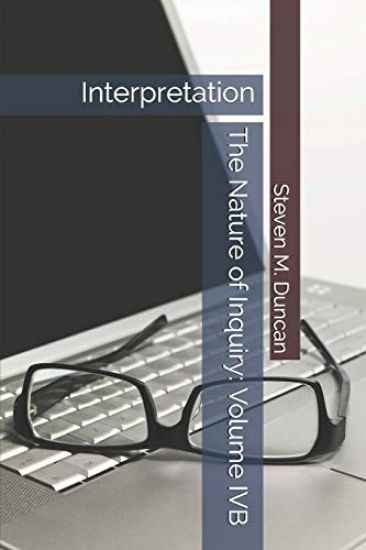
The Nature of Inquiry: Volume IVB: Interpretation

The Nature of Inquiry: Volume IVB: Interpretation

Steven M. Duncan

Independently Published
2020
nidottu
The author completes this series with a discussion of Hermeneutics, the theory of interpretation. Building on the account of intuitive knowledge offered in Volume VIA, this volume applies these ideas to two basic areas: history, on the one hand, and art and literary criticism on the other. The author addresses the Problem of Bias, the Hermeneutic Circle, and the differences history and the social sciences, on the one hand, and the natural sciences on the other. The author concludes with a discussion of the nature and ends of education as it relates to theoretical inquiry.
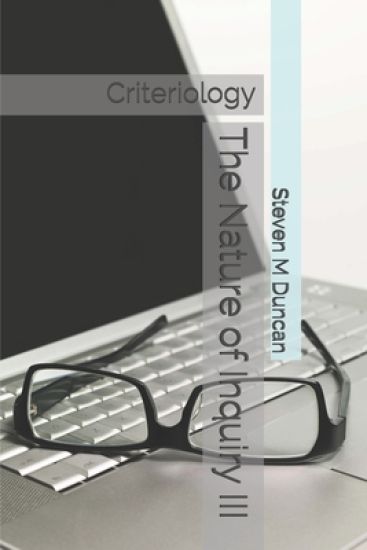
The Nature of Inquiry III: Criteriology

The Nature of Inquiry III: Criteriology

Steven M. Duncan

Independently Published
2019
nidottu
Criteriology is the normative science of substantive, empirical judgment that discovers and articulates the standards for warranted belief concerning contingent matters of fact. In this study, the formal epistemology and cognitive theory developed in the earlier volumes of this treatise are used to articulate a completed Criteriology, one that applies those earlier results to specific, concrete contexts involving both spontaneous judgment and rational belief.
Possibilities that Matter: An Introduction to Material Modal Logic

Possibilities that Matter: An Introduction to Material Modal Logic

Steven M. Duncan

Createspace Independent Publishing Platform
2017
nidottu
Subtitled "An Introduction to Material Modal Logic," this monograph explores modal logic from a realist perspective on possibility that, following Aristotle and Kant, grounds possibility in actuality and thus provides a material, rather than merely formal, interpretation of basic modal notions. It then applies this material modal logic to the understanding of contingent being and the existence of a necessary being serving as "the ground of all possibility."
The Proof of the External World

The Proof of the External World

Steven M Duncan

Wipf Stock Publishers
2008
sidottu
""Descartes' attempt to ground the possibility of human knowledge in the existence of God was judged to be a complete failure by his contemporaries, and this remains the universal opinion of philosophers to this day, despite the fact that three and a half centuries of secular epistemology--which attempts to ground the possibility of knowledge either in the unaided human intellect or in natural processes--has failed to do any better. Further, the leading twentieth-century attempts at theistic epistemology reject both the conception of knowledge and the standards of epistemic evaluation that Descartes takes for granted. ""In this book--partly an interpretation of Descartes and partly an attempt to complete his project-- the author attempts to show that a theistic epistemology incorporating Platonic and Aristotelian/Thomist elements can revitalize the Cartesian approach to the solution of the central problems of epistemology, including that most elusive of prizes--the proof of the external world."" --From the author's preface
The Proof of the External World

The Proof of the External World

Steven M Duncan

Wipf Stock Publishers
2008
pokkari
""Descartes' attempt to ground the possibility of human knowledge in the existence of God was judged to be a complete failure by his contemporaries, and this remains the universal opinion of philosophers to this day, despite the fact that three and a half centuries of secular epistemology--which attempts to ground the possibility of knowledge either in the unaided human intellect or in natural processes--has failed to do any better. Further, the leading twentieth-century attempts at theistic epistemology reject both the conception of knowledge and the standards of epistemic evaluation that Descartes takes for granted. ""In this book--partly an interpretation of Descartes and partly an attempt to complete his project-- the author attempts to show that a theistic epistemology incorporating Platonic and Aristotelian/Thomist elements can revitalize the Cartesian approach to the solution of the central problems of epistemology, including that most elusive of prizes--the proof of the external world."" --From the author's preface Steven Duncan has produced a rigorous and highly original contribution to one of the greatest philosophical problems of all time. Specialists in Descartes and philosophers doing epistemology will find this book very provocative and original, but The Proof of the External World will also appeal to the general reader interested in the history of philosophy. A wonderful contribution -Paul Herrick, Professor of Philosophy, Shoreline Community College and author of The Many Worlds of Logic Steven M. Duncan is the author of A Primer of Modern Virtue Ethics (University Press of America, 1995) and Being, Truth and Knowledge (Wadsworth, 2000). He has taught philosophy in colleges and universities for over thirty years. Duncan is currently a member of the adjunct philosophy faculty at Bellevue College.