Kirjojen hintavertailu. Mukana 12 200 028 kirjaa ja 12 kauppaa.

Kirjailija

Steven R. Smith

Kirjat ja teokset yhdessä paikassa: 13 kirjaa, julkaisuja vuosilta 1987-2023, suosituimpien joukossa The Ontology of Well-Being in Social Policy and Welfare Practice. Vertaile teosten hintoja ja tarkista saatavuus suomalaisista kirjakaupoista.

13 kirjaa

Kirjojen julkaisuhaarukka 1987-2023.

The Ontology of Well-Being in Social Policy and Welfare Practice

The Ontology of Well-Being in Social Policy and Welfare Practice

Steven R. Smith

Springer International Publishing AG
2023
nidottu
This book provides important philosophical insights concerning the kind of creatures we are such that we can experience something we understand as well-being, with these insights then being applied to various areas of social policy and welfare practice. The author defends what he calls The Ontology of Well-Being Thesis (TOWT), addressing ontological questions about the human condition, and how these questions are fundamental to issues concerning what we might know about human well-being and how we should promote it. Yet, surprisingly, these ontological questions are often side-lined in academic, political, and policy and practice based debates about well-being. Addressing these questions, head-on, six features of the human condition are identified via TOWT: human embodiment, finiteness, sociability, cognition, evaluation, and agency. The main argument of the thesis is that these features reveal the conflicting character of human experiences, which can, in turn, have a profound bearing on our experience of well-being. Notably, it is our conflicting experiences of time, emotion, and self-consciousness, which can potentially help us experience well-being in complex and multi-dimensional ways. The author then applies these insights to various social policies and welfare practices, concerning, for example, pensions, disability, bereavement counselling, social prescribing within health settings, the promotion of mental health, and co-production practices. This book is of importance to philosophers, social policy analysts, and welfare practitioners and is also relevant to the fields of psychology, sociology, politics, and the health sciences.
The Ontology of Well-Being in Social Policy and Welfare Practice

The Ontology of Well-Being in Social Policy and Welfare Practice

Steven R. Smith

Springer International Publishing AG
2022
sidottu
This book provides important philosophical insights concerning the kind of creatures we are such that we can experience something we understand as well-being, with these insights then being applied to various areas of social policy and welfare practice. The author defends what he calls The Ontology of Well-Being Thesis (TOWT), addressing ontological questions about the human condition, and how these questions are fundamental to issues concerning what we might know about human well-being and how we should promote it. Yet, surprisingly, these ontological questions are often side-lined in academic, political, and policy and practice based debates about well-being. Addressing these questions, head-on, six features of the human condition are identified via TOWT: human embodiment, finiteness, sociability, cognition, evaluation, and agency. The main argument of the thesis is that these features reveal the conflicting character of human experiences, which can, in turn, have a profound bearing on our experience of well-being. Notably, it is our conflicting experiences of time, emotion, and self-consciousness, which can potentially help us experience well-being in complex and multi-dimensional ways. The author then applies these insights to various social policies and welfare practices, concerning, for example, pensions, disability, bereavement counselling, social prescribing within health settings, the promotion of mental health, and co-production practices. This book is of importance to philosophers, social policy analysts, and welfare practitioners and is also relevant to the fields of psychology, sociology, politics, and the health sciences.

The Centre-left and New Right Divide?

The Centre-left and New Right Divide?

Steven R. Smith

Routledge
2020
nidottu
First published in 1998, this volume offers some solutions to the inherent difficulties with moving from philosophical generalities to specific policies, by exploring how a bridge might be built between political philosophy and social policy analysis. In light of these findings, Steven R. Smith evaluates the relationship between the Centre-Left and the New Right, focusing on the way in which concepts of individual autonomy and equality are used by political philosophers and social policy makers. Smith explores post-1945 training, education, social security and community care policy within the United Kingdom.
The Centre-left and New Right Divide?

The Centre-left and New Right Divide?

Steven R. Smith

Routledge
2019
sidottu
First published in 1998, this volume offers some solutions to the inherent difficulties with moving from philosophical generalities to specific policies, by exploring how a bridge might be built between political philosophy and social policy analysis. In light of these findings, Steven R. Smith evaluates the relationship between the Centre-Left and the New Right, focusing on the way in which concepts of individual autonomy and equality are used by political philosophers and social policy makers. Smith explores post-1945 training, education, social security and community care policy within the United Kingdom.
Psychology Graduate School

Psychology Graduate School

Steven R. Smith

Rowman Littlefield
2018
nidottu
Psychology Graduate School: A User’s Manual provides a user-friendly description of what graduate study in clinical, counseling, and school psychology is really like. Rather than a mere how-to manual, this book describes the nitty-gritty of the graduate student experience in a casual style so that you will be prepared and successful. Written by an experienced graduate school professor, this book cuts to the heart of what you’ll experience as a graduate student (good, bad, and otherwise). Topics include dealing with imposter syndrome, understanding faculty, starting clinical work, applying for your internship, celebrating milestones, and crafting a professional narrative. Equal parts inspirational and instructive, Steven R. Smith cuts to the chase about how to deftly navigate the system while keeping your wits about you. Punctuated with quotes and stories from graduate students from all over the country, this readable and enjoyable text will be of interest to students currently in graduate school and those looking forward to attending.
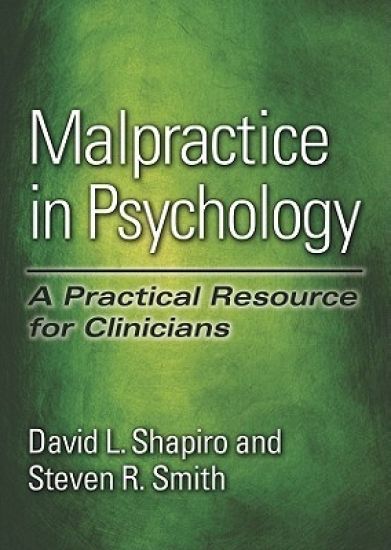
Malpractice in Psychology

Malpractice in Psychology

David L. Shapiro; Steven R. Smith

American Psychological Association
2011
sidottu
With combined expertise in psychotherapy and law, David L. Shapiro and Steven R. Smith expertly navigate readers through the unfamiliar territories of professional liability, negligence, informed consent, privacy and confidentiality, HIPAA, defamation, violence and suicide, and malpractice trials and settlements. Through its illustrative case examples and up-to-date discussion of law and ethics, this book will help mental health practitioners enrich and protect their professional practice.
Collaborative Therapeutic Neuropsychological Assessment

Collaborative Therapeutic Neuropsychological Assessment

Tad T. Gorske; Steven R. Smith

Springer-Verlag New York Inc.
2010
nidottu
One of the challenges the field of clinical neuropsychology faces is to develop an assessment process that is relevant and responsive to the needs of patients. Indeed, it has been suggested that the survival of neuropsychology as a clinical discipline may be threatened due to an overemphasis on diagnosing cognitive deficits as opposed to developing methods that meet patients’ needs. One way to meet this need is for psychologists to extend their services by developing clinical interventions that contribute to enhancing patients’ cognitive and emotional well-being. Providing feedback from the results of neuropsychological tests is one method suggested as a way to enhance patient care and satisfaction with the assessment process while providing a link between clinical assessment and therapeutic interventions. In current practice, providing feedback to patients about the results of neuropsychological assessments has been considered an optional procedure by clinicians and thus received little attention in the literature. Yet there is evidence that when feedback is provided to patients the effects are overwhelmingly positive. Feedback provides a bridge between assessment and treatment by facilitating the development of applicable treatment plans. There is no agreed upon conceptual framework for providing feedback from neuropsychological assessment, although researchers have made recommendations. However, these recommendations have done little to affect clinical practice and training despite the fact that including patient-oriented feedback enhances the likelihood that neuropsychological assessment will remain a relevant and important component of patient care. The purpose of this proposed book is to first describe developments in methods of neuropsychological assessment feedback that involve active collaboration with patients in an open exchange of information and results. Second, we will present a comprehensive model for conducting neuropsychologicalassessment feedback. The authors of this book are expert clinical practitioners and academic researchers who are at the forefront of the development and implementation of Collaborative Therapeutic Neuropsychological Assessment methods. Table of contents follows.
Collaborative Therapeutic Neuropsychological Assessment

Collaborative Therapeutic Neuropsychological Assessment

Tad T. Gorske; Steven R. Smith

Springer-Verlag New York Inc.
2008
sidottu
One of the challenges the field of clinical neuropsychology faces is to develop an assessment process that is relevant and responsive to the needs of patients. Indeed, it has been suggested that the survival of neuropsychology as a clinical discipline may be threatened due to an overemphasis on diagnosing cognitive deficits as opposed to developing methods that meet patients’ needs. One way to meet this need is for psychologists to extend their services by developing clinical interventions that contribute to enhancing patients’ cognitive and emotional well-being. Providing feedback from the results of neuropsychological tests is one method suggested as a way to enhance patient care and satisfaction with the assessment process while providing a link between clinical assessment and therapeutic interventions. In current practice, providing feedback to patients about the results of neuropsychological assessments has been considered an optional procedure by clinicians and thus received little attention in the literature. Yet there is evidence that when feedback is provided to patients the effects are overwhelmingly positive. Feedback provides a bridge between assessment and treatment by facilitating the development of applicable treatment plans. There is no agreed upon conceptual framework for providing feedback from neuropsychological assessment, although researchers have made recommendations. However, these recommendations have done little to affect clinical practice and training despite the fact that including patient-oriented feedback enhances the likelihood that neuropsychological assessment will remain a relevant and important component of patient care. The purpose of this proposed book is to first describe developments in methods of neuropsychological assessment feedback that involve active collaboration with patients in an open exchange of information and results. Second, we will present a comprehensive model for conducting neuropsychologicalassessment feedback. The authors of this book are expert clinical practitioners and academic researchers who are at the forefront of the development and implementation of Collaborative Therapeutic Neuropsychological Assessment methods. Table of contents follows.
Law, Behavior, and Mental Health

Law, Behavior, and Mental Health

Steven R. Smith; Robert Meyer

New York University Press
1988
pokkari
This comprehensive new volume on psychology and the law is an essential reference for students and professionals. It offers the most up-to-date information on issues such as malpractive, confidentiality, jury selection, punishment, competency, and the right to refuse treatment. Two well-known professionals, a lawyer and a clinical psychologist, have teamed up to write this judiciously balanced, clearly presented, and accessible guide to an ever more complex subject. they answer such questions as: What does a lie detector test really tell you? Can law enforcement officials use hypnosis to investigate a crime? Is eyewitness testimony the most reliable and persuasive evidence? Are we living in a more punitive society? These and other issues are dealt with in a concise, readable manner, one that tells readers how to approach the problems with arise in day-today practive as well as how to think about the fundamental current ethical and legal issues. Meticulously researched and documented, this important new volume offers a lively presentation, one which is must reading for students of law, and for professionals in both fields who want a complete reference guide.
Adjusting the Balance

Adjusting the Balance

Susan Freinkel; Steven R. Smith

Praeger Publishers Inc
1988
sidottu
This books offers a unique comparative perspective on the development of service programs for victims of four major violent crimes: child abuse, spouse abuse, rape, and crimes against the elderly. The study analyzes the evolution of federal policy in each area and examines the ways in which federal initiatives and federal funding affected the focus and financial stability of victim service programs. This book argues that the four issues were profoundly affected by the public policy process, the varied definition of the issues shaped by ways in which public funding was distributed. The book takes a broad view of the policymaking process--to include all branches of the federal government, as well as state and local government, the courts, and voluntary grass-roots organizations.This books offers a unique comparative perspective on the development of service programs for victims of four major violent crimes: child abuse, spouse abuse, rape, and crimes against the elderly. The study analyzes the evolution of federal policy in each area and examines the ways in which federal initiatives and federal funding affected the focus and financial stability of victim service programs. This book argues that the four issues were profoundly affected by the public policy process, the varied definition of the issues shaped by ways in which public funding was distributed. The book takes a broad view of the policymaking process--to include all branches of the federal government, as well as state and local government, the courts, and voluntary grass-roots organizations. While offering concrete information about four specific victims' policies, the book also presents very important theoretical generalizations about the policymaking process and about the effect, over time, of that process on the definition and articulation of social problems in general.
Law, Behavior, and Mental Health

Law, Behavior, and Mental Health

Steven R. Smith; Robert Meyer

New York University Press
1987
sidottu
This comprehensive new volume on psychology and the law is an essential reference for students and professionals. It offers the most up-to-date information on issues such as malpractive, confidentiality, jury selection, punishment, competency, and the right to refuse treatment. Two well-known professionals, a lawyer and a clinical psychologist, have teamed up to write this judiciously balanced, clearly presented, and accessible guide to an ever more complex subject. they answer such questions as: What does a lie detector test really tell you? Can law enforcement officials use hypnosis to investigate a crime? Is eyewitness testimony the most reliable and persuasive evidence? Are we living in a more punitive society? These and other issues are dealt with in a concise, readable manner, one that tells readers how to approach the problems with arise in day-today practive as well as how to think about the fundamental current ethical and legal issues. Meticulously researched and documented, this important new volume offers a lively presentation, one which is must reading for students of law, and for professionals in both fields who want a complete reference guide.