Kirjojen hintavertailu. Mukana 12 595 353 kirjaa ja 12 kauppaa.
Kirjailija
Steven W Popper
Kirjat ja teokset yhdessä paikassa: 14 kirjaa, julkaisuja vuosilta 1998-2022, suosituimpien joukossa Effective Policing for 21st-Century Israel. Vertaile teosten hintoja ja tarkista saatavuus suomalaisista kirjakaupoista.
Israel has changed dramatically in the past two decades. The Israel Police is transforming itself to meet the needs of modern Israel. The Ministry of Public Security, the Ministry of Finance, and the Israel Police asked RAND to conduct a study to address issues of public perceptions and trust in the police, benchmarking the police against other police organizations, performance measurement, and deterrence and crime prevention.
Aaron B Frank; Elizabeth M Bartels; Adam R Grissom; Jonathan S Blake; Gabrielle Tarini; Kelly Elizabeth Eusebi; Joseph N Mait; Elisa Jayne Bienenstock; Andrew M Parker; Steven W Popper; Paul K Davis; Edward Geist; Ben Connable; Zev Winkelman; Robert L Axtell; Justin Grana; Robert J Lempert; Kelly Klima; Sara Turner; James R Watson; Michael J Gaines; Yuna Huh Wong; Jasmin Léveillé; Timothy Marler
Israel has not routinely developed and successfully implemented strategic responses to socioeconomic problems that demand longer-term, coordinated policy action. Researchers developed detailed recommendations for the Israeli government to apply a strategic perspective toward socioeconomic issues and develop a formal socioeconomic strategy should it wish to do so.
Sino-Singapore Guangzhou Knowledge City is a planned environmentally and technologically advanced city in China's Guangzhou Development District that will host innovative industries and their workers. This report serves as an outline for a set of strategies for Knowledge City and is intended to help the developers create conditions that are conducive to innovation and the commercialization of new technologies.
The Brain Korea 21 Program (BK21), which seeks to make Korean research universities globally competitive and to produce more high-quality researchers in Korea, provides funding to graduate students and professors who belong to research groups at top universities. The authors develop quantitative and qualitative models to evaluate how well BK21 is fulfilling its goals and make suggestions for further stimulating Korean university research.
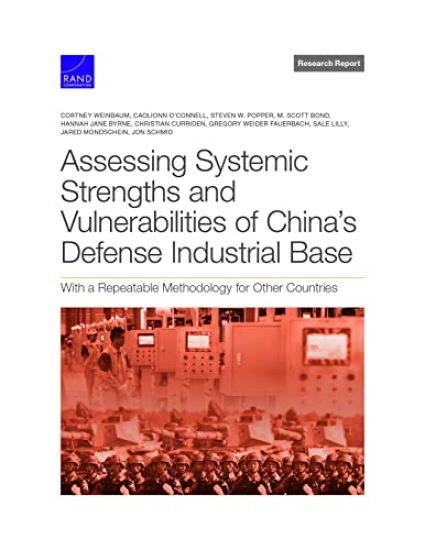
Cortney Weinbaum; Caolionn O'Connell; Steven W Popper; M Scott Bond; Hannah Jane Byrne; Christian Curriden; Gregory Weider Fauerbach; Sale Lilly; Jared Mondschein; Jon Schmid
In response to a requirement in the National Defense Authorization Act for Fiscal Year 2021, the authors examine the strengths and vulnerabilities of China's defense industrial base (DIB) by designing and applying a comparative analytic structure that could be used to assess any country's DIB. They assess six areas: economics; governance and regulations; research, development, and innovation; workforce, labor, and skills; manufacturing; and raw materials.
This open access book focuses on both the theory and practice associated with the tools and approaches for decisionmaking in the face of deep uncertainty. It explores approaches and tools supporting the design of strategic plans under deep uncertainty, and their testing in the real world, including barriers and enablers for their use in practice. The book broadens traditional approaches and tools to include the analysis of actors and networks related to the problem at hand. It also shows how lessons learned in the application process can be used to improve the approaches and tools used in the design process. The book offers guidance in identifying and applying appropriate approaches and tools to design plans, as well as advice on implementing these plans in the real world. For decisionmakers and practitioners, the book includes realistic examples and practical guidelines that should help them understand what decisionmaking under deep uncertainty is and how it may be of assistance to them. Decision Making under Deep Uncertainty: From Theory to Practice is divided into four parts. Part I presents five approaches for designing strategic plans under deep uncertainty: Robust Decision Making, Dynamic Adaptive Planning, Dynamic Adaptive Policy Pathways, Info-Gap Decision Theory, and Engineering Options Analysis. Each approach is worked out in terms of its theoretical foundations, methodological steps to follow when using the approach, latest methodological insights, and challenges for improvement. In Part II, applications of each of these approaches are presented. Based on recent case studies, the practical implications of applying each approach are discussed in depth. Part III focuses on using the approaches and tools in real-world contexts, based on insights from real-world cases. Part IV contains conclusions and a synthesis of the lessons that can be drawn for designing, applying, and implementing strategic plans under deep uncertainty, as well as recommendations for future work. The publication of this book has been funded by the Radboud University, the RAND Corporation, Delft University of Technology, and Deltares.; Offers a comprehensive examination of the approaches and tools for designing plans under deep uncertainty and their application Identifies barriers and enablers for the use of the various approaches and tools in practice Includes realistic examples and practical guidelines to help readers better understand the concepts This work was published by Saint Philip Street Press pursuant to a Creative Commons license permitting commercial use. All rights not granted by the work's license are retained by the author or authors.
This open access book focuses on both the theory and practice associated with the tools and approaches for decisionmaking in the face of deep uncertainty. It explores approaches and tools supporting the design of strategic plans under deep uncertainty, and their testing in the real world, including barriers and enablers for their use in practice. The book broadens traditional approaches and tools to include the analysis of actors and networks related to the problem at hand. It also shows how lessons learned in the application process can be used to improve the approaches and tools used in the design process. The book offers guidance in identifying and applying appropriate approaches and tools to design plans, as well as advice on implementing these plans in the real world. For decisionmakers and practitioners, the book includes realistic examples and practical guidelines that should help them understand what decisionmaking under deep uncertainty is and how it may be of assistance to them. Decision Making under Deep Uncertainty: From Theory to Practice is divided into four parts. Part I presents five approaches for designing strategic plans under deep uncertainty: Robust Decision Making, Dynamic Adaptive Planning, Dynamic Adaptive Policy Pathways, Info-Gap Decision Theory, and Engineering Options Analysis. Each approach is worked out in terms of its theoretical foundations, methodological steps to follow when using the approach, latest methodological insights, and challenges for improvement. In Part II, applications of each of these approaches are presented. Based on recent case studies, the practical implications of applying each approach are discussed in depth. Part III focuses on using the approaches and tools in real-world contexts, based on insights from real-world cases. Part IV contains conclusions and a synthesis of the lessons that can be drawn for designing, applying, and implementing strategic plans under deep uncertainty, as well as recommendations for future work. The publication of this book has been funded by the Radboud University, the RAND Corporation, Delft University of Technology, and Deltares.; Offers a comprehensive examination of the approaches and tools for designing plans under deep uncertainty and their application Identifies barriers and enablers for the use of the various approaches and tools in practice Includes realistic examples and practical guidelines to help readers better understand the concepts This work was published by Saint Philip Street Press pursuant to a Creative Commons license permitting commercial use. All rights not granted by the work's license are retained by the author or authors.
RAND researchers supported a high-level Israeli government team tasked with improving long-term socioeconomic strategy for the state. This report highlights selected inputs made to the government team to summarize the essential mechanics and roles for bringing a strategic perspective to policy consideration. To show how one can use a strategic perspective in an analysis of policy choices, the report uses the example of an aging population.
Investigates strategies and policies for Korea to pursue, particularly in science and technology, in light of a rising China. Can Korea maintain its market position in both Chinese and world markets as China becomes more competitive in many industries where Korea currently has a relative advantage? This study develops a simple model of the Korean economy and four alternative S&T strategies that Korea could follow and shows how those strategies may affect Korean prosperity, explicitly considering the many uncertainties that Korea confronts.
In this age of rapidly advancing technology, what will it take for the United States to remain competitive in the world economy? What new technologies are essential to build new industries, to drive economic growth, to improve the health and quality of life of our people, to ensure national security, and to protect the environment? Since 1991, the federal government has sponsored reports to address these questions and gain insights into key technologies or technological areas. New Forces at Work: Industry Views Critical Technologies, explores this set of issues surrounding this area of policy from an industry perspective. The authors engaged and solicited the views of presidents, CEOs, and Chief Technology Officers from 39 firms representing a cross section of industries. The result is a revealing look at the state of five major technology sectors that U.S. industry cited as essential: software, microelectronics and telecommunications technologies, manufacturing technologies, materials, and sensor and imaging technologies.