Kirjojen hintavertailu. Mukana 12 390 323 kirjaa ja 12 kauppaa.

Kirjailija

Stillman Drake

Kirjat ja teokset yhdessä paikassa: 5 kirjaa, julkaisuja vuosilta 1983-2013, suosituimpien joukossa Two New Sciences/A History of Free Fall. Vertaile teosten hintoja ja tarkista saatavuus suomalaisista kirjakaupoista.

5 kirjaa

Kirjojen julkaisuhaarukka 1983-2013.

Discourse on Bodies in Water

Discourse on Bodies in Water

Galileo Galilei; Stillman Drake

Literary Licensing, LLC
2013
sidottu
Discourse On Bodies In Water is a scientific treatise written by the renowned Italian physicist and astronomer, Galileo Galilei. The book is a detailed study of the behavior of bodies in water, exploring the laws of buoyancy and hydrostatics. Galileo's observations and experiments on the subject revolutionized the field of physics and laid the foundation for modern hydrodynamics.The book begins with an introduction to the basic principles of hydrostatics, including the concept of pressure and the behavior of fluids at rest. Galileo then delves into the specific properties of water, such as its density, viscosity, and surface tension. He also discusses the various factors that affect the buoyancy of objects in water, such as their shape, weight, and displacement.Throughout the book, Galileo presents his findings through a series of experiments and mathematical calculations. He also includes numerous illustrations and diagrams to help readers visualize the concepts he is discussing. In addition, the book contains a number of philosophical reflections on the nature of scientific inquiry and the role of experimentation in the pursuit of knowledge.Overall, Discourse On Bodies In Water is a seminal work in the history of science, providing a comprehensive and groundbreaking analysis of the behavior of fluids. Galileo's insights and discoveries continue to influence our understanding of physics and the natural world to this day.This scarce antiquarian book is a facsimile reprint of the old original and may contain some imperfections such as library marks and notations. Because we believe this work is culturally important, we have made it available as part of our commitment for protecting, preserving, and promoting the world's literature in affordable, high quality, modern editions, that are true to their original work.
Galileo

Galileo

Stillman Drake

Oxford University Press
2001
nidottu
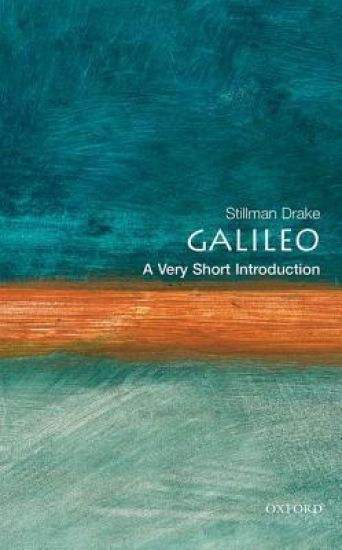
In a startling reinterpretation of the evidence, Stillman Drake advances the hypothesis that Galileo's trial and condemnation by the Inquisition was caused not by his defiance of the Church, but by the hostility of contemporary philosophers. Galileo's own beautifully lucid arguments are used to show how his scientific method was utterly divorced from the Aristotelian approach to physics in that it was based on a search not for causes but for laws. Galileo's method was of overwhelming significance for the development of modern physics, and led to a final parting of the ways between science and philosophy. ABOUT THE SERIES: The Very Short Introductions series from Oxford University Press contains hundreds of titles in almost every subject area. These pocket-sized books are the perfect way to get ahead in a new subject quickly. Our expert authors combine facts, analysis, perspective, new ideas, and enthusiasm to make interesting and challenging topics highly readable.
Telescopes, Tides, and Tactics

Telescopes, Tides, and Tactics

Stillman Drake

University of Chicago Press
1983
sidottu
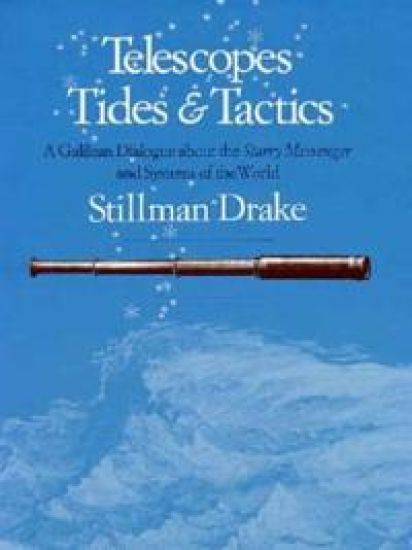
Publication of Galileo's Starry Messenger in 1610, detailing startling observations with the newly invented telescope, sparked immediate furor among the astronomers and philosophers of the day. The discovery of the "Medicean stars" (the satellites of Jupiter) was pronounced a hoax, an optical illusion, a logical and theological impossibility. Stillman Drake, one of the world's foremost Galileo scholars, recreates in Telescopes, Tides, and Tactics the fascinating aftermath of the publication of the Starry Messenger. Drawing on Galileo's scientific working papers and the letters and notebooks of his colleagues, Drake presents an imaginative Galilean dialogue using the text of the Starry Messenger as a departure point for discussions of appropriate scientific method, new discoveries, and the emergence of a new world view at this early stage of the Scientific Revolution. Drake has revised his earlier abridged translation of the Starry Messenger, and for the first time the entire work is presented here in modern English. No other edition or translation of this famous work has analyzed Galileo's recorded observations in detail, compared them with modern calculations, or explained the later use he made of them. In the accompanying fictional dialogue, Salviati, Sagredo, and Sarpi reread the Starry Messenger in 1613 and discuss events and issues raised in the three years since its publication. Much of the dialogue is based on archival materials not previously cited in English. Drake has unearthed a wealth of information that will interest the lay reader as well as the historian and the scientist—descriptions of the various and occasionally bizarre critics of Galileo, a reconstruction of Galileo's promised book on the system of the world, his tables of observations and calculations of satellite motions, and evidence for an early tide theory. It was this theory explaining tides by motions of the earth, rather than the influence of Platonic metaphysics, Drake argues that played a major role in Galileo's acceptance of Copernican astronomy. Telescopes, Tides, and Tactics is a thorough portrait of Galileo as a working astronomer. Offering much more than a commentary on the Starry Messenger, Drake has written a novel and absorbing contribution to the history of physics and astronomy and the study of the Scientific Revolution.