Kirjojen hintavertailu. Mukana 12 142 689 kirjaa ja 12 kauppaa.

Kirjailija

Stuart Corbridge

Kirjat ja teokset yhdessä paikassa: 7 kirjaa, julkaisuja vuosilta 1992-2012, suosituimpien joukossa Seeing the State. Vertaile teosten hintoja ja tarkista saatavuus suomalaisista kirjakaupoista.

7 kirjaa

Kirjojen julkaisuhaarukka 1992-2012.

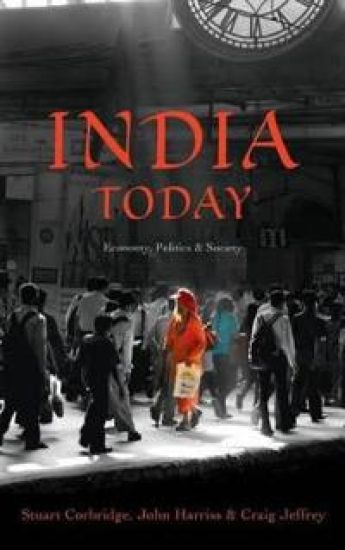
India Today

India Today

Stuart Corbridge; John Harriss; Craig Jeffrey

Polity Press
2012
sidottu
Twenty years ago India was still generally thought of as an archetypal developing country, home to the largest number of poor people of any country in the world, and beset by problems of low economic growth, casteism and violent religious conflict. Now India is being feted as an economic power-house which might well become the second largest economy in the world before the middle of this century. Its democratic traditions, moreover, remain broadly intact. How and why has this historic transformation come about? And what are its implications for the people of India, for Indian society and politics? These are the big questions addressed in this book by three scholars who have lived and researched in different parts of India during the period of this great transformation. Each of the 13 chapters seeks to answer a particular question: When and why did India take off? How did a weak state promote audacious reform? Is government in India becoming more responsive (and to whom)? Does India have a civil society? Does caste still matter? Why is India threatened by a Maoist insurgency? In addressing these and other pressing questions, the authors take full account of vibrant new scholarship that has emerged over the past decade or so, both from Indian writers and India specialists, and from social scientists who have studied India in a comparative context. India Today is a comprehensive and compelling text for students of South Asia, political economy, development and comparative politics as well as anyone interested in the future of the world's largest democracy.
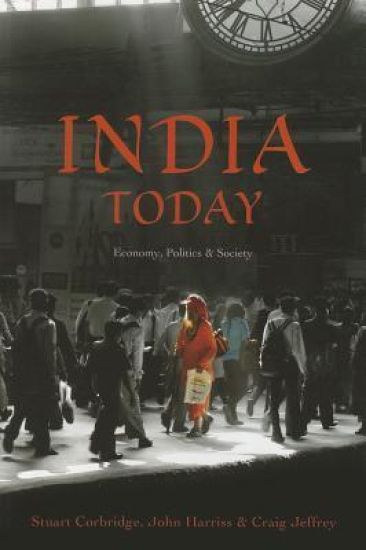
India Today

India Today

Stuart Corbridge; John Harriss; Craig Jeffrey

Polity Press
2012
nidottu
Twenty years ago India was still generally thought of as an archetypal developing country, home to the largest number of poor people of any country in the world, and beset by problems of low economic growth, casteism and violent religious conflict. Now India is being feted as an economic power-house which might well become the second largest economy in the world before the middle of this century. Its democratic traditions, moreover, remain broadly intact. How and why has this historic transformation come about? And what are its implications for the people of India, for Indian society and politics? These are the big questions addressed in this book by three scholars who have lived and researched in different parts of India during the period of this great transformation. Each of the 13 chapters seeks to answer a particular question: When and why did India take off? How did a weak state promote audacious reform? Is government in India becoming more responsive (and to whom)? Does India have a civil society? Does caste still matter? Why is India threatened by a Maoist insurgency? In addressing these and other pressing questions, the authors take full account of vibrant new scholarship that has emerged over the past decade or so, both from Indian writers and India specialists, and from social scientists who have studied India in a comparative context. India Today is a comprehensive and compelling text for students of South Asia, political economy, development and comparative politics as well as anyone interested in the future of the world's largest democracy.
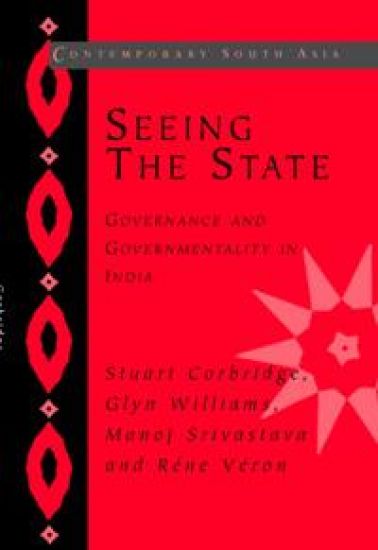
Seeing the State

Seeing the State

Stuart Corbridge; Glyn Williams; Manoj Srivastava; René Véron

Cambridge University Press
2005
sidottu
Poor people confront the state on an everyday basis all over the world. But how do they see the state, and how are these engagements conducted? This book considers the Indian case where people's accounts, in particular in the countryside, are shaped by a series of encounters that are staged at the local level, and which are also informed by ideas that are circulated by the government and the broader development community. Drawing extensively on fieldwork conducted in eastern India and their broad range of expertise, the authors review a series of key debates in development studies on participation, good governance, and the structuring of political society. They do so with particular reference to the Employment Assurance Scheme and primary education provision. Seeing the State engages with the work of James Scott, James Ferguson and Partha Chatterjee, and offers a new interpretation of the formation of citizenship in South Asia.
Seeing the State

Seeing the State

Stuart Corbridge; Glyn Williams; Manoj Srivastava; René Véron

Cambridge University Press
2005
pokkari
Poor people confront the state on an everyday basis all over the world. But how do they see the state, and how are these engagements conducted? This book considers the Indian case where people's accounts, in particular in the countryside, are shaped by a series of encounters that are staged at the local level, and which are also informed by ideas that are circulated by the government and the broader development community. Drawing extensively on fieldwork conducted in eastern India and their broad range of expertise, the authors review a series of key debates in development studies on participation, good governance, and the structuring of political society. They do so with particular reference to the Employment Assurance Scheme and primary education provision. Seeing the State engages with the work of James Scott, James Ferguson and Partha Chatterjee, and offers a new interpretation of the formation of citizenship in South Asia.
Reinventing India

Reinventing India

Stuart Corbridge; John Harriss

Polity Press
2000
sidottu
When India was invented as a "modern" country in the years after Independence in 1947 it styled itself as a secular, federal, democratic Republic committed to an ideology of development. Nehru's India never quite fulfilled this promise, but more recently his vision of India has been challenged by two "revolts of the elites": those of economic liberalization and Hindu nationalism. These revolts have been challenged, in turn, by various movements, including those of India's "Backward Classes". These movements have exploited the democratic spaces of India both to challenge for power and to contest prevailing accounts of politics, the state and modernity. Reinventing India offers an analytical account of the history of modern India and of its contemporary reinvention. Part One traces India's transformation under colonial rule, and the ideas and social forces which underlay the deliberations of the Constituent Assembly in 1946 to consider the shaping of the post-colonial state. Part Two then narrates the story of the making and unmaking of this modern India in the period from 1950 to the present day. It pays attention to both economic and political developments, and engages with the interpretations of India's recent history through key writers such as Francine Frankel, Sudipta Kaviraj and Partha Chatterjee. Part Three consists of chapters on the dialectics of economic reform, religion, the politics of Hindu nationalism, and on popular democracy. These chapters articulate a distinct position on the state and society in India at the end of the century, and they allow the authors to engage with the key debates which concern public intellectuals in contemporary India. Reinventing India is a lucid and eminently readable account of the transformations which are shaking India more than fifty years after Independence. It will be welcomed by all students of South Asia, and will be of interest to students of comparative politics and development studies.
Reinventing India

Reinventing India

Stuart Corbridge; John Harriss

Polity Press
2000
nidottu
This volume examines the history of modern India and its contemporary transformation, providing an account of the changes which are shaking India today at the beginning of the 21st century.
Debt and Development

Debt and Development

Stuart Corbridge

Blackwell Publishers
1992
nidottu
In Debt and Development Stuart Corbridge offers an exciting new approach to the study of both debt and development, focusing on the international debt crisis of the 1980's and 1990's, and it's economic and geo-political consequences. Moving far beyond the framework of a narrative account, the author demonstrates that interpretations of this crisis - and attempts to manage it - are themselves reflections of wider assumptions about the dynamics of development and the organization of the global economy. Part I sets out to provide the 'standard narrative' of the debt crisis from the OPEC oil price rises onwards, ending with the most recent attempts at crisis management. After establishing, as much as is possible, the facts of the crisis, the author then provides in part II a demonstration of how this crisis might be interpreted from three quite different perspectives: a free market 'system stability' approach; a Keynesian 'system-correction' approach; and a Marxian 'system instability' approach. In a conclusion, the author considers how these competing perspectives on debt and development might be judged. Based on wide teaching experience in the field, Debt and Development will be welcomed by students and teachers of geography, developmental studies, economics, international relations and political science.