Kirjojen hintavertailu. Mukana 12 595 353 kirjaa ja 12 kauppaa.

Kirjailija

Stuart E. Johnson

Kirjat ja teokset yhdessä paikassa: 17 kirjaa, julkaisuja vuosilta 2002-2016, suosituimpien joukossa A Framework for Programming and Budgeting for Cybersecurity. Vertaile teosten hintoja ja tarkista saatavuus suomalaisista kirjakaupoista.

Mukana myös kirjoitusasut: Stuart E Johnson

17 kirjaa

Kirjojen julkaisuhaarukka 2002-2016.

A Framework for Programming and Budgeting for Cybersecurity

A Framework for Programming and Budgeting for Cybersecurity

John S. Davis; Martin C. Libicki; Stuart E. Johnson; Jason Kumar; Michael Watson; Andrew Karode

RAND
2016
pokkari
Cybersecurity professionals are faced with the dilemma of selecting from a large set of cybersecurity defensive measures while operating with a limited set of resources with which to employ the measures. This report explains the menu of actions for defending an organization against cyberattack and recommends an approach for organizing the range of actions and evaluating cybersecurity defensive activities.
Defense Institution Building in Africa

Defense Institution Building in Africa

Michael J. McNerney; Stuart E. Johnson; Stephanie Pezard; David Stebbins; Renanah Miles; Angela O'Mahony; Chaoling Feng; Tim Oliver

RAND
2016
pokkari
This report assesses U.S. efforts in defense institution building (DIB) in Africa and suggests possible improvements to planning and execution. It defines DIB and reviews some best practices from DIB and security sector reform experiences. It also highlights how DIB activities serve U.S. official strategic guidance for Africa.
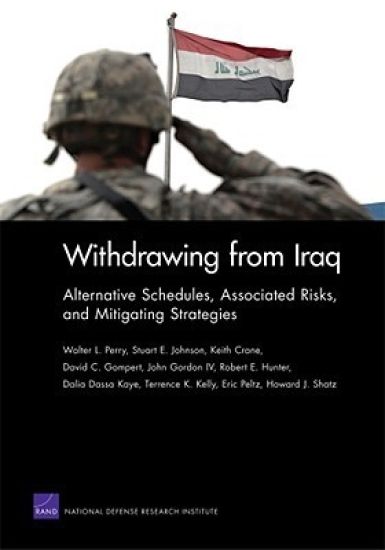
Withdrawing from Iraq

Withdrawing from Iraq

Walter L. Perry; Stuart E. Johnson; Keith Crane; David C. Gompert; John Gordon; Robert E. Hunter; Dalia Dassa Kaye; Terrence K. Kelly; Eric Peltz; Howard J. Shatz

RAND
2009
pokkari
Since 2007, security has improved dramatically in Iraq. The U.S. and Iraqi governments - and most Iraqis - want to see both the U.S. presence there reduced and the Iraqi government and security forces assuming a greater role in providing for public security. The challenge is to effect this drawdown while preserving security and stability in the country and in the region. In response to tasking from the U.S. Congress, RAND researchers conducted an independent study to examine drawdown schedules, risks, and mitigating strategies. They identified logistical constraints on moving equipment out of the country, assessed trends in insurgent activity and the ability of Iraqi security forces to counter it, and examined the implications for the size of the residual U.S. force and for security in Iraq and the region. This book presents alternative drawdown schedules - one consistent with the Obama administration's stated intentions and two others, one somewhat slower and another faster - that are responsive to these factors.It also recommends steps that the United States can take to alleviate anticipated constraints, overcome likely resistance, and reduce the potential risks associated with a drawdown. For more than 60 years, decisionmakers in the public and private sectors have turned to the RAND Corporation for objective analysis and effective solutions that address the challenges facing the nation and the world.
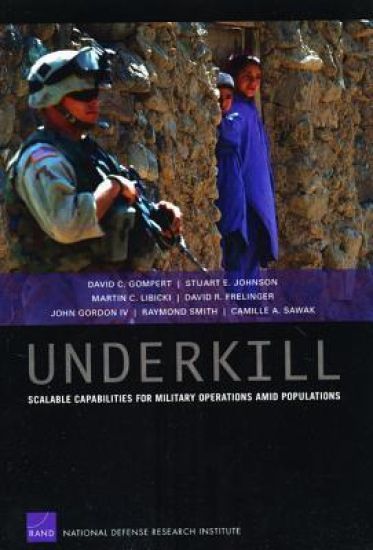
Underkill

Underkill

David C Gompert; Stuart E Johnson; Martin C Libicki; David R Frelinger; John Gordon

RAND
2009
pokkari
The U.S. military is ill-equipped to strike at extremists who hide in populations. Using deadly force against them can harm and alienate the very people whose cooperation U.S. forces are trying to earn. To solve this problem, a new RAND study proposes a "continuum of force"--a suite of capabilities that includes sound, light, lasers, cell phones, and video cameras. These technologies are available but have received insufficient attention.
Analysis of Strategy and Strategies of Analysis

Analysis of Strategy and Strategies of Analysis

David C. Gompert; Paul K. Davis; Stuart E. Johnson; Duncan Long

RAND
2008
pokkari
In a fluid global security environment such as ours, assessing the costs, risks, and likely consequences of alternative national defense strategies is as hard as it is essential. The authors show how, even in the face of uncertainty, the costs and other implications of any strategy can be assessed by examining the capabilities needed by U.S. combatant command - the chief agents of strategy - to fulfill what the strategy expects of them.
Developing Resource-informed Strategic Assessments and Recommendations

Developing Resource-informed Strategic Assessments and Recommendations

Paul K. Davis; Stuart E. Johnson; Duncan Long; David C. Gompert

RAND
2008
pokkari
A debate will likely occur in 2009 about U.S. global national-security strategy. The authors describe and illustrate a methodology to help frame and evaluate resource-informed strategies. The core is an integrated portfolio-analysis approach that compares options by their anticipated effectiveness, risks, and resource implications. Three illustrative grand strategies are compared, which deal in different ways with the problems of our time.The monograph describes a portfolio-analysis approach for integrated comparison of alternative strategies, in terms of effectiveness, risks, and resource implications.
Defense Institution Building

Defense Institution Building

Walter L. Perry; Stuart E. Johnson; Stephanie Pezard; Gillian S. Oak; David Stebbins; Chaoling Feng

RAND
2016
pokkari
This report presents an analysis of a range of defense institution building (DIB) programs and activities, recommends a set of goals and objectives for achieving them, identifies partner nation and DIB activity selection criteria, develops a strategy for coordinating DIB activities, and recommends procedures for achieving accountability and assessment.
Evaluating the Impact of the Department of Defense Regional Centers for Security Studies

Evaluating the Impact of the Department of Defense Regional Centers for Security Studies

Larry Hanauer; Stuart E. Johnson; Christopher Springer; Chaoling Feng; Michael J. McNerney; Stephanie Pezard; Shira Efron

RAND
2014
pokkari
The five U.S. Department of Defense (DoD) Regional Centers for Security Studies have been helping partner nations build strategic capacity for almost 20 years. They are high-impact components of U.S. security cooperation and engagement efforts, despite their relatively small budgets. This study analyzes the centers contributions to DoD policy priorities and the ways in which they assess their programs."
Imported Oil and U.S. National Security

Imported Oil and U.S. National Security

Keith Crane; Andreas Goldthau; Michael Toman; Thomas Light; Stuart E Johnson

RAND
2009
pokkari
In 2007, on a net basis, the United States imported 58 percent of the oil it consumed. This book critically evaluates commonly suggested links between these imports and U.S. national security and assesses the economic, political, and military costs and benefits of potential policies to alleviate imported oil-related challenges to U.S. national security.